


Ribbon Back Carver Chairs
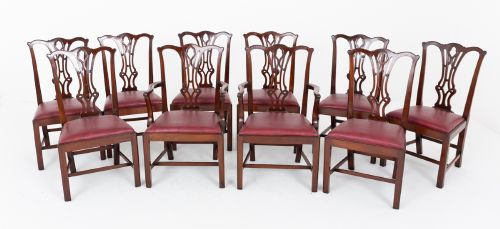
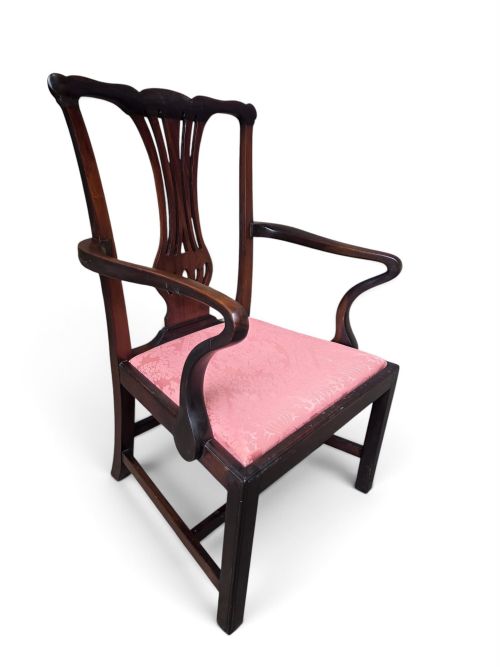
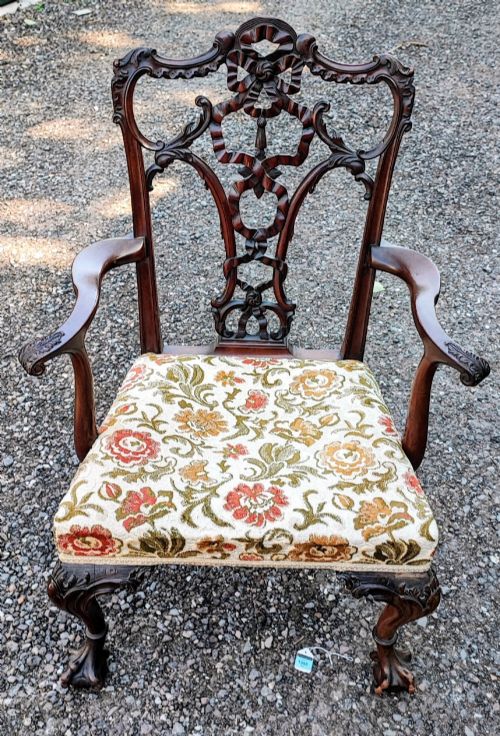
Ribbon back carver chairs are carved mahogany dining chairs and armchairs defined by intertwined central splats, offering elegance and historic gravitas to a formal interior.
Ribbon Back Carver Chairs
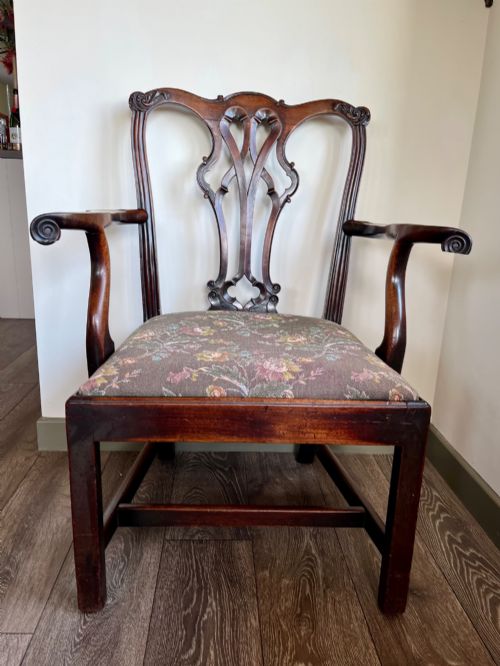
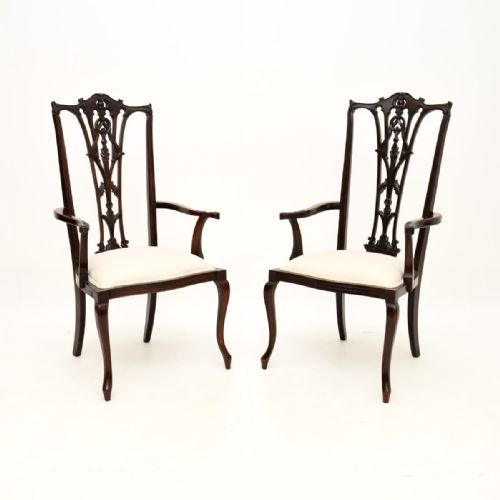
Ribbon back carver chairs appear predominantly in mahogany across this selection, spanning the eighteenth century through to the early twentieth century. Buyers encounter genuine Georgian examples alongside later Victorian and Edwardian revivals executed in the Chippendale style.
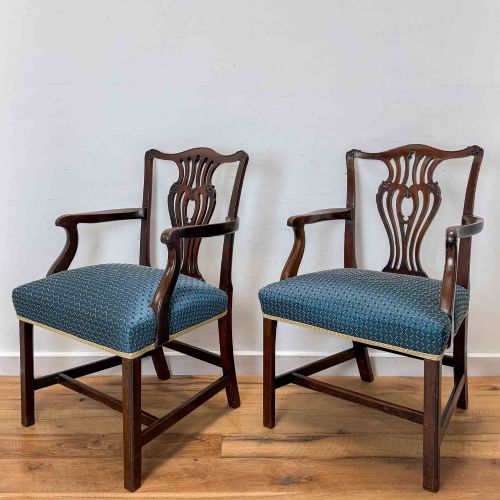
The form functions as a carver or open armchair, often accompanying larger sets of single dining chairs with open arms designed to accommodate formal dining. Pieces trace stylistic lineage back to George II Chippendale designs, with revival interpretations dating from the nineteenth and early twentieth centuries.
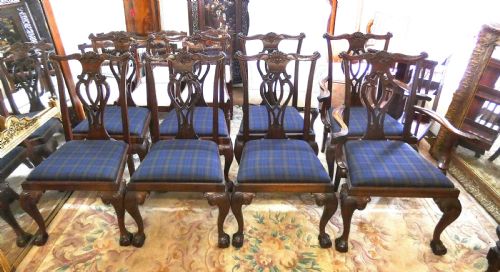
Makers and manufacturers produced these armchairs in sets, frequently combining six single chairs with two carvers, or presenting pairs and individual desk chairs. The defining visual element remains the carved ribbon back splat, distinguishing them from standard ladder or panel back seating.
Materials and construction
Makers relied primarily on solid mahogany for the frames, utilising its dense grain to achieve the intricate pierced and carved fretwork characteristic of the ribbon back motif. This timber provided the structural strength required for slender stiles and elaborate top rails.
Upholstery forms an integral part of the surviving pieces, incorporating materials such as leather, velvet, fabric, textile, and damask upholstery. Drop-in seats or pad seats allow the textile covering to be easily replaced while preserving the wooden framework underneath.
Listings span the eighteenth, nineteenth, and early twentieth centuries, uniting original Georgian examples with Victorian and Edwardian Chippendale revival pieces.
Evaluating craftsmanship and distinction
Quality rests heavily on the depth and crispness of the carving, particularly within the interwoven ribbon splat and the acanthus leaf or shell motifs on the crest rail. Finer examples display meticulous hand-chiselling that creates a convincing illusion of folded textile, whereas lesser versions appear shallow and flat.
Structural integrity and timber selection also divide the range, with superior pieces exhibiting well-figured mahogany grain and robust joinery at the arm supports and leg junctions. Revival pieces from the nineteenth and twentieth centuries demonstrate varying degrees of fidelity to original Georgian proportions and carving standards.
The Ribbon Back Carver Chairs Glossary
- Carver chair
- An armchair designed for the head of a dining table, featuring open arms to accommodate formal clothing. These pieces mirror the stylistic details of the matching single chairs in a set.
- Ribbon back
- A chair back featuring a central splat carved to resemble looped and fluttering ribbons. This decorative device originated in mid eighteenth century cabinet making and reappeared in later revival periods.
- Chippendale style
- A design idiom drawing upon the eighteenth century pattern books of Thomas Chippendale. It encompasses characteristic elements like ribbon backs, cabriole legs, and elaborate fretwork.
- Georgian revival
- A stylistic movement spanning the nineteenth and early twentieth centuries where makers reproduced earlier eighteenth century forms. These pieces often employ period timbers and traditional hand-carving methods.
- Splat
- The vertical wooden upright member positioned in the centre of a chair back. In these pieces, the splat is pierced and sculpted into the characteristic ribbon form.
Ribbon Back Carver Chairs: Frequently Asked Questions
What is a ribbon back carver chair?
A ribbon back carver chair is an open armchair featuring a carved wooden splat shaped to imitate intertwined ribbons. These chairs typically function as host seating at the head of a dining table.
The form emerged during the eighteenth century and was frequently reinterpreted during the Victorian and Edwardian revival periods using solid mahogany.
How do I date a ribbon back chair?
Dating relies on examining the timber grain, tool marks, construction joints, and stylistic quirks of the carving. Eighteenth-century originals exhibit hand-tooling and mature timber patination.
Revival pieces from the nineteenth and twentieth centuries often feature machine-assisted elements, standardised dimensions, or timber characteristics typical of later manufacturing.
Are these chairs comfortable for daily use?
These chairs provide structured upright seating suited for formal dining or office use. The open arms and upholstered drop-in seats offer traditional support.
Most surviving examples feature contemporary or period-appropriate upholstery that can be updated with modern padding or textiles to suit daily living requirements.
How do single chairs and carvers match?
Carver chairs feature the identical back design, leg style, and timber finish as the single chairs in a set, but include open armrests. They were produced as matching suites for dining rooms.
Sets frequently combined six single chairs with two carvers to maintain a uniform aesthetic around the dining table.