


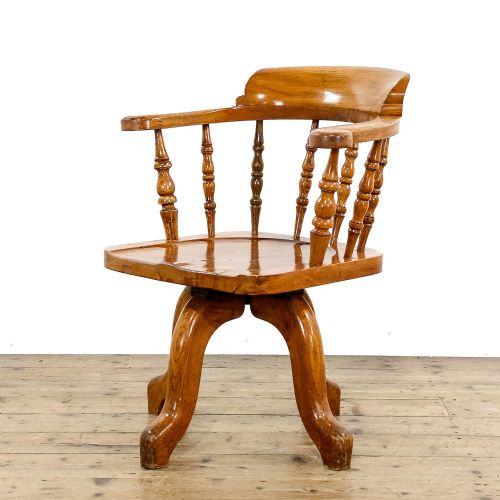

Revolving Oak Desk Armchair
A revolving oak desk armchair brings sturdy Victorian and Edwardian build quality and a practical swivel action directly to the home study.
Revolving Oak Desk Armchair
A revolving oak desk armchair provides a solid timber seat for daily study and writing, combining heavy functional purpose with domestic comfort. When you search for a revolving oak desk armchair, you encounter seating designed for Victorian and Edwardian offices, libraries, and ship cabins.
The most common examples on this page date from the late nineteenth century through to the 1920s, spanning Victorian, Edwardian, and Art Deco periods. These pieces frequently incorporate swivel and tilt mechanisms alongside adjustable height functions.
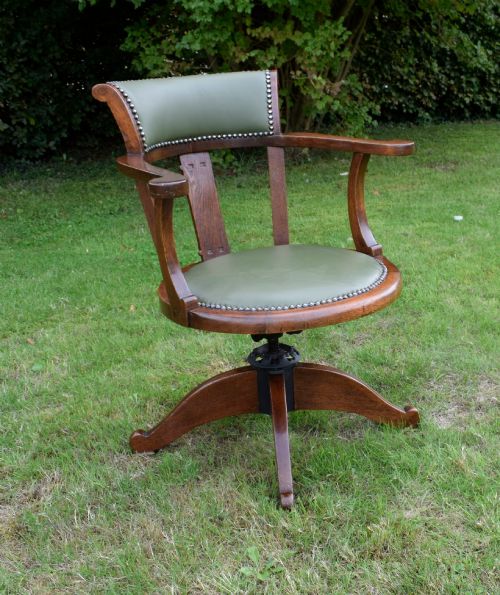
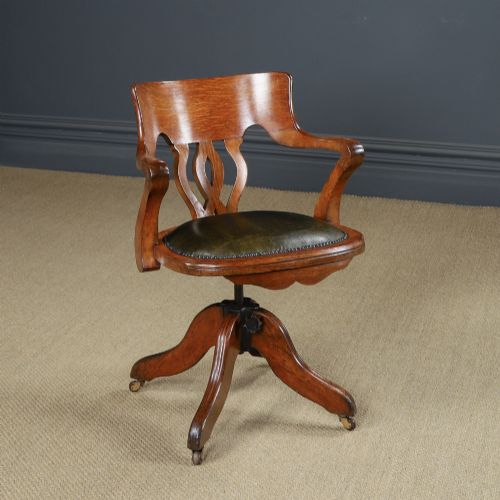
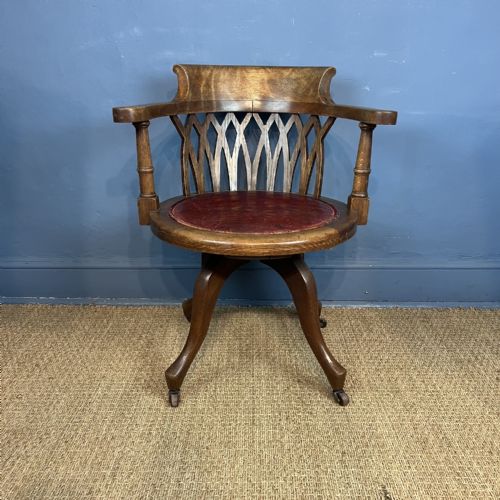
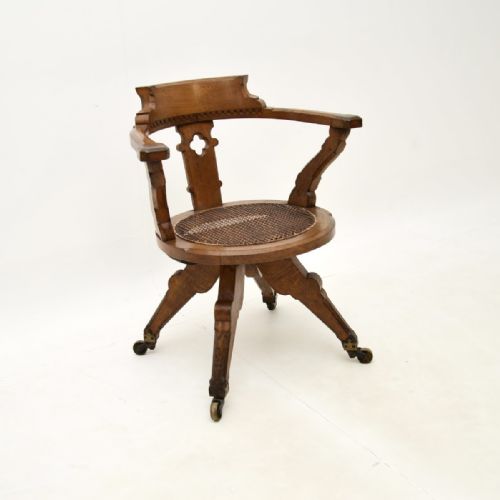
Forms range from simple wooden seats to examples fitted with green, red, or brown leather upholstery, cane panels, or heavy carved detailing. Captains chairs and library armchairs form a substantial portion of these listings, offering broad armrests and supportive back rails.
How they were made
Construction relies primarily on solid oak frames, shaped to form curved back rails and supportive armrests. Timber sections are joined using traditional methods and finished to highlight the natural grain of the wood.
Swivel mechanisms integrate iron, cast iron, brass, and other metals to provide smooth rotation and height adjustment. Upholstered variants secure leather over padding using brass tacks, whilst alternative models utilise woven cane or plain wooden panels.
Listings feature oak furniture spanning the Victorian, Edwardian, and Art Deco periods, alongside Gothic Revival and Aesthetic Movement styles.
What varies in quality
The distinction between standard office seating and superior examples lies in the depth of carving and the integrity of the underlying timber framework. Heavily carved ship chairs and Gothic Revival pieces display greater sculptural ambition than plain utilitarian models.
Mechanical complexity also defines the upper tiers, where robust swivel and tilt mechanisms remain fully operational after a century of use. The quality of supplementary materials, such as supple dyed leather and carefully woven cane, separates basic workshop output from finer library armchairs.
Kendrick & Jefferson·Edward William Godwin
The Revolving Oak Desk Armchair Glossary
- Swivel
- A mechanical pivot assembly allowing the upper seat portion to rotate fully without moving the base. This metal apparatus often includes height adjustment screws.
- Tilt
- A mechanism permitting the backrest and seat to angle backward against tension springs. This function offers customized posture support during long hours at a desk.
- Bergere
- A timber-framed armchair featuring woven cane panels on the back and sometimes the sides. Originating in earlier centuries, this technique persists in Edwardian office seating.
- Gothic Revival
- An architectural and decorative style drawing on medieval forms, featuring pointed arches and heavy relief carving. Victorian iterations apply these motifs to robust office furniture.
- Aesthetic Movement
- A late nineteenth-century design current emphasising visual beauty over narrative content, associated with makers like Edward William Godwin. Pieces from this school show refined lines and careful proportioning.
Revolving Oak Desk Armchair: Frequently Asked Questions
How do I adjust the height on these chairs?
Most of these chairs utilise a central threaded iron spindle or screw mechanism beneath the seat. Turning the seat clockwise or anticlockwise raises or lowers the wooden platform.
Older mechanisms may require releasing a locking lever before spinning the upper frame to the desired level. Regular lubrication keeps these vintage metal components turning smoothly.
Were these chairs used only in offices?
While frequently termed office or desk chairs, these pieces served in diverse environments including private libraries, ships, and domestic studies. Examples often originate from maritime contexts such as passenger liners.
Their robust timber frames and comfortable armrests made them suitable for any space requiring prolonged seated work. Victorian libraries and Edwardian studies adopted them widely for daily administrative tasks.
How should I care for the leather seats?
Leather upholstery benefits from gentle cleaning using a damp cloth followed by a neutral leather conditioner. Avoid harsh chemical cleaners that can dry out the historic hide.
Keeping the leather nourished preserves its flexibility and prevents cracking around the brass tack fixings. Regular dusting maintains the finish of both the hide and the surrounding oak frame.
How can I tell a Victorian chair from an Edwardian one?
Victorian examples often display heavier proportions, darker timber finishes, and stylistic influences like Gothic Revival or deep relief carving. They frequently date from the late nineteenth century and utilise cast iron swivel mechanisms.
Edwardian pieces tend toward slightly lighter construction, incorporating green or red leather upholstery and simplified woodwork. Circa dates provided in listings help confirm the exact manufacturing era.