



Revolving Arm Chair
A revolving arm chair offers practical mobility at the desk, combining period character with everyday utility.
Revolving Arm Chair
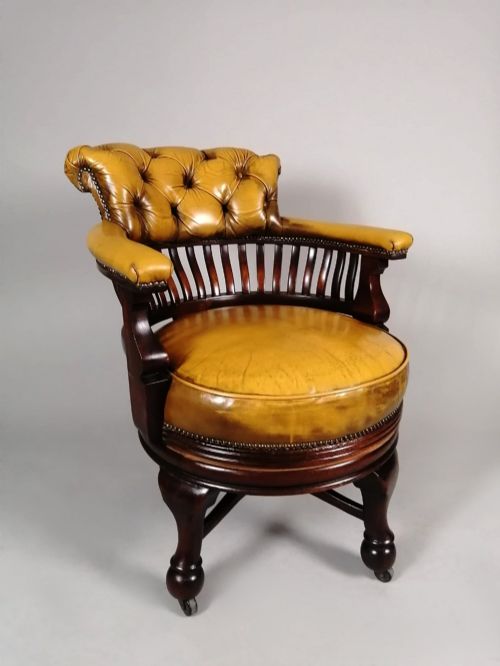
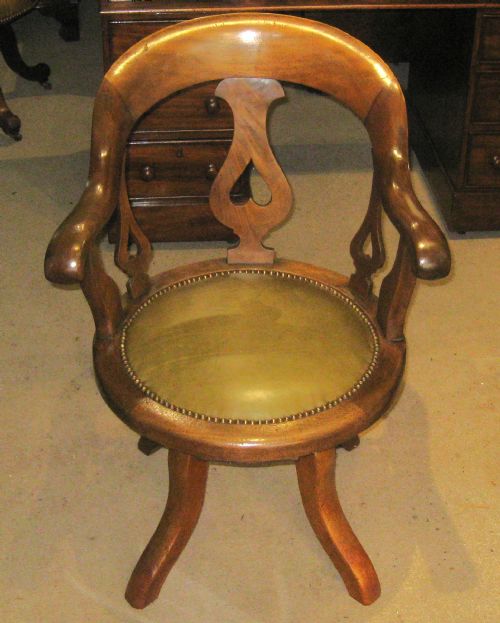
A revolving arm chair provides seating designed for the office, library or study, featuring a mechanism that allows the seat to turn fully or swivel. When searching for a revolving arm chair, a buyer encounters pieces originating from the nineteenth century through the early twentieth century, spanning periods such as the Victorian and Edwardian eras.
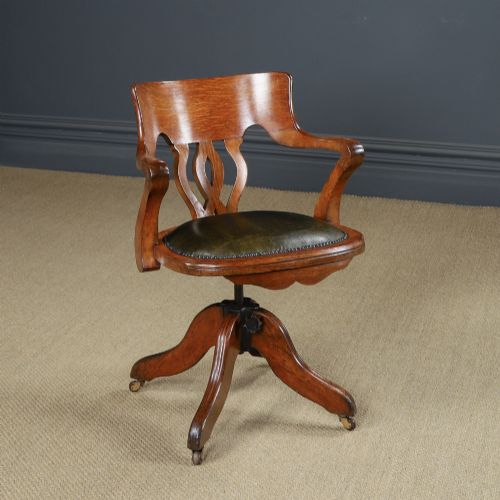
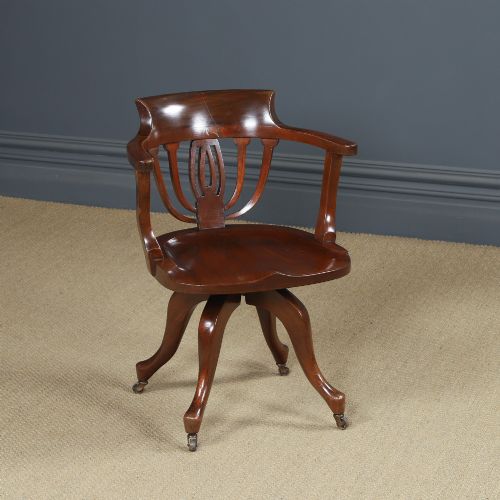
The forms on this page include standard desk chairs, office armchairs and library chairs with swivel mechanisms. Buyers are most likely to meet mahogany, oak, ash and beech examples, frequently paired with leather upholstery and adjustable height functions.
Makers and craftsmen applied various styles to these utilitarian seats, ranging from Late Victorian and Victorian Gothic Revival to Edwardian and Art Deco. Heavy carving appears on specific variants like ships chairs, while bentwood and standard turned frames represent lighter commercial production of the period.
How they were made
Makers constructed the frames of a revolving arm chair using solid hardwoods such as mahogany, oak, ash and beech, often combining multiple timbers within a single piece for structural strength. Joinery methods included turned spindles, steam-bent components for bentwood variants, and heavily carved wooden details on specialist forms.
Cast iron and brass hardware formed the swivel and height-adjustment mechanisms that enabled the rotation of the seat. Upholstered versions incorporated leather seat pads secured with tacks over padding, while fully rotating ships chairs utilised robust mechanical assemblies to withstand movement.
Revolving Arm Chair Retail Price Guide 2026
Typical asking prices for revolving arm chair among the pieces listed under this phrase on Sellingantiques today, from the lower quarter to the upper quarter. They describe what is for sale here now, not the wider market.
Styles span Victorian Gothic Revival, Edwardian, and Interwar Art Deco.
What varies in quality
Quality in a revolving arm chair is determined by the robustness of the timber frame and the mechanical integrity of the swivel action. Superior examples utilise dense hardwoods like golden mahogany or quarter-sawn oak alongside substantial cast iron and brass hardware that ensures smooth, stable rotation.
The refinement of the carving, the condition and thickness of the leather upholstery, and the precision of the height adjustment mechanism distinguish finer workshop production from simpler commercial office seating.
The Revolving Arm Chair Glossary
- Swivel mechanism
- The iron or brass assembly beneath the seat that permits rotation. It allows the user to turn fully without moving the base.
- Bentwood
- Wood shaped by steam into curved structural forms. This technique created resilient, lighter chair frames during the Victorian and Edwardian periods.
- Victorian Gothic Revival
- A nineteenth-century design style drawing on medieval architectural motifs. It manifests in these chairs through heavy carving and structural austerity.
- Quarter-sawn oak
- Timber cut radially from the log to display prominent growth rings. This method yields stable boards prized in Edwardian office furniture.
- Golden mahogany
- A rich tropical hardwood displaying warm reddish-brown tones. Cabinet makers selected it for formal Victorian desk chairs.
Revolving Arm Chair: Frequently Asked Questions
What periods do these chairs come from?
The pieces span the nineteenth and early twentieth centuries, including Victorian, Edwardian, and Art Deco eras.
Dates generally range from the 1880s through the 1920s, reflecting the growth of dedicated office and library furniture.
How do the swivel mechanisms work?
Most utilise a central iron or brass spindle secured to a heavy wooden base or a set of legs.
Some include threaded posts that allow the user to alter the seat height by turning the chair.
Were these chairs used in homes or offices?
They served in domestic studies, home libraries, and professional offices alike.
Their mobility made them practical for working at large partners desks or writing tables.
What timbers were used for the frames?
Makers relied on durable hardwoods such as mahogany, oak, ash, and beech.
Darker woods like mahogany appeared in formal settings, while oak and bentwood served general office and commercial needs.
How do I identify an Edwardian example?
Edwardian pieces often feature lighter framing, simpler lines, and materials such as oak combined with green leather.
They date from around the turn of the twentieth century up to the First World War.