


Retro Gold Ruby Jewellery
Retro gold ruby jewellery brings together bold mid-century yellow gold work, rich rubies, and diamonds for a striking vintage look.
Retro Gold Ruby Jewellery
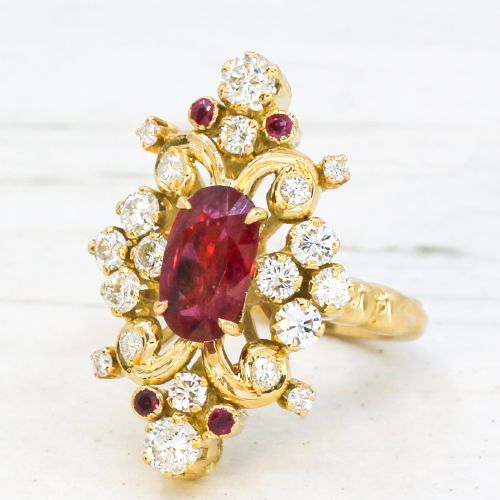
Retro gold ruby jewellery spans robust mid-century designs, featuring cocktail rings, drop earrings, pendants, and bracelets created predominantly across the 1940s, 1950s, and 1960s. These pieces often pair deep red rubies with sparkling diamonds in substantial gold settings, reflecting the heavy, sculptural metalwork of the post-war decades.
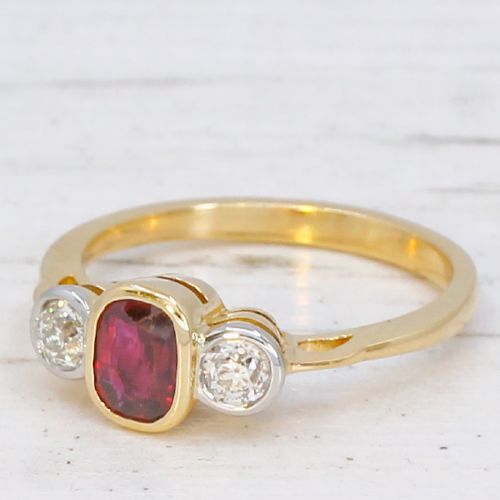
The selection encountered most frequently on this page includes cocktail rings, such as tank rings and bombé styles, alongside diamond and ruby cluster or three-stone configurations. Alongside rings, one finds pendants, screw-back earrings, heart bar brooches, and multi-gem necklaces incorporating sapphires, emeralds, and pearls.
Origins and materials extend from mid-century European workshops to specific pieces stamped with London hallmarks or attributed to notable makers like Kutchinsky and Gubelin. While the core of the inventory centres on the 1940s and 1950s, occasional Edwardian and nineteenth-century examples appear alongside modern twentieth-century pieces.
How they were made
Gold forms the structural backbone of these items, utilised in various purities and colours including 18ct yellow gold, 18ct white gold, 22ct yellow gold, and 8ct rose gold, as well as occasional 9ct white gold settings. Goldsmiths shaped this metal into heavy, dimensional forms such as tank rings, lattice frameworks, spiral clusters, and articulated bracelets.
Gemstone selection combines natural rubies - originating from sources like Burma and Mozambique - with old-cut or brilliant-cut diamonds, and occasionally synthetic rubies in mid-century cocktail pieces. Stones are set into heavy bezels, claw configurations, and channel arrangements alongside other precious gems including emeralds, sapphires, and cultured pearls.
Listings feature yellow gold, white gold, and rose gold across purities ranging from 8ct up to 22ct.
What varies in quality
The distinction between tiers of retro gold ruby jewellery rests heavily on the origin and characteristics of the central rubies, with unheated Burmese stones commanding significant attention compared to treated or synthetic alternatives. The weight, clarity, and cut of accompanying diamonds further separate standard commercial items from exceptional mid-century cocktail pieces.
Execution and provenance dictate the upper range of quality, visible in the weight of the solid gold mount, the complexity of construction such as lattice or tank work, and signatures from established houses like Kutchinsky or Gubelin. Solid, heavy metalwork paired with balanced gemstone proportioning defines the more accomplished examples.
Kutchinsky·Gubelin
The Retro Gold Ruby Jewellery Glossary
- Tank ring
- A bold, chunky ring style originating in the 1940s, characterised by heavy, stylised gold work inspired by military machinery and armoured vehicles. These pieces often incorporate channel-set rubies and diamonds.
- Bombé ring
- A domed, swelling ring profile popular in mid-century jewellery design, curving outward dramatically from the finger to display pavé or cluster-set rubies and diamonds.
- Unheated ruby
- A natural ruby that has undergone no thermal enhancement to improve its colour or clarity. Such stones are documented with specific geographical origins like Burma.
- Old-cut diamond
- A hand-faceted diamond cut before modern brilliant proportions were standardised, typically featuring a smaller table, higher crown, and open culet. These stones frequently appear in mid-century and earlier ruby rings.
- Screw-back earring
- A non-pierced earring fastening mechanism utilising a threaded post and a small screw nut to secure the piece to the earlobe. This type is common in vintage earrings from the mid-century period.
Retro Gold Ruby Jewellery: Frequently Asked Questions
What is a tank ring?
A tank ring is a heavy, sculptural ring style that emerged during the 1940s, featuring bold geometric gold work inspired by wartime machinery. These substantial mounts frequently showcase rows of calibré-cut rubies and diamonds.
Such rings were designed to make a strong visual statement using generous quantities of yellow, rose, or white gold. They represent a distinct subset of retro jewellery production.
How do I wear a cocktail ring?
Cocktail rings are large, prominent dress rings traditionally worn for evening events and social gatherings. Their substantial size and colourful gem combinations make them natural conversation pieces that stand alone on the hand.
When wearing these pieces daily, take care to protect the central rubies and gold settings from knocks against hard surfaces. Pairing them with simpler attire allows the sculptural design and vibrant red stones to take centre stage.
What is retro gold jewellery?
Retro gold jewellery refers to pieces made roughly between the 1940s and 1950s, characterised by heavy yellow and rose gold construction, dimensional forms, and colourful gemstone pairings. This aesthetic moved away from delicate platinum Edwardian styles toward warmer, bolder metalwork.
Items from this era often combine rubies, sapphires, and diamonds within architectural shapes such as bows, flowers, and tank motifs. The resulting objects reflect the post-war return to expressive, substantial luxury ornamentation.