


Repeating Travel Timepiece
A repeating travel timepiece is a portable mechanical clock designed to sound the time on demand.
Repeating Travel Timepiece
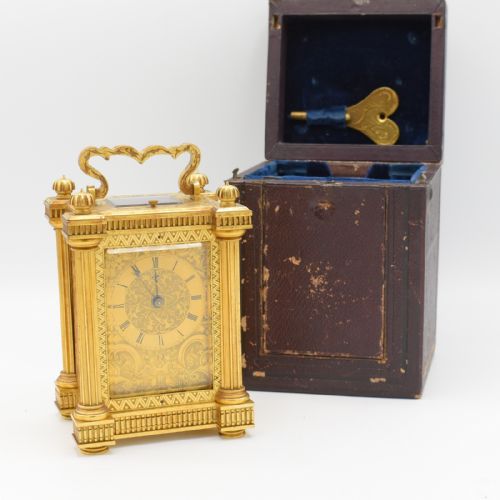
A repeating travel timepiece is a portable mechanical clock designed to sound the hours and quarters on demand, traditionally used by travellers who needed to know the hour in the dark. On this page, you will mostly find French carriage clocks dating from the nineteenth century, housed in brass and glass cases. These pieces range from simple platform-escapement timekeepers to complex grand sonnerie and alarm movements.
The typical piece encountered here is a nineteenth-century French carriage clock with a repeating mechanism, often retaining its original gilding or engraved brass case. Makers supplied these clocks in distinct case styles, such as the stepped gorge case or fully engraved panels decorated with enamel paintings and floral designs. Buyers look for these items to appreciate period horology and decorative metalwork in domestic settings.
Materials and technique
Makers constructed these clocks primarily from brass and gilt bronze, enclosing the movement within bevelled glass panels that reveal the internal escapement. Dials are commonly white enamel with Roman numerals, sometimes accompanied by subsidiary alarm dials or painted enamel flower designs. Cases frequently receive heavy gilding or silver plating over brass, with hand-engraved scrollwork and masks surrounding the dial.
The mechanical movements utilise spring-driven gear trains governed by platform escapements, incorporating repeating mechanisms activated by a button or plunger on the top of the case. Gongs and bells mounted inside the backplate sound the hours and fractions when the repeater is triggered. Complex examples integrate striking trains like petite sonnerie, grand sonnerie, or alarm functions alongside the timekeeping gears.
Materials recorded across these items include gilt brass, silver, leather, and glass, housing complex mechanical striking trains.
What varies in quality
Quality in a repeating travel timepiece lies in the complexity of its striking movement and the execution of its exterior case. Pieces with grand sonnerie or quarter-repeating complications represent a higher tier of horological skill than simple hour-strikers or plain timepieces. The weight and thickness of the gilt brass or silver-gilt case also indicate the standard of production.
The artistry applied to the dial and case surfaces further separates standard examples from exceptional ones. Hand-engraved brass panels, polychrome enamel paintings of flowers or scenes, and signed works by established makers elevate a clock's standing. Original mercury gilding and the presence of matching numbered components throughout the movement denote superior preservation.
Howell And James·Drocourt·Henry Jacot·J W Benson·Richard And Co
The Repeating Travel Timepiece Glossary
- Repeating movement
- A mechanism that sounds the last elapsed hour or quarter-hour when a plunger is pressed on the top of the case. This function allowed owners to check the time in a dark room without lighting a candle.
- Carriage clock
- A portable spring-driven timepiece developed for travel in the nineteenth century. These clocks typically feature rectangular brass cases with glass panels and a folding carrying handle.
- Platform escapement
- The self-contained regulating unit holding the balance wheel and hairspring in a carriage clock. It replaced the pendulum to allow portable timekeeping.
- Sonnerie
- A striking train that sounds the hours and quarters automatically as they pass, similar to a church clock. Grand sonnerie strikes both hours and quarters at every quarter hour, while petite sonnerie strikes only the quarters and the full hours on the hour.
Repeating Travel Timepiece: Frequently Asked Questions
What is a repeating travel timepiece?
A repeating travel timepiece is a portable mechanical clock designed to sound the time on demand when a button is pressed. They were built for travellers in the nineteenth century to check the hour during the night.
Most examples seen here are French carriage clocks featuring brass and glass cases with spring-driven movements. They combine practical timekeeping with decorative metalwork and complex striking mechanisms.
How do you wind a carriage clock?
You wind a carriage clock using a dedicated winding key inserted into the arbours on the backplate of the movement. One arbour drives the timekeeping train, while others power the striking and alarm trains if present.
Care should be taken not to overwind the mainsprings. Most nineteenth-century movements require winding once a week to maintain accurate time.
What is the difference between striking and repeating?
A striking clock sounds the hours automatically on a bell or gong as the hands reach each hour. This happens without human intervention.
A repeating clock includes an extra mechanism activated by pressing a button or lever on the case. This causes the clock to repeat the last struck hour or quarter-hour on demand.
How should I care for a antique carriage clock?
Keep your carriage clock in a stable environment away from direct sunlight, dampness, and extreme temperature variations. The delicate brass gears and platform escapement rely on clean oil to function smoothly.
Professional cleaning and servicing every few years will prevent wear on the pivots and maintain the accuracy of the repeating mechanism.