

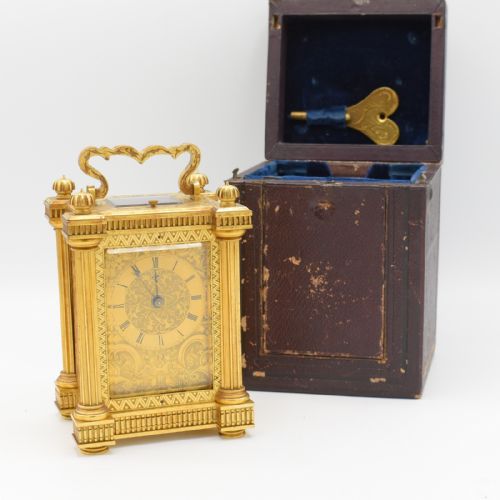


Repeating Brass Timepiece
A repeating brass timepiece delivers the chime of the hours on demand, housed within heavy metal frames designed for travel.
Repeating Brass Timepiece
A repeating brass timepiece is primarily represented here by carriage clocks dating from the nineteenth century, largely originating from French workshops and retailers. These portable mechanisms were constructed for travellers who required accurate timekeeping and striking functions away from home.
Most examples found on this page adopt classic forms such as the gorge case or the doucine case, featuring bevelled glass panels that reveal the internal escapement and gear trains. The primary function involves repeating the last hour or quarter-hour when a button or plunger on the case is pressed.
Materials and Construction
The heavy frames utilise brass and gilt bronze, often finished with gilding or polished surfaces, whilst enclosing intricate steel gear wheels and lever escapements. Enamel dials provide the face for the Roman or Arabic numerals, frequently complemented by painted floral motifs or subsidiary alarm dials.
Protective panelling employs thick glass to enclose the movement while allowing a clear view of the ticking balance wheel. Leather travelling cases occasionally accompany these pieces, preserving the polished metal and delicate exterior decoration during transit.
Repeating Brass Timepiece Retail Price Guide 2026
Typical asking prices for repeating brass timepiece among the pieces listed under this phrase on Sellingantiques today, from the lower quarter to the upper quarter. They describe what is for sale here now, not the wider market.
Listings feature brass and gilt bronze carriage clocks spanning the Victorian era through to the late nineteenth century.
Evaluating Quality
Quality rests in the complexity of the movement and the finish of the case, distinguishing simple striking mechanisms from those with grand sonnerie or quarter-striking capability. Elaborate hand-engraving on the brass masks and detailed enamel panel paintings separate standard production models from exceptional retailer-signed commissions.
The presence of original gilding and signed backplates from notable horologists indicates higher manufacturing standards. Cases featuring specialised forms, such as giant proportions or decorative gorge framing, demonstrate superior craftsmanship.
Drocourt·Henry Jacot·Dwerrihouse And Bell·Howell And James·John Walker
The Repeating Brass Timepiece Glossary
- Gorge case
- A stepped rectangular brass case with a distinctive moulded top and base profile. This design is frequently encountered on better quality nineteenth-century French models.
- Grand sonnerie
- A striking system that chimes both the hours and the quarters automatically on every quarter-hour, in addition to repeating them on command. Such movements represent a higher tier of horological complexity.
- Doucine case
- A rounded, scroll-sided brass case shape popular during the nineteenth century. It offers a softer silhouette than the rigid angles of standard rectangular housings.
- Platform escapement
- The small, self-contained escapement assembly mounted visibly at the top of the movement. This innovation allowed portable clocks to maintain accuracy while resting on uneven surfaces.
- Ting tang
- A two-bell striking system that sounds two different pitches to indicate quarters. It produces a distinct chime unlike single-bell or gongs.
Repeating Brass Timepiece: Frequently Asked Questions
How do I operate the repeater mechanism?
Depress the plunger or button located on the top of the case to activate the strike train. The clock will sound the last elapsed hour and quarters audibly.
Ensure the mechanism completes its full sequence before pressing the button again to prevent jamming the internal racks.
Why does the clock need winding?
Spring-driven barrels power both the going train and the striking trains within these portable clocks. Regular winding keeps the mainsprings under tension for continuous operation.
Keys are typically used to wind the arbors positioned on the backplate of the movement.
How do I set the alarm?
Turn the small central hand on the alarm subdial to the desired wakeup time using the dedicated square arbor. Pull or push the alarm lever if the model requires manual engagement before resting.
The strike train will sound the bell when the hour hand reaches the set position.
Where should I place a carriage clock?
Position the piece on a stable, level surface away from direct sunlight, drafts, and sources of extreme temperature fluctuation. Wooden mantelpieces or sturdy desks provide suitable support for steady operation.
Avoid high-traffic areas where the heavy brass housing might be accidentally knocked.