
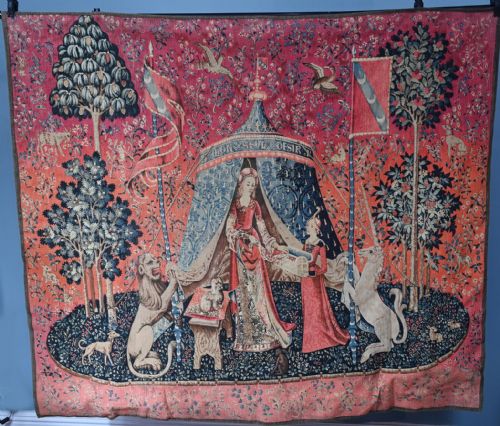
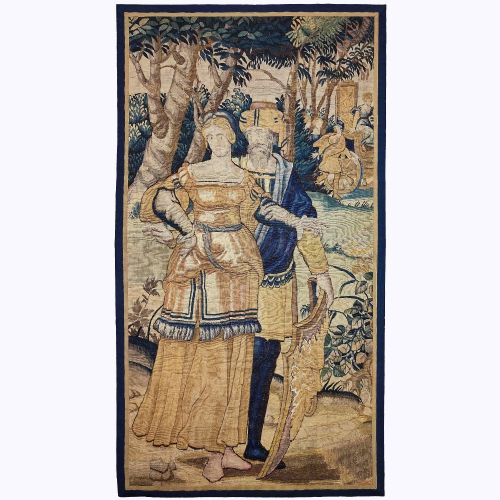


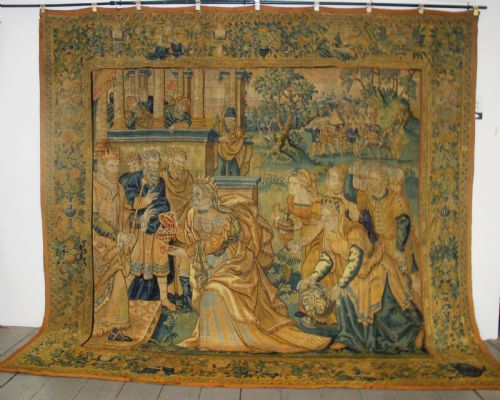
Renaissance Wall Tapestry
A renaissance wall tapestry brings grand historical narrative and deep textile texture directly into a room.
Renaissance Wall Tapestry
When you search for a renaissance wall tapestry, you encounter large woven textiles designed to adorn large interior vertical surfaces. These pieces display classical imagery, noble figures, and ornate borders characteristic of historic European interiors.
The versions most likely to meet you on this page range from original 16th century and 17th century Flemish and continental panels to later 19th century revivals. Forms include wall hangings, framed needlepoint panels, and substantial woven wall coverings.
Makers and weavers of these works utilised rich narrative scenes, ranging from classical figures to elaborate floral and grotesque motifs. Surviving examples often appear as fragments or larger coordinated pairs designed for significant architectural spaces.
Construction and materials
Traditional creation relied on woven wool and silk fibres, often enriched with metallic thread to catch candlelight and daylight within a grand chamber. Artisans built complex pictorial compositions through meticulous hand-weaving techniques on large looms.
Later revivals and panels incorporated varied materials such as cotton and needlepoint embroidery mounted within giltwood frames. Supporting structures frequently utilised wood frames or textile backings to support the heavy weight of the woven panels.
Listings feature pieces spanning five distinct centuries, from the 16th century through to the mid-20th century.
Judging quality and condition
Quality rests in the fineness of the weave and the complexity of the pictorial design, separating dense pictorial panels from simpler decorative textiles. The survival of rich colour tones within the wool and silk fibres dictates visual impact.
Structural integrity also separates top examples, as centuries of hanging place strain on textile fibres and metallic threads. Intact borders and well-preserved figural details demonstrate superior original craftsmanship and careful historical preservation.
The Renaissance Wall Tapestry Glossary
- Flemish Renaissance
- A northern European artistic movement known for detailed landscapes, bustling figural scenes, and rich textile production. This style dominates many early woven wall hangings.
- Mille-Fleurs
- A background style composed of a multitude of small flowers and plants strewn across a dark field. This decorative device frequently appears behind central figures in early textiles.
- Grotesque
- A style of decorative ornamentation featuring fantastical human and animal forms intertwined with foliage. These motifs frequently populate the borders and panels of classical wall hangings.
- Needlepoint
- A type of canvas work embroidery stitched by hand using wool or silk yarn. Panels executed in this technique often date to later revival periods.
- Giltwood
- Wood carved and covered with a thin layer of gold leaf or gold paint. This material forms the ornate frames frequently housing antique textile panels.
Renaissance Wall Tapestry: Frequently Asked Questions
How were tapestries originally used?
Historic households hung these heavy textiles on stone walls to insulate rooms against cold drafts and to display wealth and status. Large narratives depicted classical or biblical stories to educate and impress visitors.
Over time, these textiles became permanent decorative fixtures in noble residences, often custom-sized to fit specific architectural wall panels and galleries.
How do I hang a heavy textile?
Hanging a large woven panel requires distributing the weight evenly across the top edge rather than supporting it at isolated points. Conservation methods often involve sewing a sturdy canvas sleeve to the reverse and sliding a flat wooden batten through it.
Ensure the wall mount anchors securely into structural studs, keeping the textile away from direct sunlight and heat sources to protect the fragile fibres.
How can I tell a 16th century piece from a 19th century revival?
Early pieces display hand-spun wool and silk yarns dyed with natural substances, showing subtle colour variations and organic wear patterns. The complexity of the weave and the specific style of the figures align with period workshop practices.
Nineteenth-century revival pieces often utilise machine-spun consistency, brighter synthetic dyes, or standardised framing techniques that reflect later Victorian historicism.