


Renaissance Textile Panels
These renaissance textile panels bring centuries of European craftsmanship into modern interiors as striking wall art and historic hangings.
Renaissance Textile Panels
When you search for renaissance textile panels, you encounter historic wall hangings, framed needlepoints, and tapestries originating primarily from the sixteenth and seventeenth centuries. The examples met on this page span Flemish, Italian, French, and German workshops, reflecting centuries of European textile traditions.
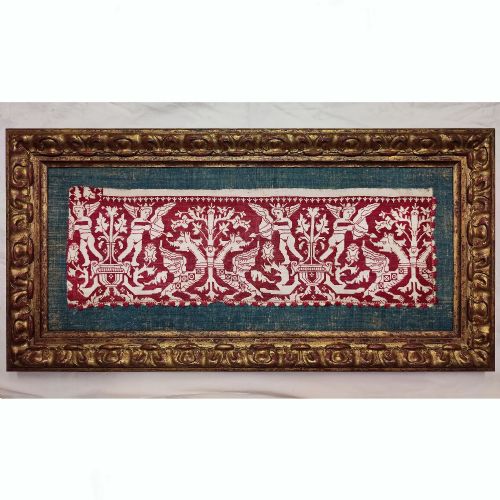
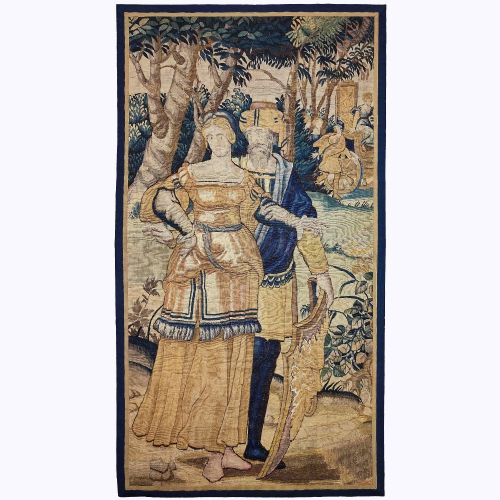
Most pieces function as wall art, architectural fragments, or framed textiles designed to decorate large interior spaces. Forms range from long pilaster hangings and embroidered borders to large tapestries featuring classical motifs, grotesques, and noble figures.
While many listings date directly to the sixteenth and seventeenth centuries, the selection also includes later nineteenth-century revivals such as Renaissance Revival and Gothic Revival works. These later pieces emulate the grand scale and rich iconography of earlier centuries using traditional materials.
How they were made
The construction of these textiles relies on natural fibres such as wool, silk, and linen, often enriched with metallic elements. Artisans worked these materials into complex tapestries and embroideries using traditional looms and needlework techniques.
Many panels incorporate gold thread and silk velvet to create tactile contrast and catch the light across elaborate pictorial scenes. Supporting structures frequently involve wood and gilded wood frames, particularly for pieces adapted as framed wall art.
Tuscan noblemen and grotesque masks peer out from centuries past, proving that Renaissance decorators knew how to throw a dramatic wall.
What varies in quality
Quality in these textiles rests upon the intricacy of the design, the preservation of the fibres, and the richness of the materials employed. Panels featuring metal thread and fine silk velvet demonstrate a higher level of workshop skill than simpler woollen grounds.
The survival of original dimensions and the integrity of the weave or embroidery distinguish the superior examples. Complete borders, crisp classical details, and authentic nineteenth-century or earlier framing add considerable architectural presence.
The Renaissance Textile Panels Glossary
- Tapestry
- A form of textile art woven on a vertical loom by hand, typically featuring pictorial scenes or decorative patterns.
- Pilaster hanging
- A long, narrow textile panel designed to fit between architectural columns or wall divisions.
- Grotesque
- A style of decorative ornamentation featuring fantastical human and animal forms intertwined with foliage, common in sixteenth- and seventeenth-century design.
- Needlepoint
- Embroidery stitched onto a canvas or linen ground to cover the entire foundation with dense patterns.
- Renaissance Revival
- An architectural and decorative style from the nineteenth century that drew inspiration from the forms and motifs of the fifteenth and sixteenth centuries.
Renaissance Textile Panels: Frequently Asked Questions
How do I hang a heavy tapestry panel?
Large tapestries and wall hangings require even weight distribution to prevent distortion of the historic fibres. Professional framing or specialist hanging rails help support the full length safely.
Avoid placing delicate silk and wool panels in direct sunlight or damp environments to preserve the integrity of the weave.
Are these panels from the original period?
The selection includes authentic sixteenth- and seventeenth-century European fragments alongside later nineteenth-century revival pieces. Each listing specifies the attributed period or century based on material and style.
Review the description details for specific regional origins such as Flemish, Italian, or German workshops.
What is the difference between a tapestry and embroidery?
Tapestries are woven on a loom where the design is built into the fabric structure using warp and weft threads. Embroidery is stitched onto an existing woven textile foundation using a needle.
Both techniques appear across sixteenth- and seventeenth-century panels, often utilising metal thread and silk.