


Relief Carved Sideboard
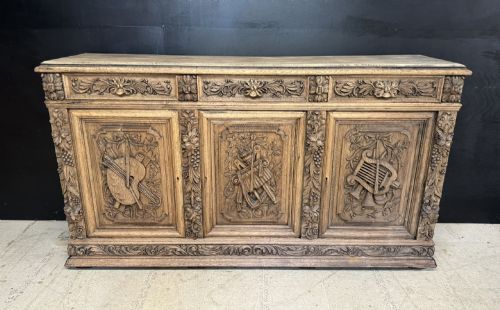
A relief carved sideboard brings heavy architectural presence and deep figural carving into a dining space, offering both display and storage.
Relief Carved Sideboard
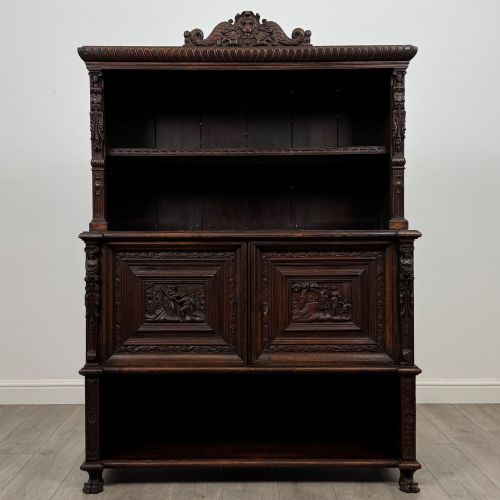
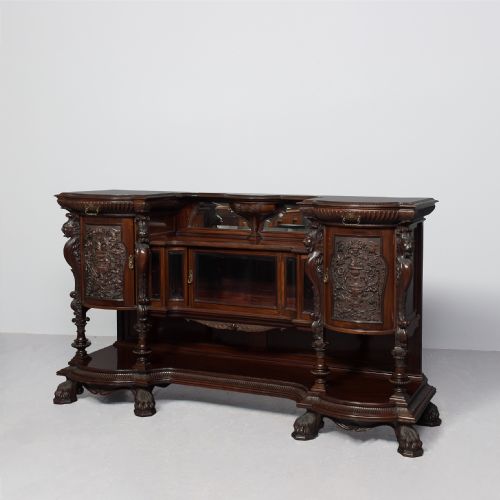
When you search for a relief carved sideboard, you encounter substantial storage furniture dominated by deep sculptural woodwork, cabinets, and cupboards. These pieces bridge the gap between functional dining room storage and display architecture, often featuring mirror-backs or tiered staging surfaces.
The versions most likely to meet you on this page stem predominantly from the nineteenth century, embracing Victorian, Renaissance Revival, and Gothic revival movements. You will also find earlier sixteenth-century examples alongside continental forms like French buffets and Italian cabinets on stands.
Makers and regional workshops across Britain and continental Europe applied dense ornamentation, utilising oak and walnut as primary timber mediums. The structural formats vary from simple two-door hall cupboards to massive multi-tiered sideboards with brass and iron hardware.
Materials and construction methods
Makers relied heavily on solid oak and walnut timbers to provide a stable canvas for deep chisel work, mortise and tenon joinery, and heavy panel construction. These dense hardwoods supported protruding relief motifs without warping or splitting under the weight of the elaborate ornamentation.
Artisans applied hand-carving techniques directly into the structural framework of the doors, panels, and cornices, sometimes incorporating inset marble tops and mirrored glass panels. Iron and brass hardware completed the construction, functioning both as structural reinforcement and decorative punctuation.
One exceptional Italian fantasy buffet comes signed by a wood sculptor who clearly possessed an extremely vivid imagination.
Distinctions in craftsmanship and design
The hierarchy of quality rests primarily on the depth, clarity, and ambition of the hand-carving rather than simple surface decoration. Superior examples display undercut relief work with distinct musculature and foliage, whereas lesser pieces rely on shallow stamping or repetitive machine-routed detailing.
Proportion and timber selection dictate the upper tier of the range, where figured walnut or quarter-sawn oak timbers exhibit harmonious grain patterns across large cabinet doors. The integration of secondary materials, such as heavy marble slabs and bevelled mirror glass, further separates standard regional cupboards from ambitious continental showpieces.
The Relief Carved Sideboard Glossary
- Relief carving
- A sculptural technique where figures and motifs project from a flat background timber surface. This method defines the primary visual impact of nineteenth-century revival furniture.
- Buffet de corp
- A large formal French cupboard or sideboard featuring upper and lower cabinet sections. It typically provides extensive storage for dining silver and glassware.
- Renaissance revival
- An eclectic nineteenth-century style that reinterprets sixteenth-century classical architectural motifs, symmetry, and heavy relief work. It heavily influences the proportions of Victorian cabinets.
- Gothic revival
- An architectural and decorative style drawing inspiration from medieval ecclesiastical design, pointed arches, and tracery. It appears frequently on nineteenth-century oak cupboards.
- Pot cupboard
- A small bedside or freestanding cabinet designed to house a chamber pot, often constructed with a marble top. These compact pieces share the carved vocabulary of larger sideboards.
Relief Carved Sideboard: Frequently Asked Questions
How do I clean a carved wooden sideboard?
Dust the deep recesses regularly with a soft natural-bristle brush to prevent particle accumulation in the intricate undercut carvings. Avoid modern silicone sprays that build up residue over time, opting instead for a traditional microcrystalline wax applied sparingly to nourish the hardwood.
Buff the surfaces gently with a clean cotton cloth to maintain the natural sheen of the timber. Keep the furniture away from direct heat sources and strong sunlight to prevent the oak or walnut from drying and splitting.
Can I use a antique cupboard in a modern kitchen?
These large storage pieces adapt well to contemporary dining spaces or open-plan kitchens when given sufficient breathing room against neutral walls. Their deep shelves and enclosed cupboards offer practical concealment for modern dinnerware and glassware.
Ensure the floor surface is level to prevent the heavy doors from sagging on their original hinges. The contrast between historical woodwork and clean modern architecture often creates a balanced interior scheme.
How do I distinguish Victorian revival from sixteenth-century work?
Examine the interior construction, saw marks, and joint methods, as nineteenth-century revival pieces often incorporate mechanical aids and standardised fixings alongside hand tools. Sixteenth-century originals display irregular hand-pit-sawn timber and primitive joinery developed before industrial standardisation.
The crispness of the patina and the wear patterns on high-touch areas also reveal the true age of the timber. Revival pieces from the 1800s consciously imitate earlier styles but retain the heavier, machine-milled framing techniques of the Victorian era.
What is the difference between a sideboard and a buffet?
Sideboards traditionally function as serving tables or low storage units designed for dining rooms, occasionally featuring drawers and open serving surfaces. Buffets frequently incorporate upper superstructure cabinets or enclosed shelving units like the French buffet de corp.
Both forms utilise heavy relief carved panels in revival designs, but buffets tend to offer greater vertical presence and enclosed storage capacity. The nomenclature often overlaps depending on regional cataloguing traditions of the nineteenth century.