
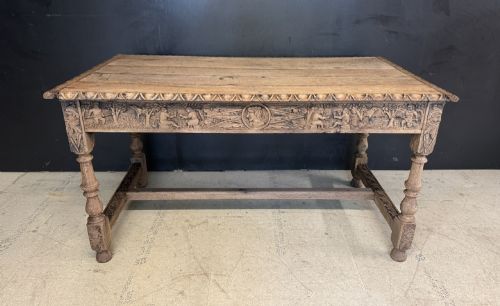
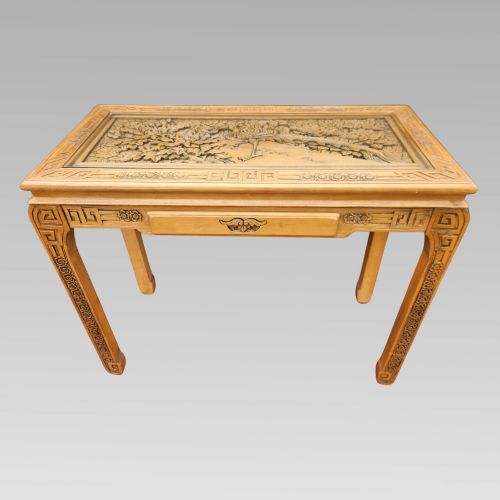


Relief Carved Side Tables
Relief carved side tables bring deep textural panels and regional craftsmanship into everyday rooms.
Relief Carved Side Tables
Relief carved side tables encompass a diverse range of occasional furniture shaped by distinct regional traditions, spanning Chinese export, Anglo-Indian, and Middle Eastern workshops. When exploring relief carved side tables on this page, buyers frequently encounter pieces dating from the nineteenth and early twentieth centuries, alongside occasional examples from the nineteen-twenties and thirties.
The forms extend beyond simple single stands to include nests of tables, console tables, coffee tables, and octagonal occasional pieces. Hardwoods such as teak, oak, camphorwood, and mahogany form the structural backbone of these items, often decorated with elaborate motifs like dragons, elephants, and traditional floral patterns.
Materials and construction methods
Craftsmen utilised dense hardwoods, particularly teak and mahogany, which possessed the structural stability required to support deep chisel work without splitting. These surfaces were hand carved with intricate relief details, cutting away the background to leave figures, foliage, and animals projecting forward.
Joinery techniques varied from traditional interlocking joints to folding mechanisms found on portable occasional tables. Secondary materials such as bone inlay, glass tops, and brass fixtures occasionally appear, complementing the carved wooden structures.
Several sets feature diminutive carved elephants lumbering around the borders, proving that nineteenth-century artisans appreciated a touch of wildlife.
Assessing quality and execution
Quality rests primarily on the depth, crispness, and anatomical accuracy of the carved relief work, distinguishing master carvers from routine production pieces. Sharp undercut details and well-proportioned motifs indicate superior workshop output.
The selection and seasoning of the underlying hardwood also dictate longevity, with tight-grained timbers resisting seasonal movement better than lesser planks. Integrity of form, particularly in nests of tables and folding mechanisms, separates well-preserved examples from those with extensive alterations or structural fatigue.
The Relief Carved Side Tables Glossary
- Relief carving
- A sculptural technique where figures or patterns project from a flat background. This method defines the primary ornamentation on the surfaces of these tables.
- Chinese Export
- Goods manufactured in China specifically for Western markets during the nineteenth and early twentieth centuries. These pieces often combine traditional Eastern motifs with forms suited to European interiors.
- Chinoiserie
- A European decorative style reflecting Chinese artistic influences. It appears on furniture through characteristic scenic and floral depictions.
- Nest of tables
- A set of graduated tables designed to fit neatly beneath one another when not in use. This practical form is common in export and early twentieth-century groupings.
- Occasional table
- A small, versatile piece of furniture intended for light, specific uses rather than permanent placement. These items function easily beside chairs or in hallways.
Relief Carved Side Tables: Frequently Asked Questions
What periods do these tables come from?
The pieces span from the nineteenth century through the early decades of the twentieth century, including items from eighteen-sixty up to nineteen-thirty.
Production methods and regional styles evolved across these decades, reflecting both traditional workshop practices and changing international tastes.
Are these tables sturdy enough for daily use?
Most examples are constructed from dense hardwoods like teak and mahogany, making them structurally sound for holding lamps, drinks, or books.
Care should be taken with folding mechanisms or delicate nests to ensure joints remain stable during rearrangement.
What is a nest of tables?
A nest of tables consists of a set of graduated pieces designed to slide one beneath another to save floor space.
This practical arrangement allows multiple surfaces to be deployed simultaneously when entertaining guests.
Where should I place a console table?
Console tables fit naturally against hallway walls or beneath windows, providing a narrow surface for display items.
Their elongated proportions make them suitable for entryways where floor space is restricted.