

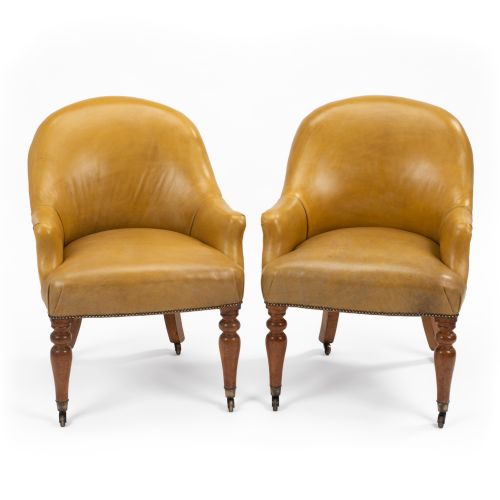
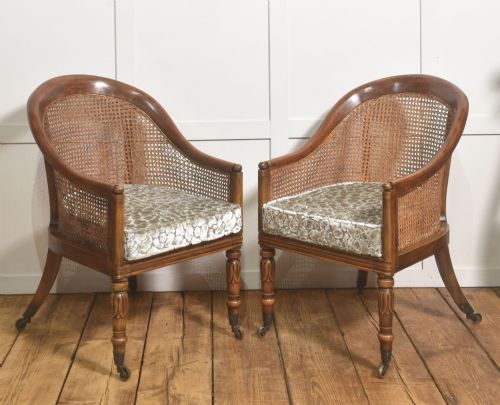
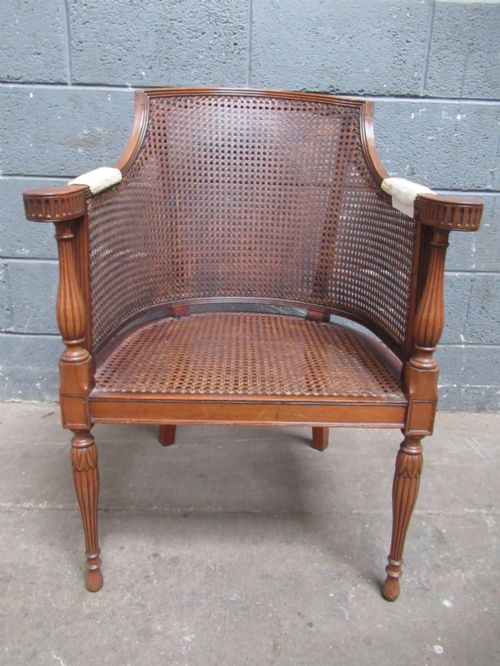
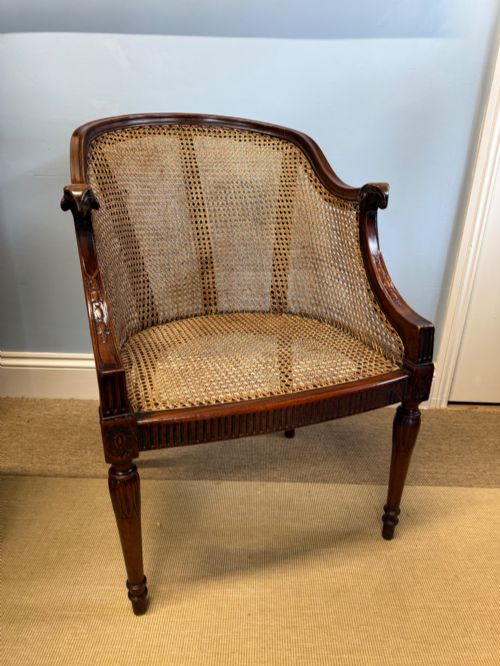
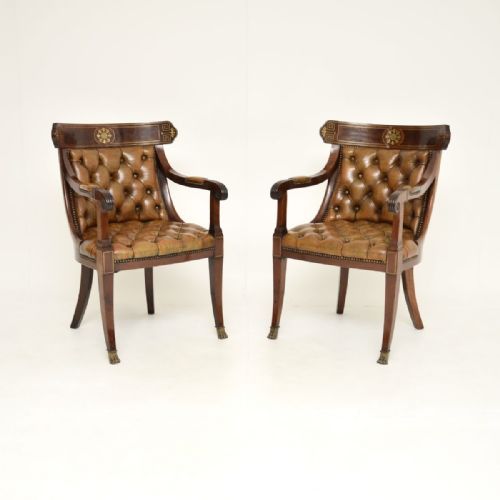


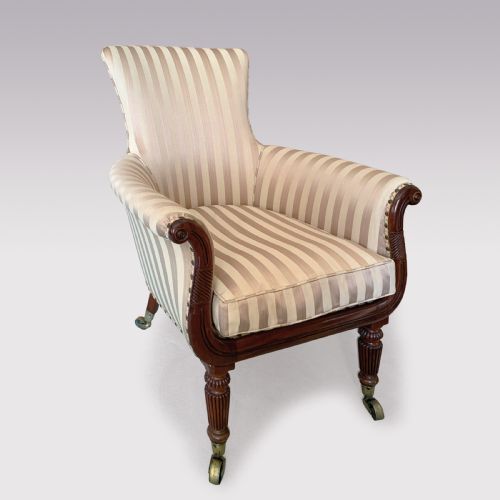


Regency Tub Armchair
A regency tub armchair offers deep, curved seating designed for comfort, combining elegant library proportions with classic period framing.
Regency Tub Armchair
A regency tub armchair combines a rounded enclosing back with low arms designed to tuck neatly beneath a desk or library table. These pieces emerge primarily from the Regency period, though later revivals span the nineteenth and early twentieth centuries in varying interpretations.
The selections on this page feature robust hardwood frames, most commonly mahogany, paired with seating surfaces of cane, leather, or upholstered textile. Alongside standard library armchairs, buyers will encounter bergères, occasional chairs, and occasional child variants reflecting the same curved lineage.
Makers of the era utilised distinct stylistic elements including brass inlay, simulated rosewood finishes, and structural lyre fronts. These chairs served utility in libraries and drawing rooms, evolving from formal seating into comfortable reading chairs.
Evaluating craftsmanship
Superior examples demonstrate crisp execution in the joinery of the curved back rail and the precision of brass inlay work. The quality of the timber grain, particularly in figured mahogany or faux rosewood graining, dictates the visual weight of the piece.
Original caning integrity and the retention of period upholstery styles distinguish finer library armchairs from later nineteenth or twentieth-century revivals. Proportion, such as the sweep of the arms and the grace of the lyre front, marks the distinction between standard workshop output and attributed cabinetmaking.
Regency Tub Armchair Retail Price Guide 2026
Typical asking prices for regency tub armchair among the pieces listed under this phrase on Sellingantiques today, from the lower quarter to the upper quarter. They describe what is for sale here now, not the wider market.
Listings span the Regency, William IV, Victorian, and Edwardian periods, alongside later twentieth-century revival dates from 1910 and 1930.
Gillows·Miles & Edward’s
The Regency Tub Armchair Glossary
- Bergère
- An enclosed upholstered armchair featuring cane panels to the sides and back. This French-influenced form provides lighter structural weight while maintaining deep seating comfort.
- Ebonised
- Timber treated with a dark finish to imitate ebony wood. This technique creates a dramatic, dark surface often utilised on Regency library seating.
- Curule
- A form of cross-framed X-shaped support derived from ancient Roman magistrate seats. Library armchairs utilising this design display outward-curving intersecting legs.
- Faux rosewood
- A painted or stained finish applied to a secondary wood to simulate the rich grain patterns of true rosewood. Cabinetmakers employed this technique during the Regency period to achieve opulent visuals with alternative timbers.
- Lyre front
- A structural or decorative front rail shaped in the profile of a classical musical lyre. This motif appears frequently on the arm supports of library chairs.
Regency Tub Armchair: Frequently Asked Questions
What is a regency tub armchair?
A regency tub armchair is a seating form defined by a continuous curved back enclosing the sitter, often paired with low armrests designed for library use.
These pieces typically date from the early nineteenth century and feature solid mahogany construction with cane or leather inserts.
Where were these chairs used?
Libraries, studies, and drawing rooms served as the primary locations for these comfortable reading and desk chairs. Their compact curved profile allowed them to sit snugly near writing surfaces or beside bookshelves.
During the period, gentlemen and scholars utilised them for prolonged reading and writing tasks.
How do I care for cane panels?
Cane requires gentle maintenance to prevent drying and snapping over time. Regular dusting with a soft brush keeps the woven surfaces clear of debris.
Keeping the room at a stable humidity level protects the natural rattan material from becoming brittle.
Are later revivals valuable?
Nineteenth-century and early twentieth-century revival pieces carry distinct craftsmanship value reflecting the enduring popularity of the Regency style. Cabinetmakers in later decades meticulously copied earlier proportions and brass inlay techniques.
Collectors often appreciate these subsequent interpretations for their sturdy build quality and historical design continuity.