
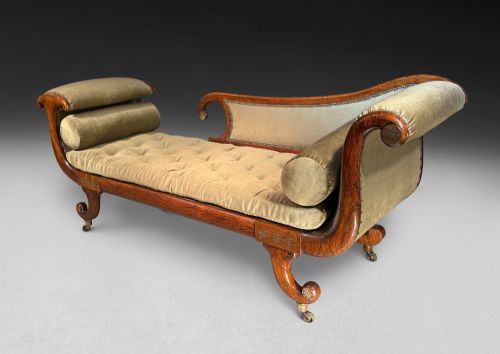
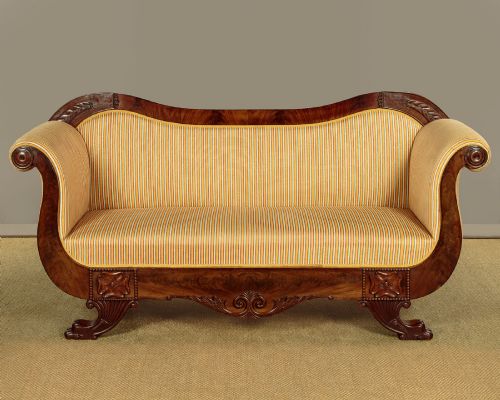
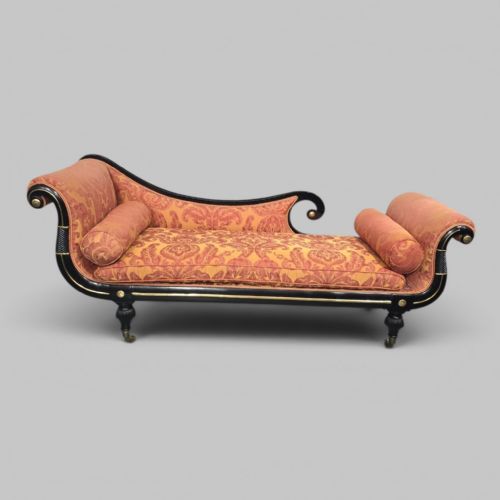
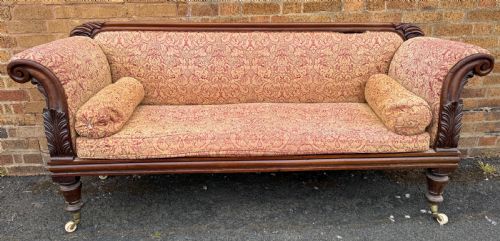
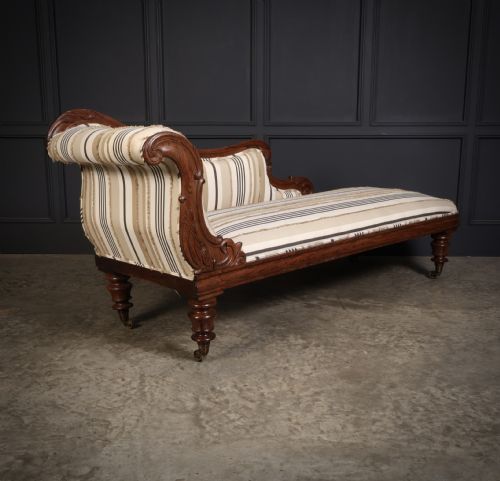


Regency Scroll End Couch
A regency scroll end couch brings dramatic architectural line and comfortable reclining form directly into a drawing room.
Regency Scroll End Couch
A regency scroll end couch provides a distinctive asymmetrical or double-ended lounging silhouette defined by sweeping, curved timber arms. These seating forms appear primarily across Regency, William IV, and nineteenth-century periods, capturing the classical revival tastes of the era.
The pieces listed here encompass various configurations including traditional daybeds, chaise longues, and larger settees designed for principal rooms. Mahogany, simulated rosewood, and ebonised wood form the primary structural frameworks supporting these substantial seats.
Buyers will encounter single scroll ends alongside double-ended sofas that allow the sitter to recline from either direction. Many examples demonstrate the refined proportions characteristic of country house seating from the early nineteenth century.
Materials and construction
Cabinet makers utilised solid mahogany and thoughtfully prepared timbers finished as simulated rosewood or ebonised wood to achieve a dense, dark ground. Brass inlay frequently punctuates these polished surfaces, tracing geometric lines along the wooden frames.
Upholstery forms a fundamental part of the construction, utilising traditional materials such as hessian and fabric foundations beneath damask and modern upholstery fabrics. Carved wooden details often accent the structural rails and the sweeping terminals of the scroll ends.
Some nineteenth-century makers cleverly painted common local timbers to look like exotic rosewood just to satisfy the prevailing fashion.
Assessing quality and proportion
Superior examples demonstrate crispness in the carved mahogany details and precision in any brass inlay work applied to the wooden frame. The sweep of the scroll end should possess a fluent, organic curve rather than a stiff or abrupt angle.
The underlying timber quality and the integrity of the joinery dictate the longevity of these substantial frames. Finer pieces maintain balanced proportions between the open scrolling architecture and the upholstered bed, avoiding a heavy or clumsy appearance.
Willian Trotter
The Regency Scroll End Couch Glossary
- Scroll end
- A wooden or upholstered arm that curves outward and downward in a tight or sweeping spiral shape. This defining feature lends the couch its classical profile.
- Chaise longue
- An elongated chair or daybed designed for reclining in a semi-recumbent posture. It combines the backrest of a sofa with the extended seat of a bed.
- Simulated rosewood
- A painted or stained surface treatment applied to a cheaper timber to imitate the rich grain and deep colour of genuine rosewood. Craftsmen achieved this effect using specialised graining brushes and dark glazes.
- Récamier
- A type of daybed with two raised ends and an open side, named after the French society figure painted by Jacques-Louis David. This form provides symmetrical or asymmetrical reclining options.
- Ebonised wood
- Timber treated with chemical stains or black finishes to resemble solid ebony. This technique was popular for creating a formal, high-contrast appearance on nineteenth-century frames.
Regency Scroll End Couch: Frequently Asked Questions
How do I tell a Regency piece from a William IV one?
Regency pieces generally display lighter, more restrained classical lines with delicate brass inlay and slender mahogany frames. William IV examples tend to be heavier and more robust, featuring bolder carving and darker woods.
Both periods overlap closely in the archive, reflecting a continuous evolution in British furniture design from the early nineteenth century onward.
Where should I place a double-ended sofa in a room?
A double-ended sofa is designed to sit away from the wall, often floating in the middle of a large drawing room or library. Its symmetrical scroll ends allow it to be viewed from all angles.
Sufficient floor space is essential to appreciate the sweeping timber curves and the elongated profile of the piece properly.
What fabrics were originally used on these couches?
Original upholstery schemes often incorporated damask, patterned textiles, and sturdy woven fabrics supported by hessian webbing and traditional stuffing materials. Many surviving pieces have since been recovered to suit modern interiors.
When selecting a fabric for re-upholstery, heavy-weave textiles complement the substantial scale of nineteenth-century frames.