
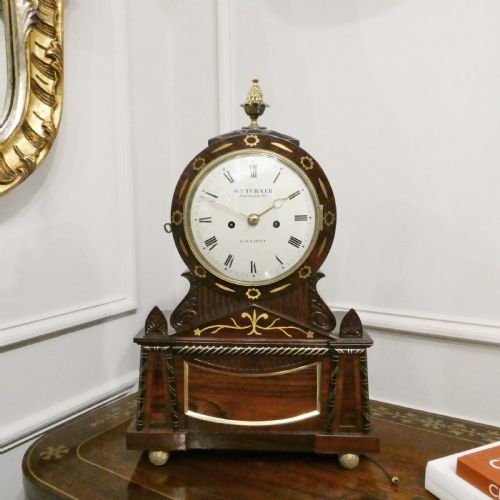


Regency Rosewood Clock
A regency rosewood clock brings warmth and precise mechanical movement to a room through dark timber and contrasting brass work.
Regency Rosewood Clock
When you search for a regency rosewood clock, you encounter timepieces produced during the nineteenth century, spanning periods from Georgian through to Victorian. The selection centres heavily on bracket clocks, mantel clocks, and wall clocks housed in rich tropical timber.
You are most likely to meet mantel and bracket pieces designed for tabletops and shelves, alongside octagonal and dial wall clocks meant for hanging. These items display styles including Regency, Gothic Revival, and William IV.
Makers housed these movements in compact table formats, library clocks, and larger bracket designs, often incorporating glass panels to reveal the dial and interior mechanics.
Materials and construction methods
Cabinet makers utilised dense rosewood veneers over firmer secondary woods, applying brass inlay in geometric and scroll patterns across the front panels. Dial faces typically feature silvered metal or white enamel protected beneath bevelled glass.
Movements rely on fusee mechanisms, single or twin fusee trains, and drum head configurations to drive the hands and striking components with consistent force.
Secondary detailing includes gilt metal mounts, mother-of-pearl accents, and ebonised wood mouldings that frame the primary timber.
Some nineteenth-century makers packed their delicate clock movements inside small library cases just so busy readers could keep track of tea time.
Distinctions in craftsmanship
The standard of a regency rosewood clock rests on the precision of the brass inlay and the depth of figure in the rosewood timber grain. Finer examples exhibit crisp engraving on silvered dial plates and meticulous attention to the proportions of the case architecture.
Turner of London·George Orpwood·Seller of Reading·S Simpson Southampton·Litherland Davies Of Liverpool·Arnold and Frodsham·Ganthony of London·Kleyser of London·Walker and Hall·Plumbly and Tupman·L Donne·James Tupman·D Duff of Paisley
The Regency Rosewood Clock Glossary
- Fusee
- A conical pulley used in spring-driven clocks to maintain equal power as the mainspring unwinds. This device ensures accurate timekeeping throughout the running cycle.
- Bracket clock
- A portable timekeeper originally designed to sit on a wall bracket or table. These pieces frequently feature intricate wooden cases and striking trains.
- Silvered metal
- A brass dial plate treated with a silver coating and engraved with numerals and maker details. The technique provides high legibility against dark timber cases.
- Library clock
- A compact and often understated timekeeper intended for reading rooms and studies. They emphasise readability and dependable movement over elaborate ornamentation.
- Dial clock
- A wall-mounted timepiece featuring a prominent circular face framed by a wooden surround. They were widely used in public spaces and domestic halls for clear time telling.
Regency Rosewood Clock: Frequently Asked Questions
What is a fusee movement?
A fusee movement uses a conical pulley and cord or chain to equalise the declining power of the mainspring. This mechanism ensures the clock maintains steady accuracy throughout its running period.
Most high quality bracket and table clocks from the nineteenth century rely on this system to regulate the force delivered to the escapement.
Where should I place a bracket clock?
Bracket clocks suit heavy wooden sideboards, mantels, or dedicated wall shelves where their solid timber cases and glass panels remain stable. Avoid placing them near direct heat sources or damp walls.
Because many include striking or chiming trains, position them in spaces where the acoustic chime can be enjoyed without disturbance.
How do I identify a Regency period clock?
Regency timepieces often feature dense rosewood veneers combined with precise brass inlay, chamfered top cases, and silvered metal dials. Stylistic cues include classical architectural motifs and restrained brass mounts.
Checking the movement signature and construction details helps separate genuine Regency pieces from later nineteenth century revivals.
Why do some clocks have twin fusee trains?
Twin fusee trains separate the timekeeping function from the striking or chiming mechanism, providing independent power sources for each operation. This arrangement prevents the striking train from interfering with the precision of the clock hands.
Clocks with this feature typically require two winding holes on the dial face.