
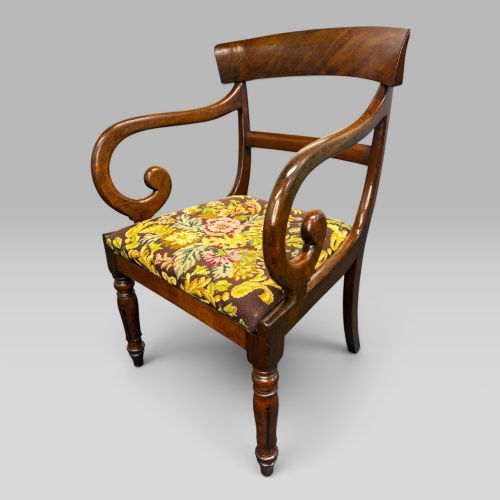


Regency Needlepoint Chair
These regency needlepoint chairs bring together solid timber frames and hand-worked wool textiles for daily seating that has endured for centuries.
Regency Needlepoint Chair
A regency needlepoint chair combines the structural woodwork of the late eighteenth and nineteenth centuries with textile upholstery. The pieces on this page span several decades, reaching from the Georgian era through to the Victorian period.
The selection includes armchairs, side chairs, dining chairs, elbow chairs, and piano stools alongside specialised prayer seats. Timber frames are built predominantly in mahogany and rosewood, paired with wool work, tapestry, and needlepoint upholstery.
Most examples originate from English workshops, employing sabre legs, scroll arms, and drop-in seats. Buyers encounter everything from single carver chairs to matched sets intended for the dining room or drawing room.
How They Were Made
Cabinetmakers shaped the structural frames using dense hardwoods like mahogany and walnut, often finished with brass details or simple inlay work. Joinery relied on traditional methods to bear weight across elbow chairs, side chairs, and heavy carver seats.
Upholstery required hand-stitched needlepoint, wool work, and tapestry textiles secured over drop-in frames or stuffed seat pads. These covers utilised heavy wool threads to withstand regular use in parlours, bedrooms, and studies.
Object forms span from standard dining chairs and elbow armchairs to specialised prayer seats and piano stools.
What Varies in Quality
The density and selection of the timber dictate the base quality of the frame, with choice cuts of mahogany and rosewood holding up better than secondary softwoods. Refined turning on legs and crisp carving on arm supports set finer drawing-room pieces apart from utilitarian seating.
Needlepoint upholstery varies according to the tightness of the stitch and the complexity of the wool work pattern. Original textiles retained in good condition hold higher standing than later re-webbed or re-stitched replacements.
The Regency Needlepoint Chair Glossary
- Needlepoint
- A type of counted thread embroidery stitched onto an open-weave canvas foundation. It forms the durable pictorial or geometric covers seen on nineteenth-century seats.
- Carver Chair
- An armchair, usually designed with open arms and used at the head of a dining table or as a desk chair. These pieces match larger sets of simpler side chairs.
- Sabre Leg
- A convex-curved rear or outward-curving front furniture leg shaped like a cavalry sword. This form appears frequently on seating from the Regency period.
- Prie-Dieu Chair
- A low devotional chair featuring a padded top rail designed for kneeling prayer. Examples often incorporate ecclesiastical needlepoint or wool work.
- Drop-in Seat
- A removable upholstered wooden frame that fits snugly into the seat rails of a chair. This construction method allows easier reupholstering without dismantling the main frame.
Regency Needlepoint Chair: Frequently Asked Questions
Can I use these chairs every day?
Most of these antique chairs remain sturdy enough for regular sitting provided the joints stay tight and stable. Periodic checks on the frame construction help prevent loosening from daily use.
Heavier everyday wear will affect antique textiles faster than modern fabrics. Placing high-traffic seating in quieter rooms preserves both the timber frame and the needlepoint work.
How do I spot a Regency piece?
Regency seating often displays specific classical elements such as sabre legs, reeded frames, and dark mahogany or rosewood timbers. Proportions tend to be clean and restrained compared to heavier Victorian designs.
Looking underneath the seat reveals timber ageing, hand-cut screws, and traditional joinery methods that distinguish early nineteenth-century work from later reproductions.
Are the needlepoint seats original?
Needlepoint and wool work covers can be either original to the nineteenth century or later replacements stitched during subsequent restorations. Close inspection of the wool yarn and the backing canvas helps determine the age of the textile.
Many chairs survived centuries of use by receiving fresh upholstery while retaining their original wooden frames. Both period-correct replacements and surviving antique tapestries appear across these listings.
What is a piano stool?
Piano stools were manufactured with adjustable seats to accommodate musicians playing keyboard instruments in nineteenth-century parlours. They often feature solid rosewood or mahogany frames with upholstered tops.
Unlike standard dining chairs, these stools utilise mechanical screw mechanisms concealed beneath the seat to raise or lower the height.