







Regency Lyre Side Table
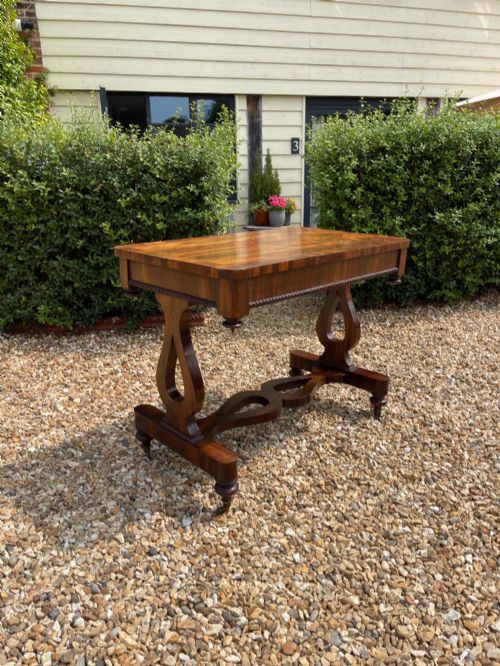
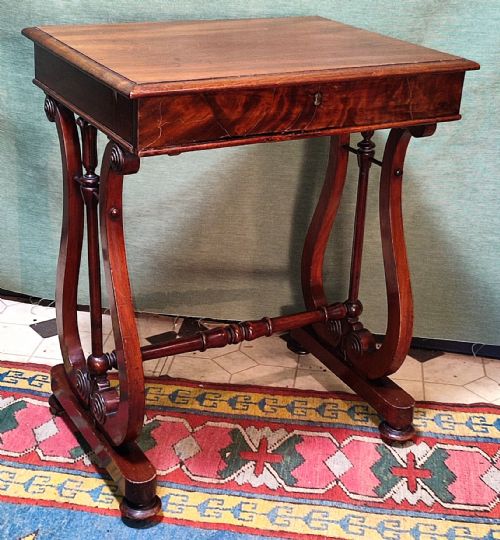
These pieces are a regency lyre side table, bringing structural elegance and refined proportion to a room.

Regency Lyre Side Table
When you search for a regency lyre side table, you encounter forms that span work tables, sofa tables, tea tables, and occasional tables. These pieces typically feature distinct lyre-shaped supports connected by a stretcher, reflecting the neoclassical tastes of the nineteenth century. The selection includes original Regency period examples alongside later revivals from the Edwardian era and the 1920s.
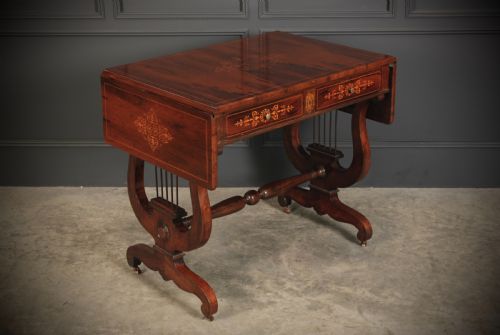
The most frequent configuration on this page is the sofa table or work table, often fitted with drawers or drop leaves. While authentic early nineteenth-century items appear alongside George IV and William IV variants, you also find Regency Style and Regency Revival pieces made a century later. The core aesthetic relies on symmetry, balanced proportions, and the characteristic harp-like pedestal base.
Materials and construction
Makers utilised dense hardwoods such as mahogany, rosewood, and kingwood, frequently selecting figured timber for the table tops to create visual depth. Boxwood and satinwood stringing or marquetry inlay often accentuates the borders and drawer fronts of finer examples. Brass details, including paw feet, castors, and mounts, frequently appear on the supports.
The lyre ends require precise joinery to bear the weight of the top while maintaining slender, curved profiles. Drop leaves operate smoothly on folding wooden brackets or rule joints, and draw mechanisms rely on well-fitted side runners. Ebonised wood and birch also appear, showing how cabinet makers varied their timber choices to suit the commission.
The listings on this page span the Georgian, Regency, and Edwardian periods, featuring materials from solid mahogany to ebonised wood and brass.
Assessing quality
Quality rests in the choice of timber figure and the crispness of the carving on the lyre supports. Superior examples display book-matched veneers and meticulous inlay, whereas lesser pieces rely on plain timber surfaces with minimal detail. The integration of secondary woods in the drawer construction and the weight of the brass fittings further distinguish the work.
Proportion and stability dictate the enduring appeal of these tables. A well-constructed piece maintains rigid joints at the pedestal base without wobble, and the turning of the central stretcher shows careful lathe work. The handling of the curves on the lyre dictates whether the silhouette appears graceful or heavy.
The Regency Lyre Side Table Glossary
- Lyre support
- A pedestal shaped like an ancient Greek lyre or harp, forming the structural end of the table base.
- Sofa table
- A rectangular table traditionally placed in front of a sofa, featuring drop leaves on either side.
- Marquetry
- Decorative patterns formed by inserting pieces of coloured wood, veneer, or shell into a solid wood background.
- Stringing
- A thin inlay of contrasting wood used to outline drawers, borders, and tabletops.
- Pollard oak
- Timber taken from trees that have been pollarded, producing a knotty, highly figured grain pattern.
Regency Lyre Side Table: Frequently Asked Questions
What is a regency lyre side table used for?
These tables function as surface space for lamps, books, or decorative objects in a drawing room or hallway.
Many versions include drawers or drop leaves, making them adaptable for writing, sewing, or serving tea.
How do I date a regency lyre side table?
Examine the secondary timbers inside the drawers and the construction methods used for the joints.
Original nineteenth-century pieces show hand-cut dovetails and natural ageing, while Edwardian and 1920s revivals often display machine precision.
Are all these tables from the Regency period?
The listings include both original nineteenth-century pieces and later revival items made around 1900 to 1920.
Styles span Georgian, Regency, William IV, and later interpretations that mimic the classic harp-shaped supports.
How do I care for mahogany and rosewood surfaces?
Keep the timber away from direct sunlight and sudden temperature changes to prevent the veneer from drying or cracking.
Apply a microcrystalline wax periodically to nourish the grain and maintain a soft, protective sheen.