

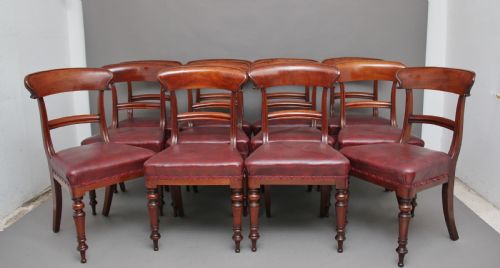


Regency Leather Dining Chairs
Regency leather dining chairs bring architectural line and rich hide into the dining room, offering sturdy seats designed for long evening meals.
Regency Leather Dining Chairs
When you search for regency leather dining chairs, you encounter seating built during the early nineteenth century alongside later revivals from the nineteenth and twentieth centuries. The earliest examples date from the Regency and George III periods, whilst later interpretations draw on William IV and Neoclassical manners.
The forms span single dining chairs, carvers, armchairs, and larger sets designed to surround mahogany or rosewood tables. Alongside standard dining chairs, you find barback, rope back, and scroll arm variations upholstered in hide.
Mahogany remains the dominant wood, accompanied by Cuban mahogany, pollard oak, rosewood, and Scottish oak. Brass inlay and reeded legs frequently appear on the examples recorded here.
Materials and construction
Cabinetmakers utilised dense timbers such as mahogany and rosewood, often turning or carving the wood to form sabre legs, reeded supports, and curved back splats. Pollard oak and brass inlay provided contrasting details on select pieces.
Seats were upholstered in leather, sometimes secured with studs, providing a durable and wipeable surface suited to daily dining. Frames were joined using traditional cabinetmaking techniques to withstand heavy use.
Listings feature woods spanning mahogany, Cuban mahogany, rosewood, pollard oak, Scottish oak, and ebony.
Judging the range
Quality reveals itself in the selection of timber and the crispness of the carving on the back splats and legs. Dense grain in the mahogany and precise inlay separate standard sets from exhibition quality pieces.
The integrity of the frame and the proportion of the armchairs or carvers dictate the visual balance of the set. Matching sets of twelve or fourteen demand superior consistency across every chair compared to smaller groups of four or six.
Gillows·W W Peirce·Henry Maxwell
The Regency Leather Dining Chairs Glossary
- Carver
- An armchair designed to sit at the head of a dining table. These typically feature open arms and match the smaller side chairs in a set.
- Barback
- A chair style featuring a horizontal top rail shaped like the crossbar of a piece of harnesses. This design appears frequently on Regency and William IV dining chairs.
- Reeded
- Formed with parallel convex moulding cut into the wood. This decorative technique is commonly seen on the legs of Regency dining chairs.
- Pollard oak
- Timber taken from trees that have been pollarded, producing a dense, highly figured grain pattern. It provides a striking, mottled surface on brown leather dining chairs.
- Sabre leg
- A curving, outward-splaying leg rounded or square in section, typical of Regency seating. The shape mimics the curve of a cavalry sabre.
Regency Leather Dining Chairs: Frequently Asked Questions
How many chairs come in a typical set?
Sets vary widely, ranging from pairs and small groups of four or six up to larger dining suites comprising ten, twelve, fourteen, or fifteen chairs.
Larger gatherings of matching chairs often indicate boardroom or substantial dining table sets from the period.
What woods are used in these chairs?
Mahogany is the primary timber, including Cuban mahogany variants, alongside rosewood, Scottish oak, and pollard oak.
Brass inlay and ebony details occasionally accent the primary wood frames.
Are all these chairs from the Regency period?
The records include authentic Regency and Georgian pieces alongside later William IV, Victorian, and 1920s revival sets.
Stylistic influences also encompass Neoclassical design across various nineteenth and early twentieth-century dates.
What seat coverings do these chairs feature?
Leather is the predominant upholstery material, frequently finished with studded edges on carver chairs and standard dining seats.
Alternative materials such as fabric occasionally appear, though hide remains the traditional choice for these forms.