
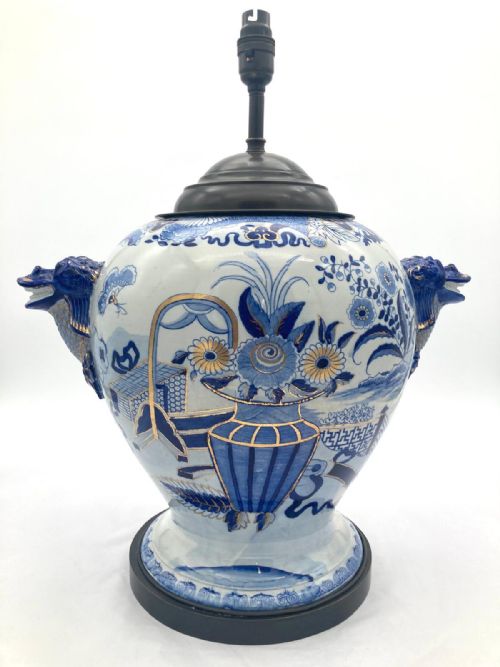


Regency Ironstone Vase
These regency ironstone vase pieces are heavy earthenware vessels from the early nineteenth century that bring robust colour and decorative presence to a room.
Regency Ironstone Vase
When you search for a regency ironstone vase, you encounter sturdy ceramic vessels dating primarily from the Regency and Georgian periods. These pieces include large lidded urns, pot pourri jars, and decorative hall vases.
The versions most frequently met on this page are robust nineteenth century examples created by prominent English potteries. Many retain their original bold proportions, while others have been later converted into functional table lamps.
How they were made
These vessels are formed from durable ironstone ceramic, a dense body patented to withstand heavy everyday use while accepting intricate surface decoration. Potters shaped the clay into robust forms before applying rich enamel colours and hand-painted details.
Many examples incorporate applied gold leaf or fine gilding to accent the moulded body and handles. Certain pieces also feature delicate brass components, particularly where lids, mounts, or later lamp fittings are attached.
Certain lidded vessels were pierced with tiny holes specifically designed to let sweet-scented pot pourri gently perfume a Regency drawing room.
What varies in quality
The distinction between standard examples and superior pieces rests upon the ambition of the hand-painted decoration and the crispness of the moulded form. Elaborate Chinoiserie patterns and deep mazarine blue grounds require greater skill than simpler geometric bandings.
Scale and completeness also dictate the standing of a piece within the range. Large matched pairs and vessels retaining their original pierced covers represent the highest tier of manufacturing output.
Hicks and Meigh·Masons Ironstone·Miles Mason
The Regency Ironstone Vase Glossary
- Ironstone
- A patented heavy earthenware ceramic developed in the nineteenth century to imitate durable Chinese porcelain. It provides a dense, opaque body suitable for thick enamel decoration.
- Pot pourri
- A decorative lidded vase pierced with small holes to release the scent of dried flowers and spices placed inside. These vessels formed a central part of nineteenth century interior display.
- Chinoiserie
- A European artistic style reflecting Chinese decorative motifs and imaginary landscapes. It appears frequently on early nineteenth century ceramic surfaces.
- Mazarine blue
- A deep, rich shade of cobalt blue utilised as a ground colour on high-quality ceramics. It provides a striking contrast against gilded and enamelled details.
Regency Ironstone Vase: Frequently Asked Questions
What is an ironstone vase?
An ironstone vase is a sturdy ceramic vessel produced from a dense earthenware body designed to imitate porcelain. These pieces date predominantly to the early nineteenth century and feature heavy walls.
Potters utilised this durable material for large decorative urns, hall vases, and pot pourri containers that could carry rich enamel and gilt decoration without fragility.
How are these vases decorated?
Decoration on these vessels typically involves hand-painted enamel colours combined with gold leaf or gilding. Many early examples display Chinoiserie scenes or deep mazarine blue grounds.
The surface patterns were applied over the fired ceramic body before undergoing a final kiln process to fix the pigments permanently.
Why are some vases converted into lamps?
Many large nineteenth century ceramic vessels were later adapted into table lamps to give them a practical function in modern rooms. This conversion often involved drilling a discreet channel for wiring while retaining the original body.
Such pieces allow collectors to enjoy robust antique ceramic forms with the added utility of lighting.
How do I identify a Regency period piece?
Regency and Georgian examples are identified by their specific ceramic bodies, heavy potting weights, and characteristic early nineteenth century decorative motifs. Marked pieces often bear factory impressions or printed transfer details.
The presence of early hand-painted Chinoiserie patterns or rich cobalt grounds further points towards production from this specific era.