

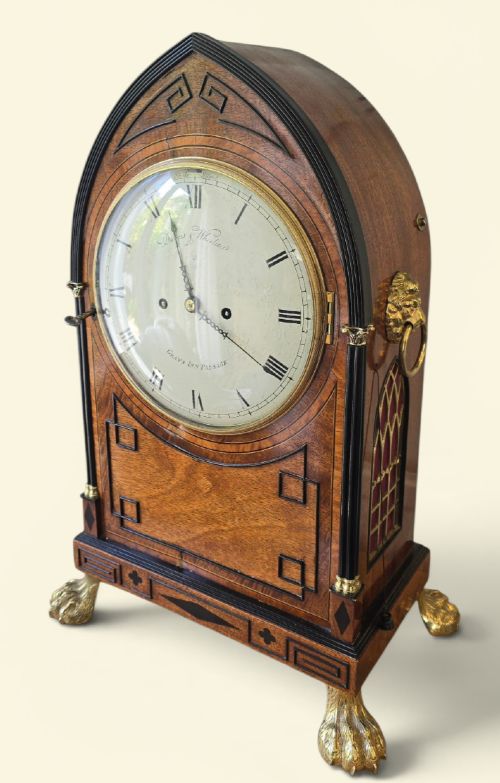


Regency Gothic Clock
A regency gothic clock brings together architectural Revival design and precision movement, capturing the serious architectural taste of the nineteenth century in mahogany, rosewood, and brass.
Regency Gothic Clock
The most striking versions display Gothic Revival architectural details housed within rich mahogany, flame mahogany, or rosewood cases.
These timepieces range from tall grandfather clocks to mantel and bracket formats featuring painted iron dials and glass bezels.
Materials and construction
Cabinetmakers constructed the architectural cases using dense timbers like mahogany, flame mahogany, and rosewood, frequently incorporating precise brass inlay.
Clockmakers fitted these housings with complex mechanical movements, employing enamel and painted iron for the legible dials visible behind glass panels.
Regency Gothic Clock Retail Price Guide 2026
Typical asking prices for regency gothic clock among the pieces listed under this phrase on Sellingantiques today, from the lower quarter to the upper quarter. They describe what is for sale here now, not the wider market.
Some grandfather clocks feature a rocking seesaw mechanism, adding unexpected movement to the traditional tall case.
Judging quality
Quality rests upon the crispness of the Gothic Revival architectural carving and the selection of figured timbers like flame mahogany or rosewood.
The sophistication of the movement, particularly quarter-striking mechanisms by known London or provincial makers, elevates an example above standard production.
George Orpwood·Desbois & Wheeler·William Moon London·Cording of London·Wilkinson Leicester·Wightman Of London·Garman Meonstoke·Ganthony of London·Perigal Bond Street·Mitchell & Russell
The Regency Gothic Clock Glossary
- Bracket clock
- A portable clock originally designed to sit on a wall bracket or table. These spring-driven pieces often feature brass carrying handles.
- Longcase clock
- A tall pendulum clock housed in a wooden case standing directly on the floor. They are also known historically as grandfather clocks.
- Fusee
- A conical pulley used in spring-driven clocks to maintain equal power as the mainspring unwinds. This mechanism ensures consistent timekeeping.
- Lancet top
- An architectural case shape featuring a pointed arched top reminiscent of Gothic ecclesiastical windows. It appears frequently on mantel and bracket clocks.
- Quarter striking
- A complex movement train that chimes the quarter hours on bells or gongs. Such mechanisms require skilled assembly by master clockmakers.
Regency Gothic Clock: Frequently Asked Questions
What is a regency gothic clock?
A regency gothic clock is a timepiece from the early nineteenth century that combines traditional mechanical movements with Gothic Revival architectural styling. These pieces utilise pointed arches, lancet tops, and rich cabinet timbers.
They appear as both large floor-standing longcase clocks and smaller bracket or mantel formats designed for tabletops.
How do I wind my bracket clock?
Most bracket and mantel clocks utilise a key-wind mechanism operating through small holes on the dial face. Care must be taken not to overwind the mainspring.
Consult the specific movement instructions before adjusting the hands, particularly on quarter-striking models.
Where should I place a longcase clock?
A longcase clock requires a stable, level floor against a secure interior wall to keep the pendulum swinging evenly. Avoid areas subject to direct sunlight or damp conditions.
Placing the piece away from heavy foot traffic helps protect the tall wooden case from accidental knocks.
How do I identify the period?
Dating relies on examining the case timbers, dial construction, and stylistic markers such as Regency Gothic Revival proportions. Mahogany, rosewood, and brass inlay point directly to nineteenth-century production.
Inscribed signatures on the painted iron or enamel dials often name the original maker and working location.