
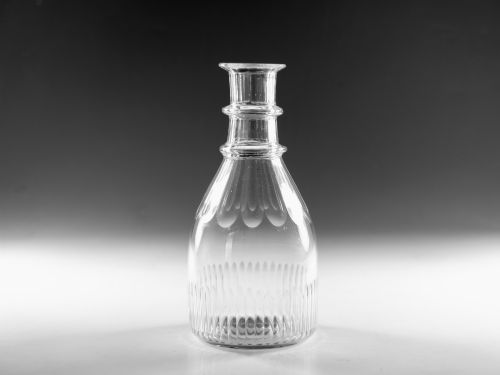
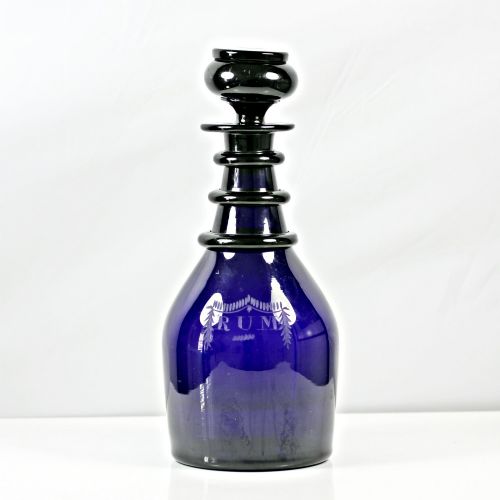
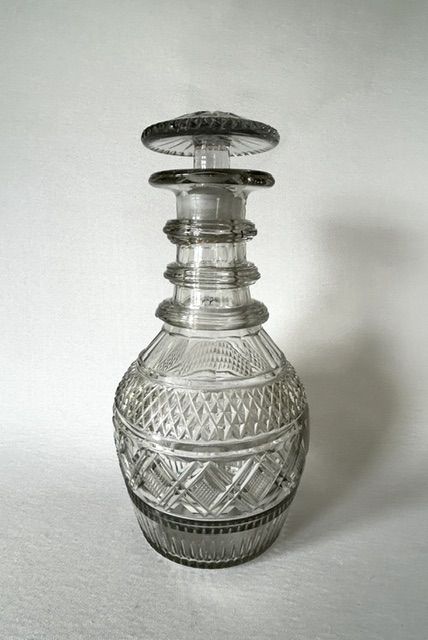


Regency Glass Carafe
A regency glass carafe brings weighty lead crystal and brilliant hand-cutting to the table, offering a glimpse into early nineteenth-century dining elegance.
Regency Glass Carafe
When you search for a regency glass carafe, you encounter robust serving vessels designed for wine, spirits, and water during the Georgian and Regency periods. The forms range from three-ring decanters and ship's decanters to heavy pillar-cut cylinders and mell decanters.
The versions most commonly met on this page date from around eighteen hundred to eighteen thirty, encompassing both English and Irish production. These pieces often arrive as pairs or single bottles, featuring distinct neck rings and broad bases designed for stability on dining tables.
Materials and manufacture
These vessels are fashioned from lead crystal and heavy lead glass, which provided the necessary weight and clarity for deep geometric cutting. Craftsmen utilised techniques such as pillar cutting and flute cutting to catch the candlelight on polished surfaces.
Decoration extends beyond cutting into coloured glass variants, including Bristol blue and amethyst glass, occasionally enhanced with gold leaf and hand-painted enamel details. This combination of rich hues and reflective facets defines the material character of the period.
Some ship's decanters possess bases so broad they look like tiny glass pyramids ready to weather any storm.
Distinctions in quality
Quality rests upon the crispness of the cut glass facets and the depth of the metal in the lead crystal. Superior examples display sharp, well-defined rims and carefully finished pontil marks on the base.
The presence of rich coloured glass, such as Bristol blue or amethyst, combined with gilt and enamel work, elevates a piece. Furthermore, matching pairs demonstrate a higher level of original workshop output than individual surviving bottles.
The Regency Glass Carafe Glossary
- Lead crystal
- Heavy, high-clarity glass containing lead oxide, which increases the material's refractive index and weight. This composition allowed makers to cut deep, brilliant patterns into the surface.
- Mell decanter
- A mallet-shaped serving bottle with a tapered body and short neck, popular during the Georgian era. These vessels sat securely on sideboard trays.
- Ship's decanter
- A bottle featuring a wide, conical base that prevented tipping aboard a rolling vessel at sea. The low centre of gravity made them practical for maritime dining.
- Pontil mark
- A rough scar left on the base of blown glass where the pontil rod was snapped off after shaping. Its presence indicates traditional hand-blown manufacturing methods.
- Ring decanter
- A serving bottle featuring applied horizontal glass rings around the neck to aid grip when pouring. These rings were typically numbering two or three.
Regency Glass Carafe: Frequently Asked Questions
How do I identify a Regency period piece?
Look for characteristic design markers such as three neck rings, heavy lead crystal weight, and distinct geometric cutting styles typical of the early nineteenth century.
Compare the proportions and manufacturing traits against documented examples from the Georgian and Regency eras to confirm the timeframe.
Were these used for wine or water?
They served multiple functions on the dining table, holding wine, spirits, and water depending on the specific form and capacity of the vessel.
Mell shapes often held whiskey or spirits, while three-ring decanters commonly managed wine service during formal meals.
Why do some decanters have coloured glass?
Coloured glass variations like Bristol blue and amethyst were produced to protect sensitive contents from light and to add vibrant decoration to the dining table.
These coloured vessels were frequently enhanced with gilding or enamel painting for wealthier households.
How should I clean an antique decanter?
Gentle washing with warm water and specialised cleaning beads helps remove internal residue without scratching the delicate historic lead glass.
Avoid sudden temperature changes to protect the material from thermal shock and preserve the clarity of the crystal.