
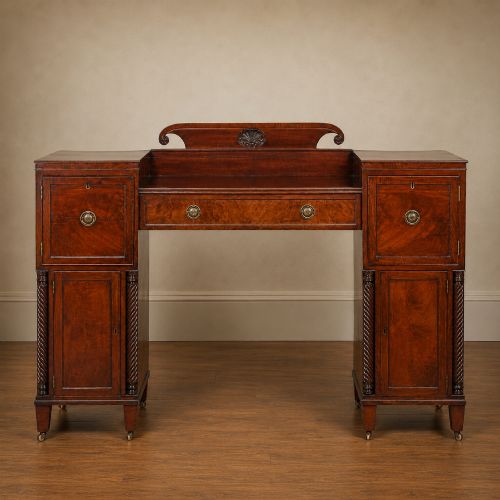


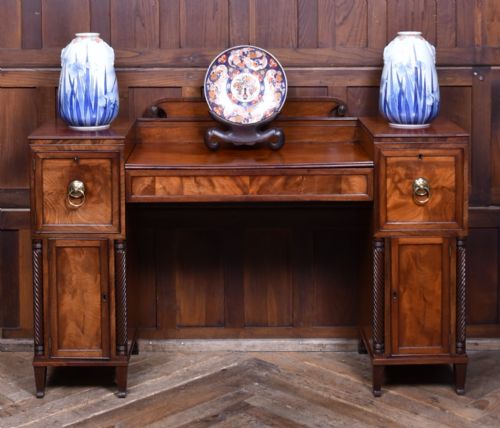


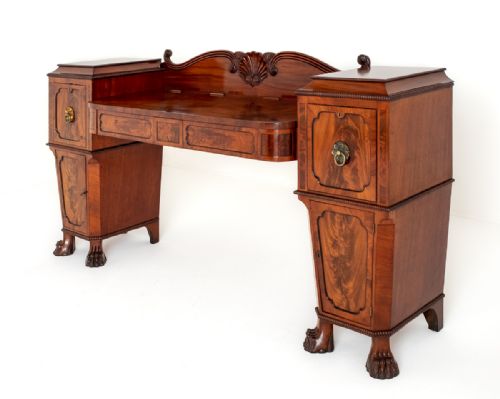


Regency Carved Pedestal Sideboard
These regency carved pedestal sideboard pieces bring grand proportion and heavy timber presence to a formal dining room.
Regency Carved Pedestal Sideboard
A regency carved pedestal sideboard comprises a long central top or board flanked by upright cabinets, sitting within the Regency, William IV and Late Georgian periods. These substantial dining room pieces serve as servers and storage units, often displaying carved wooden details.
The version most commonly met on this page uses figured mahogany or flame mahogany veneer, arranged with distinct pedestals at either end. Makers working in the manner of established cabinet makers constructed these items to anchor large reception and dining spaces.
Materials and construction methods
Cabinet makers utilised solid mahogany and applied flame mahogany veneer to large carcases, achieving dramatic grain patterns across the front surfaces. Wood inlay and brass fittings punctuate the dense timber construction.
Structural elements rely on heavy joining techniques, incorporating breakfront layouts and drop well configurations within the pedestals. Carved wooden ornamentation defines the stylistic output of the early nineteenth century workshops.
A drop well lets your roast beef rest comfortably while the gravy stays out of sight.
Factors that distinguish quality
The depth and sharpness of the carved work determine the level of craftsmanship, distinguishing standard production from pieces with sculptural ambition. Figured timber selection dictates visual richness, where bookmatched flame veneers display superior surface movement.
Proportion and scale dictate the success of the composition, with balanced pedestal cabinets aligning harmoniously with the central serving surface. Maker attribution or stamps elevate the standing of a specific example.
John Gregory London·James Mein of Kelso·Holland and Sons
The Regency Carved Pedestal Sideboard Glossary
- Pedestal sideboard
- A large dining room furnishing featuring two flanking cupboards or columns connected by a central board or table. This form provides substantial storage and serving space.
- Flame mahogany veneer
- A thin slice of timber cut from the fork of a mahogany tree to reveal a flickering, flame-like grain pattern. Cabinet makers applied this to prominent door and drawer fronts.
- Breakfront
- A cabinet facade where the central section projects forward from the flanking pedestals. This architectural arrangement creates depth and shadow.
- Drop well
- A lowered central section within the top surface of a serving table or sideboard. This feature accommodated large mixing bowls and serving dishes.
Regency Carved Pedestal Sideboard: Frequently Asked Questions
How do I clean a mahogany pedestal sideboard?
Dust regularly with a soft, dry cloth to prevent particulate buildup on the carved surfaces. Apply a quality beeswax periodically to nourish the timber and maintain the polish of the veneer.
Avoid placing these items in direct sunlight or near heat sources to prevent the mahogany from splitting. Proper humidity control protects both the solid wood and the applied veneers.
What is the difference between Regency and William IV sideboards?
Regency pieces typically display classical restraint, incorporating delicate brass inlay, reeding, and slender proportions. Cabinet makers drew inspiration from ancient Greek and Roman designs.
William IV examples generally exhibit heavier, more robust carving, bolder scrolls, and denser solid mahogany construction. The scale tends to be monumental, reflecting the tastes of the 1830s and 1840s.
Where were these sideboards used in a house?
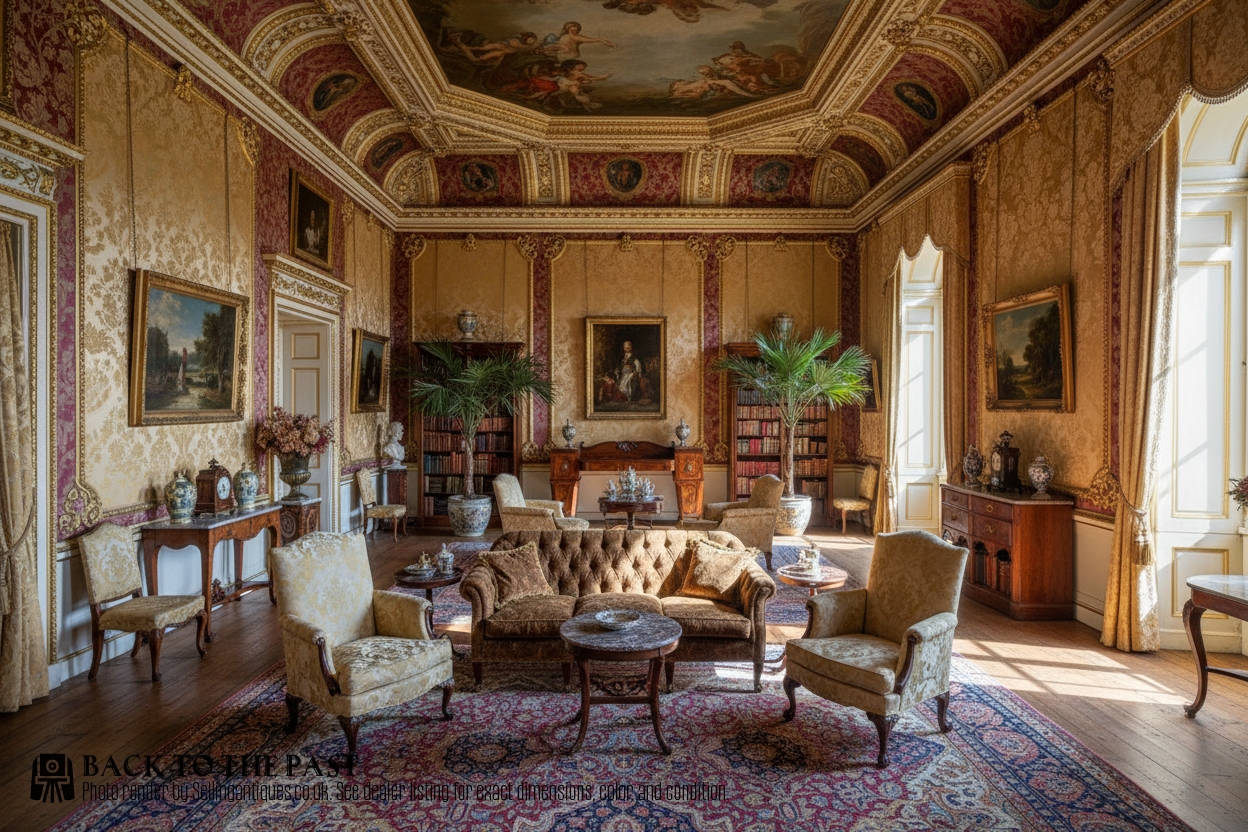
These large serving tables stood principally in formal dining rooms and country house reception spaces. They functioned as staging areas for heavy silver, serving dishes, and wine decanters during large meals.
The flanking pedestal cabinets provided concealed storage for cutlery, linens, and bottles. This layout kept the dining table clear while allowing servants to manage service efficiently.
How can I tell if the veneer is original?
Examine the grain continuity and the uniformity of the timber ageing across the entire facade. Original flame mahogany veneers show subtle shrinkage lines and a soft, oxidized patina.
Replacements or repairs often display modern adhesives under magnification and a mismatch in timber colour or figure. Hand-cut veneer thickness varies slightly across nineteenth-century panels.