
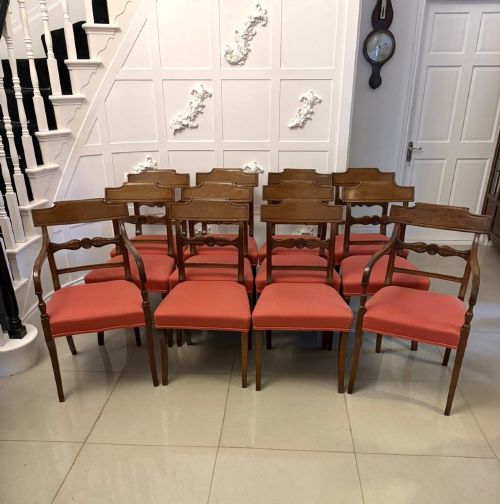
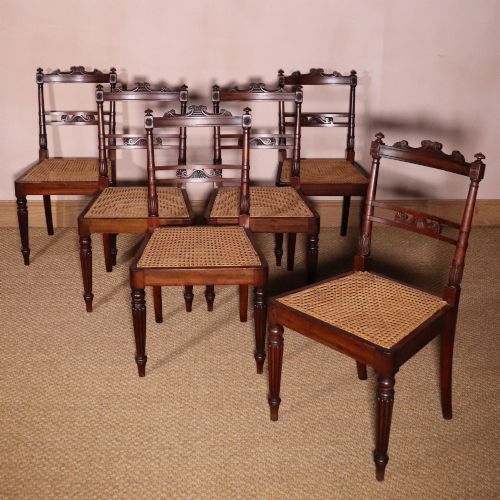
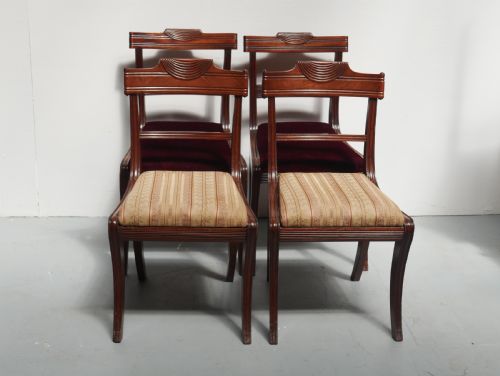


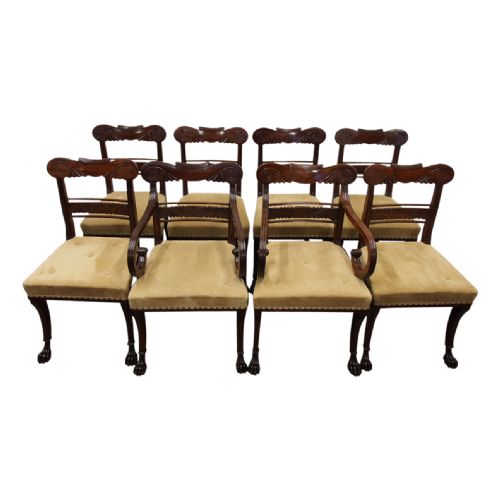


Regency Carved Crest Rail Chairs
Regency carved crest rail chairs bring architectural lines and rich timber into a room, offering structured seating shaped by early nineteenth-century design.
Regency Carved Crest Rail Chairs
Regency carved crest rail chairs encompass seating from the Regency period alongside later nineteenth-century interpretations and twentieth-century revivals. These pieces combine classic proportion with shaped top rails, appearing frequently as sets of dining chairs or smaller groups of side chairs and carvers.
Buyers encounter forms ranging from formal dining chairs in mahogany and rosewood to lighter designs utilising simulated rosewood finishes. The selection spans straightforward side chairs, open armchairs, and occasional klismos forms fitted with cane or upholstered seats.
How they were made
Cabinetmakers constructed these frames primarily in solid timber, selecting mahogany, rosewood, oak, and gonçalo alves for their grain and strength. Workshops often applied faux finishes to alternative woods to imitate exotic rosewood, achieving a uniform decorative surface.
Decoration relied on precise carving along the crest rail and occasional brass inlay set directly into the timber. Seats utilised traditional methods, integrating drop-in frames covered in fabric, leather, velvet, or woven cane alongside bergere panels.
Periods represented span from the early Regency era through the nineteenth century into twentieth-century revivals.
What varies in quality
Quality rests upon the crispness of the carved crest rail and the integration of the timber grain across each set. Uniformity within a larger set distinguishes high workshop production from assembled groups.
The choice of primary wood and secondary framing timber dictates the durability and visual depth of the piece. Subtle details such as inlaid brass work and retained original simulated finishes elevate the character of the design.
The Regency Carved Crest Rail Chairs Glossary
- Crest rail
- The top horizontal member of a chair back, frequently shaped or carved in Regency designs. It provides the primary visual focal point when the chairs are arranged around a table.
- Klismos
- An ancient Greek chair form revived during the Regency period, characterised by concave curved legs and a sweeping backrest. This design offers a low, ergonomic profile.
- Carver
- An armchair designed to match a set of dining side chairs, usually placed at the head of the table. These incorporate supportive arms that flow directly from the back uprights.
- Bergere
- An enclosed upholstered armchair featuring woven cane panels on the sides and back. It provides a lighter alternative to fully padded upholstery.
Regency Carved Crest Rail Chairs: Frequently Asked Questions
How do I spot a true Regency chair?
Examine the timber selection, construction methods, and the specific shaping of the crest rail. True period pieces display the characteristic weight and grain of early nineteenth-century cabinetmaking.
Compare the proportions against documented examples from the era. Details like brass inlay or simulated rosewood finishes help confirm the period aesthetic.
Can I mix different chair sets?
Mixing chairs requires careful attention to seat height, timber tone, and stylistic period. Matching carvers with side chairs from similar nineteenth-century traditions creates a cohesive dining arrangement.
Ensure the scale of the crest rails complements the surrounding furniture. Subtle differences in wood grain add character when the overall forms align.
How should I care for cane seats?
Keep cane seats away from direct heat sources and excessive moisture to prevent the natural material from becoming brittle. Regular dusting with a soft brush maintains the weave.
Occasional light dampening of the underside can help preserve flexibility in older cane. Avoid placing heavy, sharp objects directly on the woven surface.
What is simulated rosewood?
Simulated or faux rosewood is a decorative painted finish applied to a more common timber base to mimic the grain and colour of genuine rosewood. Artisans used this technique during the Regency era to achieve an exotic look economically.
This finish requires gentle cleaning to protect the painted surface from wear. It represents a deliberate stylistic choice characteristic of early nineteenth-century workshops.