
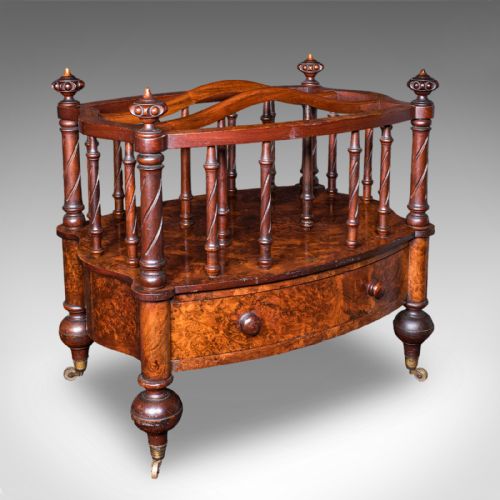


Regency Carved Canterbury Rack
A regency carved canterbury rack brings architectural elegance and tidy organisation to a room, holding newspapers, magazines, and sheet music with understated grace.
Regency Carved Canterbury Rack
A regency carved canterbury rack is a low, compartmentalised stand designed for holding periodicals, music sheets, and newspapers. The pieces seen here span the Regency, William IV, George IV, and broader nineteenth-century periods, alongside Georgian and later interpretations.
Most examples appear in rosewood or mahogany, with occasional variations in burr walnut, walnut, Cuban mahogany, and painted wood. Forms range from dedicated magazine racks and newspaper stands to combined music stands and multi-tier storage cabinets.
Origins trace primarily to English workshops and country houses, embodying the refined utility demanded by period interiors. Buyers encounter both compact reading stands and large exhibition pieces tailored for domestic convenience.
Materials and Construction
Cabinetmakers utilised dense timbers such as mahogany and rosewood to construct the slatted partitions and supporting frames. These woods provided the necessary structural strength for holding heavy folios and bound volumes upright.
Carving and turning shaped the upright pillars, carrying handles, and feet, frequently incorporating decorative motifs like Prince of Wales feathers or wreath carvings. Brass castors often permitted smooth movement across carpeted drawing room floors.
Formats on offer include dedicated newspaper racks, sheet music stands, and combined magazine storage cabinets.
Distinctions in Quality
The choice of timber underpins the hierarchy of these stands, with richly figured rosewood and Cuban mahogany representing the upper tier. Selection of dense, highly grained veneers and solid hardwoods elevates an example above plain utility pieces.
Refinement in the carving work dictates the distinction between standard production and master craftsmanship. Crisp detailing on pierced slats, turned spindles, and applied decorative elements reflects the skill invested by the maker.
Gillows of Lancaster·J C Loudon
The Regency Carved Canterbury Rack Glossary
- Canterbury
- A low stand with vertical partitions designed to hold music sheets, newspapers, and magazines. The form originated around the late eighteenth century and persisted through the Victorian era.
- Rosewood
- A heavy, dense timber valued for its dark purple-brown hue and distinctive grain patterns. Cabinetmakers favoured it for high-status furniture during the Regency and William IV periods.
- Cuban Mahogany
- A dense, dark variety of mahogany exported from the Caribbean, prized for its stability and rich lustre. It was frequently used in superior English cabinetmaking.
- Castor
- A small wheel fitted to the legs of furniture to facilitate easy movement. Brass mountings with ceramic or metal rollers appear commonly on period stands.
- Foliage Carving
- Decorative sculptural work shaped to resemble leaves, scrolls, or natural motifs. It adds tactile depth to the structural uprights of fine stands.
Regency Carved Canterbury Rack: Frequently Asked Questions
What were canterbury racks used for originally?
These stands served as portable storage for sheet music, daily newspapers, and periodicals in the drawing room or study. They kept reading materials organised and within reach of seating areas.
Over time, their role expanded to accommodate folio volumes and writing papers, functioning as both practical furniture and decorative display pieces.
How do I date a regency canterbury?
Dating relies upon timber selection, hardware, and stylistic motifs characteristic of the early nineteenth century. Rosewood and figured mahogany dominate pieces from this era, often accompanied by brass castors.
Carved details such as wreath motifs or Prince of Wales feathers align with Regency and William IV design vocabularies. Comparing construction methods with documented workshop practices helps narrow the decade.
Are these stands suitable for modern magazines?
Most period compartments easily accommodate contemporary periodicals, newspapers, and standard paperbacks. The slatted vertical dividers keep softcover publications upright and visible.
Care should be taken with oversized or exceptionally heavy modern folios to avoid placing undue strain on delicate nineteenth-century wooden partitions.
How do I care for rosewood and mahogany?
Maintain the timber by keeping the stand away from direct sunlight and abrupt changes in ambient temperature. Occasional dusting with a soft, dry cloth preserves the natural polish of the wood.
Avoid liquid furniture polishes containing silicone, which can penetrate porous historic finishes and attract dust over time.