
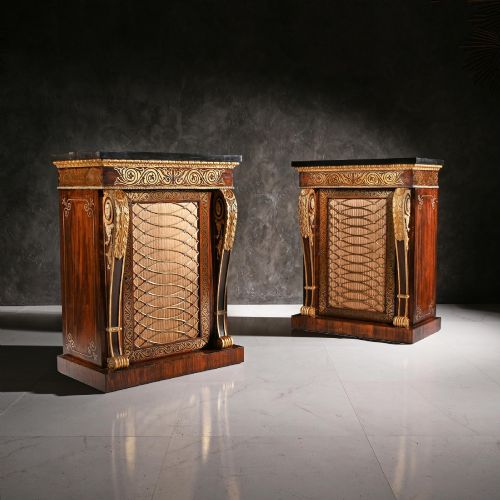


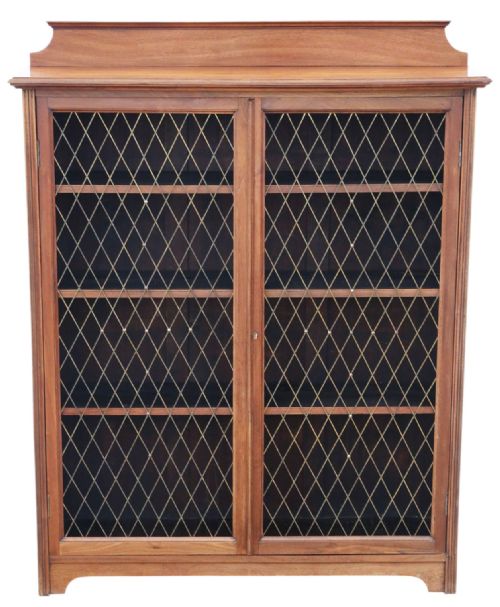

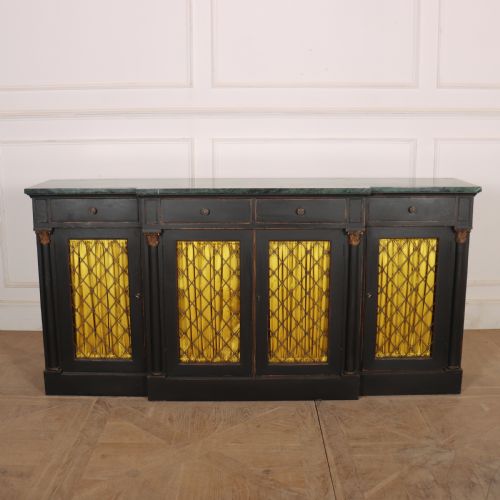


Regency Brass Mesh Cupboard
A regency brass mesh cupboard brings architectural order and refined metalwork into a room.
Regency Brass Mesh Cupboard
A regency brass mesh cupboard encompasses side cabinets, chiffoniers, bookcases, and wardrobes spanning the Regency, Victorian, and Edwardian eras. These storage pieces combine timber frames with woven metal panels to display or conceal contents while introducing classic proportions.
How they were made
Cabinetmakers constructed these forms using dense hardwoods like rosewood and mahogany, frequently incorporating satinwood veneers and fine brass inlays to accent the surfaces. Fine wire mesh was secured into door frames to allow ventilation while protecting the contents within.
Makers utilised traditional joinery techniques suited to the periods, integrating marble tops, adjustable display shelves, and glass panels where appropriate. The execution balances structural timber frames with delicate metalwork details.
The listings span multiple centuries, uniting Regency, Victorian, and Edwardian cabinet forms in rosewood, mahogany, walnut, and satinwood.
What varies in quality
Quality rests upon the crispness of the brass inlay, the selection and matching of wood veneers, and the integrity of the joinery across the cabinet carcass. Finer examples display meticulous attention to proportion, balanced grain patterns, and carefully woven mesh panels.
Attribution to notable makers or adherence to specific design idioms such as Egyptian revival elevates an individual piece above standard utility furniture. The harmony between timber selection and metal embellishment dictates the overall standard.
Louis Constantin Le Gaigneur
The Regency Brass Mesh Cupboard Glossary
- Regency
- A stylistic period spanning the early nineteenth century, characterised by neoclassical symmetry, ancient Greek and Roman influences, and sharp architectural lines.
- Chiffonier
- A low cabinet or sideboard featuring shelves, drawers, or doors, popular during the nineteenth century for dining and drawing rooms.
- Satinwood
- A lustrous, yellow-toned timber used extensively for decorative veneers and fine stringing on cabinet doors and tabletops.
- Egyptian Revival
- A nineteenth-century design movement incorporating motifs and decorative vocabulary derived from ancient Egyptian art and architecture.
- Breakfront
- A cabinet design where the central section projects forward from the flanking outer sections, creating depth and visual rhythm.
Regency Brass Mesh Cupboard: Frequently Asked Questions
What rooms suit a side cabinet?
These cabinets function effectively in dining rooms, libraries, and hallways where refined storage is required. Their proportions allow them to sit neatly against walls while holding books, glassware, or linens.
The inclusion of brass mesh or glass doors makes them particularly useful for displaying collections while keeping dust at bay.
How do I identify a Regency piece?
Regency furniture typically displays classical architectural proportions, restrained ornamentation, and symmetrical wood grains. Look for geometric brass inlays and specific revival motifs.
Construction methods, such as hand-cut dovetails and traditional timber preparation, also help confirm the period of manufacture.
What is Egyptian revival style?
Egyptian revival is a design movement that draws upon the iconography and architectural forms of ancient Egypt. It frequently appears alongside neoclassical details in nineteenth-century British cabinetmaking.
Porter chairs, cabinets, and tables from this movement exhibit distinctive ornamentation that sets them apart from standard Regency designs.
Are shelves adjustable in older cabinets?
Many nineteenth-century bookcases and cabinets feature adjustable display shelves supported by wooden ratchets or metal pins. This adaptability allowed owners to alter the interior layout for different book sizes or display items.
Examining the interior uprights reveals whether the shelving system is original to the piece.