


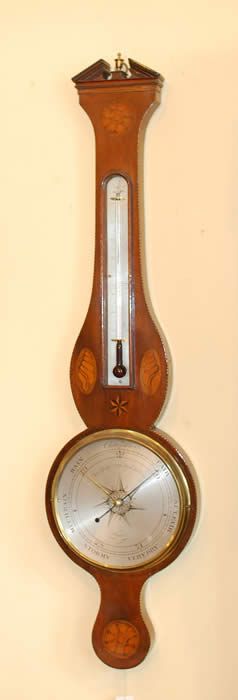


Regency Banjo Barometer
A regency banjo barometer is a domestic weather gauge built during the early nineteenth century, prized for its distinctive shaped case and silvered dial.
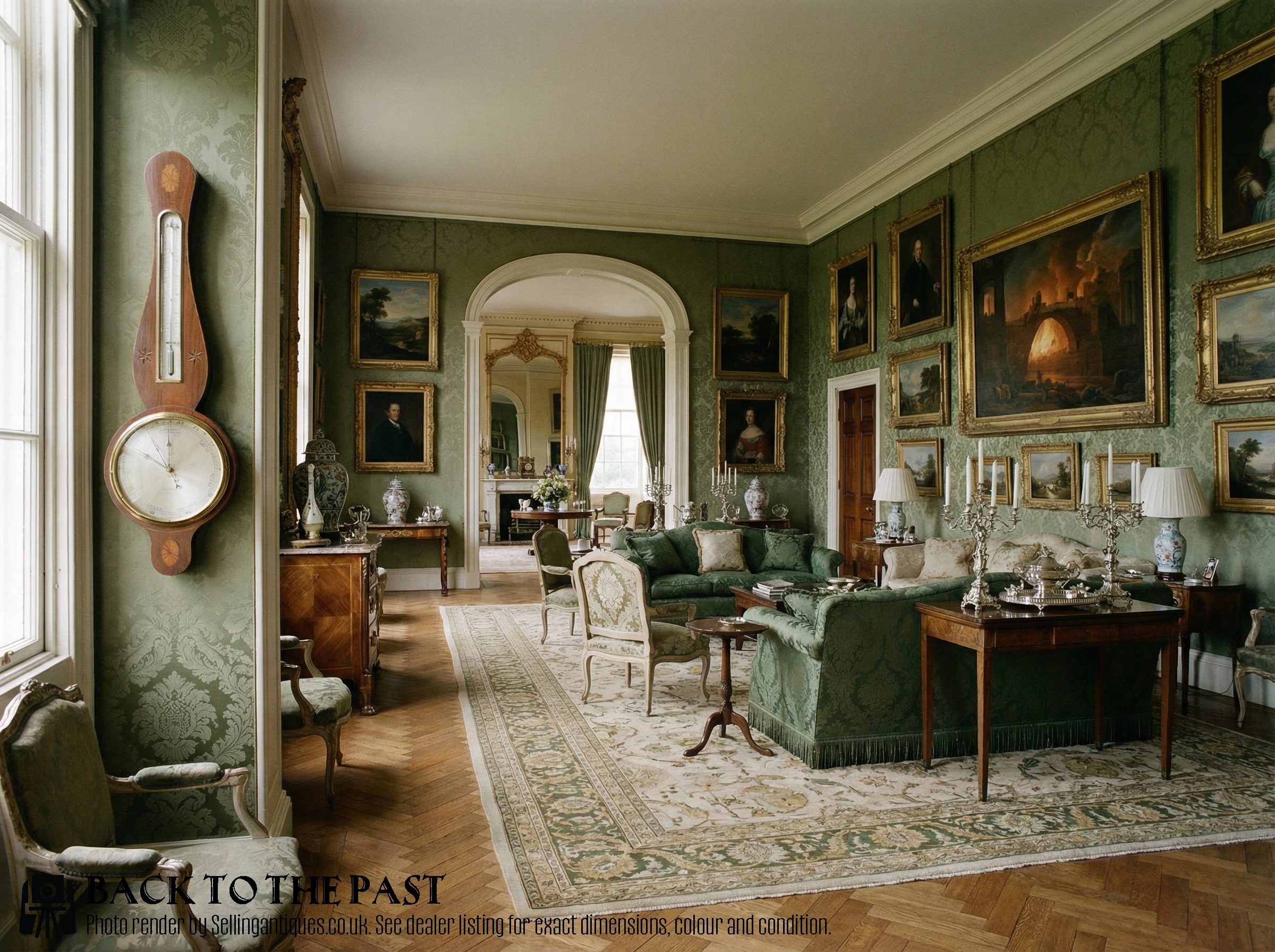
Regency Banjo Barometer
A regency banjo barometer takes its name from its characteristic long-necked, bulbous-bottomed timber profile that resembles the musical instrument. These domestic weather instruments record atmospheric pressure changes using internal mercury columns.
The versions appearing here originate predominantly from the nineteenth century, including Georgian and Regency periods. Most examples present tall wooden bodies designed to hang upon a wall in a principal room.
Makers often integrated secondary instruments into the main body, pairing the primary barometer dial with hygrometers, thermometers, or spirit levels. Surviving pieces display the work of regional English makers as well as London firms.
Materials and construction
Cases rely heavily on dense hardwoods like mahogany and rosewood, frequently enhanced by contrasting veneers including satinwood, boxwood, and birdseye maple. Flame mahogany variations exhibit highly figured grain patterns across the front panel.
Dial faces utilise silvered metal engraved with weather descriptors and barometric scales, protected behind convex glass set within cast brass bezels. Many incorporate delicate brass or silvered indicators operated by ivory adjustment knobs.
Regency Banjo Barometer Retail Price Guide 2026
Typical asking prices for regency banjo barometer among the pieces listed under this phrase on Sellingantiques today, from the lower quarter to the upper quarter. They describe what is for sale here now, not the wider market.
Several examples include a dampness dial at the top, ensuring homeowners could worry about the weather indoors as well as out.
Assessing quality and execution
Quality separates simple utility pieces from ambitious parlour instruments through the selection of timber veneers and the intricacy of stringing. Edge inlays using boxwood or ebony require precise carpentry to follow the curved shoulders of the case.
The engraving on the silvered metal dial dictates the visual standard of the instrument, where crisp lettering and detailed floral or geometric motifs reflect skilled handwork. Maker signatures etched into the metal elevate the historical interest of the piece.
Ganthony of London·Molton of Norwich·L Casatelli of Liverpool·Roncoroni·H Marks·Vecchio and Co·A Rivolta·Bassi·J C Moretti·F Salteri and Co·Dominic Gatty·Russell of Liverpool·L Malacrida·George Dollond·Schiavi of Chesham·C Bellatti·Vaughan of Newport
The Regency Banjo Barometer Glossary
- Wheel barometer
- An instrument that translates vertical mercury movement into rotational pointer movement via a pulley and weight system. This mechanical arrangement permits a large circular dial to display pressure readings clearly.
- Silvered metal
- A brass or copper plate treated with a silver solution to create a bright, matte finish suitable for engraving scales. It forms the readable face behind the glass bezel.
- Flame mahogany
- Timber cut from the fork of the mahogany tree to produce a dramatic, flickering grain pattern. Cabinetmakers reserved this prized veneer for the prominent surfaces of superior cases.
- Hygrometer
- A secondary dial measuring atmospheric humidity, frequently mounted in the upper neck of the instrument. It works alongside the main barometer dial to provide a complete weather record.
Regency Banjo Barometer: Frequently Asked Questions
How do these barometers work?
Inside the wooden case, a sealed glass tube containing mercury rises and falls with shifting atmospheric pressure.
A fine silk thread and pulley connect the mercury column to a mechanical pointer on the front dial, translating the fluid movement into a visible reading.
Where should I hang my barometer?
These instruments suit principal reception rooms or hallways where interior temperature remains relatively stable.
Avoid placing them in direct sunlight or near active heat sources that might affect the internal mercury and timber case.
How do I identify the period?
Period markers include the choice of timber, the style of dial engraving, and the presence of specific maker signatures.
Early nineteenth-century examples often feature figured mahogany veneers, boxwood stringing, and hand-engraved silvered metal dials.