

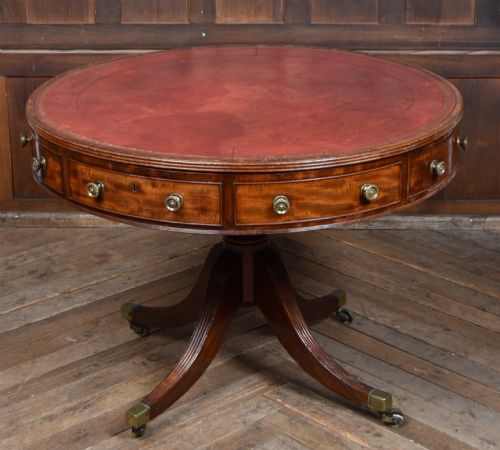
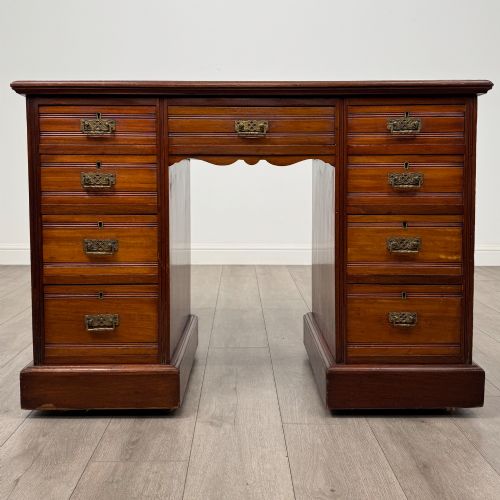


Reeded Pedestal Desk
A reeded pedestal desk is a substantial writing furniture piece offering fitted drawers and distinct linear carved detailing, built to anchor a serious study or library.
Reeded Pedestal Desk
When you search for a reeded pedestal desk, you are looking for functional workspace furniture defined by vertical carved moulding and sturdy cabinet supports, commonly encountered in walnut and mahogany timbers from periods spanning the Georgian era to the Edwardian decades.
The evidence on this page shows how desks, writing tables, and pedestal forms share design traits with library and drum tables, often featuring the characteristic reeded linear detail across varied forms such as partners desks and architects desks.
While the single archived piece specifically exhibits a three-part twin pedestal construction with crossbanded walnut and a tooled leather top, current listings demonstrate that similar classical proportions appear in pieces originating from the Regency and Victorian periods.
How they were made
Cabinet makers constructed these pieces primarily from solid and figured mahogany or walnut, frequently incorporating brass hardware such as swan neck handles and decorative columns.
Writing surfaces integrated inset leather tops, whilst structural edges utilised precise joinery and linear reeding carved directly into the timber framework.
Reeded Pedestal Desk Retail Price Guide 2026
Typical asking prices for reeded pedestal desk among the pieces listed under this phrase on Sellingantiques today, from the lower quarter to the upper quarter. They describe what is for sale here now, not the wider market.
Listings on this site feature mahogany and walnut timbers alongside brass, glass, and leather components across Regency, Victorian, and Edwardian periods.
What varies in quality
The distinction between standard utility items and finer examples lies in the selection of figured timber veneers, the crispness of the hand-carved reeding along plinths and edges, and the integration of secondary woods.
Superior construction is evident in the harmonious grain matching across multiple drawer tiers and the retention of original brass fittings rather than later replacements.
Gillow & Co.·Gillows of Lancaster and London·Holland & Sons·William Trotter
The Reeded Pedestal Desk Glossary
- Reeded
- A decorative moulding formed of parallel convex strips resembling bundled reeds. This linear carving frequently decorates the borders and legs of tables and desks.
- Pedestal desk
- A heavy writing table supported by two vertical banks of drawers rather than four separate legs. This form provides substantial storage beneath the main writing surface.
- Crossbanded
- A border technique where thin strips of veneer are laid across the grain of the primary wood panel. This method creates a decorative frame around drawer fronts or table tops.
- Partners desk
- A double-sided writing desk designed for two people to work opposite one another. These large pieces feature drawers and cupboards on both faces.
Reeded Pedestal Desk: Frequently Asked Questions
What is a reeded pedestal desk?
A reeded pedestal desk is a formal writing table featuring two supporting banks of drawers and decorative parallel carved moulding along the structural edges.
These pieces combine functional storage with classical cabinetwork derived from Georgian and Regency design traditions.
How do I care for the leather top?
Leather writing surfaces require gentle cleaning with a slightly damp cloth followed by appropriate leather dressings to prevent drying and cracking over time.
Avoid placing damp items or direct heat sources onto the leather to preserve the original tooled finish.
Where were these desks placed?
These desks were traditionally positioned within libraries, private studies, or administrative offices where a substantial writing surface was required.
Because many pedestal forms are finished on all sides, they could sit freely in the middle of a room rather than against a wall.
How do I identify the period?
Period identification relies on observing the combination of timber selection, structural proportions, and hardware styles associated with eras like Regency or Edwardian.
Details such as brass swan neck handles, canted edges, and specific veneer treatments help narrow down the date of manufacture.