
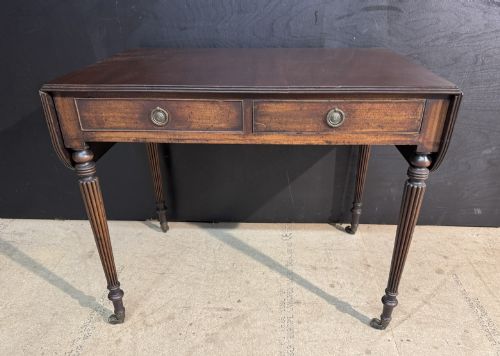
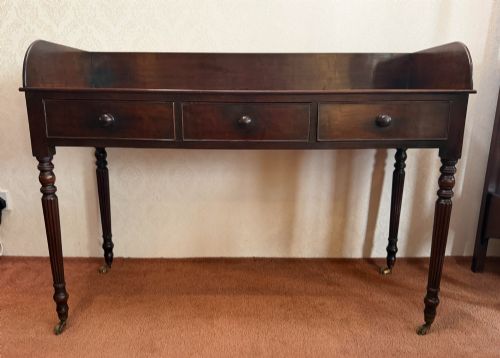
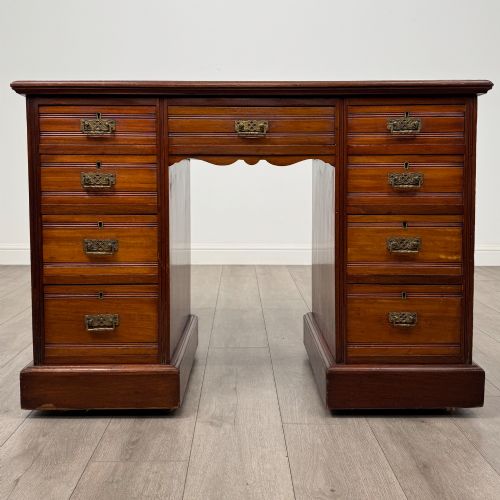
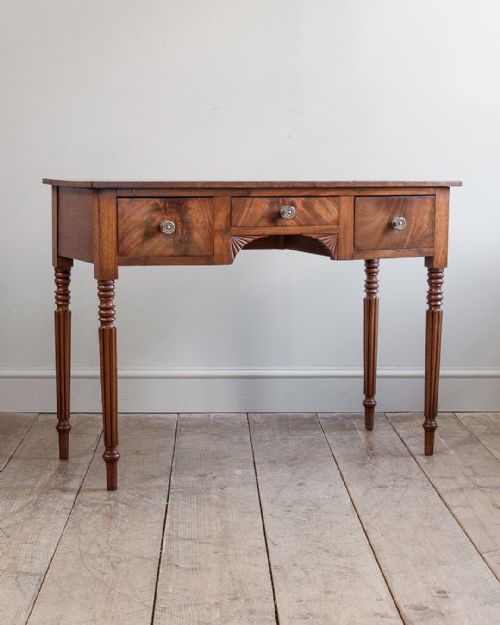




Reeded Drawer Desk
A reeded drawer desk brings together period timber and crisp linear carving, offering a functional writing surface rooted in Georgian, Regency, and Victorian craftsmanship.
Reeded Drawer Desk
A reeded drawer desk encompasses a variety of writing surfaces, side tables, and library tables found across this page, predominantly shaped during the Georgian, Regency, and Victorian periods.
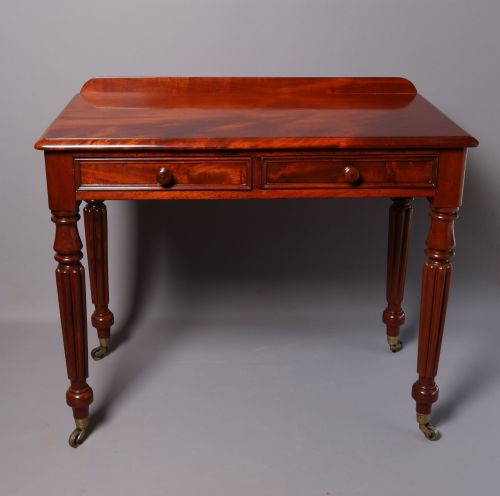
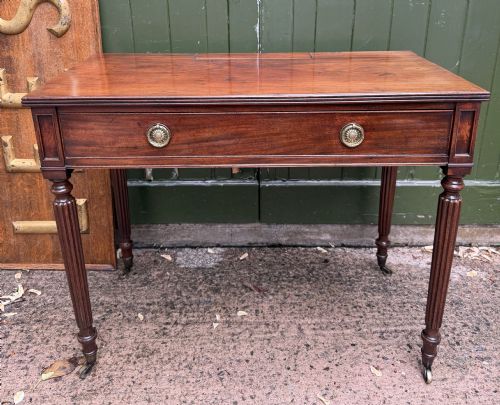
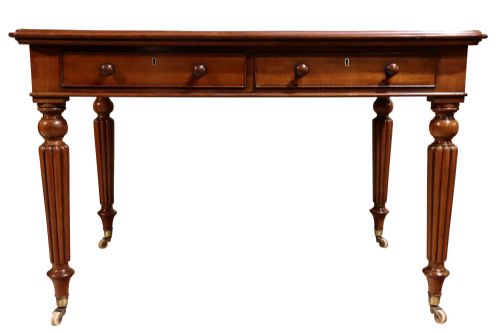
The pieces appearing here lean heavily toward mahogany forms, spanning compact chamber tables, twin pedestal library desks, and multipiece writing tables with integrated drawer space.
Buyers seeking a reeded drawer desk will primarily encounter nineteenth-century English craftsmanship, where functional storage meets linear ornamentation on legs, edges, and structural supports.
Assessing quality in the range
Quality rests in the precision of the timber selection, such as figured mahogany or crossbanded walnut, and the crispness of the linear reeding carved into the legs or supports.
Proportion and scale dictate the upper tier, where restrained proportions, harmonious drawer configurations, and matching brass hardware elevate a standard utilitarian table into a refined piece of furniture.
Some chamber tables hide a clever modesty behind their formal reeding, waiting quietly in a corner to hold a morning cup of tea.
Gillow & Co.·Gillows of Lancaster·Holland & Sons
The Reeded Drawer Desk Glossary
- Reeding
- Parallel convex mouldings carved closely together, resembling bundled plant stems. This decorative technique often appears on the legs and supports of tables and desks from the Georgian and Regency eras.
- Crossbanding
- A strip of veneer applied perpendicularly to the grain of the primary surface around the border of a drawer or top. It creates a contrasting visual frame.
- Pedestal desk
- A freestanding desk consisting of two smaller drawer pedestals supporting a large top. These often feature inset tooled leather writing surfaces.
- Pembroke table
- A small occasional or breakfast table with hinged drop leaves on two opposing sides. Many include a single functional drawer.
Reeded Drawer Desk: Frequently Asked Questions
What periods do these desks cover?
The listings span the Georgian, Regency, and Victorian eras, stretching from the late eighteenth century through the nineteenth century and into the Edwardian period.
Most pieces originate from the nineteenth century, showcasing transitional styles from George III and George IV designs into later Victorian interpretations.
How were these tables used originally?
These pieces served as writing tables, library desks, and chamber tables for correspondence and estate management. Larger library tables accommodated ledgers and open folios.
Smaller side tables and chamber tables functioned in private rooms or dressing areas, providing a stable surface and convenient drawer storage.
How do I care for the leather top?
Leather inserts benefit from gentle cleaning and occasional conditioning to maintain suppleness and prevent cracking over time. Keep moisture away from the surrounding timber.
Avoid harsh chemical cleaners on the tooled gilt borders to preserve the original decorative finish.
How do I distinguish Regency from Victorian pieces?
Regency pieces often display lighter timbers like satinwood or classical painted finishes, reflecting neoclassical influences of the early nineteenth century.
Victorian items tend toward heavier proportions and deeper mahogany tones, reflecting the industrial production methods and changing domestic tastes of the later era.