




Reeded Arm Armchair
A reeded arm armchair brings structural elegance and classic timber warmth to a room, offering both functional seating and crisp architectural lines.
Reeded Arm Armchair
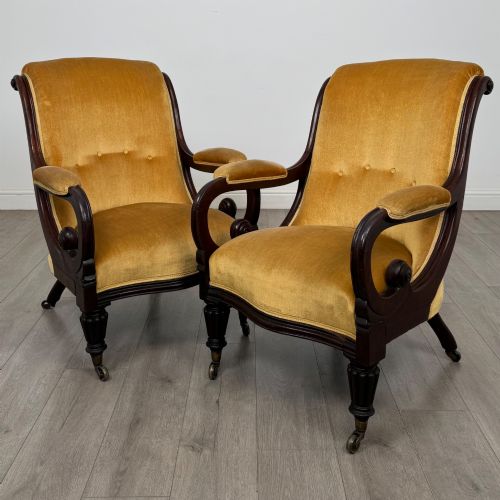
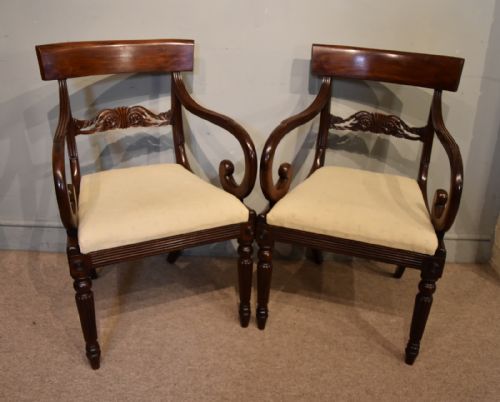
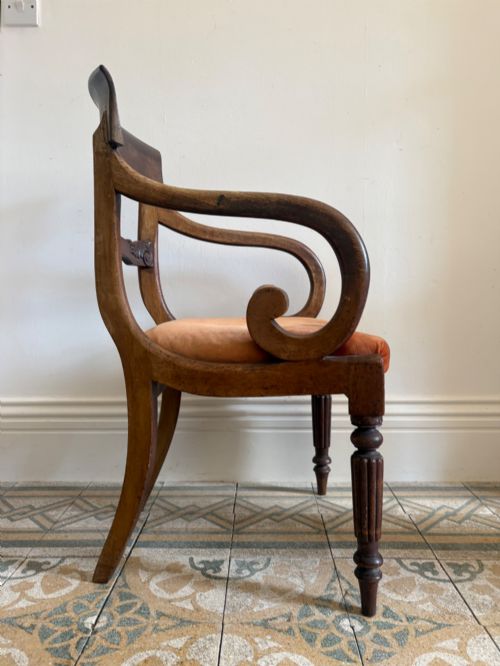
The defining characteristic across these examples is the linear carved reeding, which appears either along the structural arms or down the supporting legs. Most examples on this page date from the Regency era, featuring mahogany frames paired with drop-in seats or traditional upholstery.
Makers of the period adapted these chairs for various domestic spaces, from formal libraries to writing desks. You will encounter open armchairs alongside scroll armchairs and barrel back variants, all sharing the distinct reeded detail.
How they were made
Cabinetmakers constructed these frames using solid mahogany, shaping the timber by hand before applying meticulous parallel grooves known as reeding. This decorative carving required steady precision to maintain uniform depth and spacing along the curved or straight wooden members.
Upholstery methods varied according to the specific function of the armchair, utilising materials such as velvet, leather, corduroy, needlepoint, and tapestry. Drop-in seats offered practical versatility, while bergère and barrel back designs incorporated complex internal framing and supportive webbing.
Listings feature mahogany frames upholstered in velvet, leather, needlepoint, and tapestry across Regency, Georgian, and nineteenth-century periods.
What varies in quality
The refinement of the carved reeding largely distinguishes standard production from superior examples, with finer pieces exhibiting crisp, evenly spaced channels that catch the light cleanly. The quality of the underlying mahogany frame, particularly the tightness of the joinery and the selection of timber with rich graining, further elevates a piece.
Proportion and stance dictate the visual success of the armchair, where well-balanced scroll arms and graceful sabre or reeded legs create a harmonious silhouette. Original upholstery specifications and the retention of period components also contribute significantly to the overall integrity of the chair.
The Reeded Arm Armchair Glossary
- Reeding
- Parallel convex mouldings carved into timber to resemble a bundle of reeds or plant stems. This decorative technique creates texture and linear interest on arms and legs.
- Bergère
- An enclosed upholstered armchair featuring solid sides and a padded back, often utilising cane or fabric panels. These seats appeared frequently during the Regency period.
- Sabre leg
- A concave curved leg that tapers towards the foot, resembling the blade of a cavalry sabre. This form provides a distinct outward sweep characteristic of Regency seating.
- Drop-in seat
- A removable wooden frame upholstered separately and dropped into the seat rails of a chair. This construction method allows for straightforward reupholstering without altering the main frame.
- Carver chair
- An armchair designed with open sides to accommodate voluminous historical clothing, often used at the head of a dining table or at a desk.
Reeded Arm Armchair: Frequently Asked Questions
How do I date a reeded armchair?
Dating relies on observing the silhouette, leg form, and timber characteristics alongside stylistic markers from the Regency and Georgian eras. Sabre legs, scroll arms, and specific brass or wood turnings help establish the manufacturing period.
Comparing construction joints and upholstery foundations also provides insight into whether a piece belongs to the early nineteenth century or later revival periods.
Were these chairs used at desks?
Many examples function specifically as desk or library chairs, offering sturdy wooden arms and supportive backs for writing or reading. These pieces often feature compact proportions to fit neatly beneath traditional writing tables.
Desk variants frequently include drop-in seats covered in leather or velvet for comfortable extended use.
How should I care for mahogany frames?
Mahogany frames benefit from gentle dusting with a dry, soft cloth and occasional treatment with appropriate traditional wax polish to nourish the timber. Direct sunlight and sudden temperature shifts should be avoided to prevent the wood from drying out or splitting.
Maintaining stable indoor humidity preserves both the structural integrity of the joints and the finish of the carved reeding.