


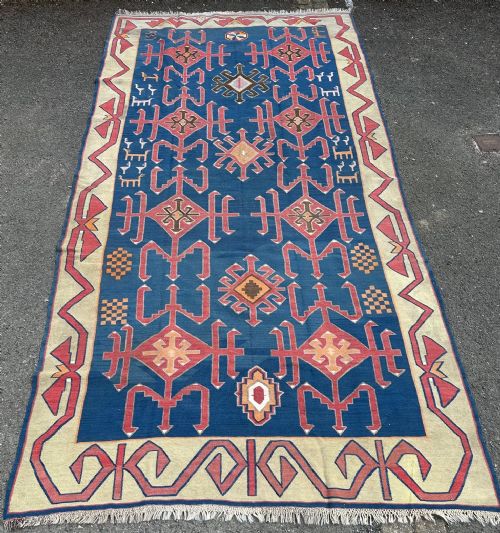


Red Kilim Runner
When choosing a red kilim runner, you are selecting a flat-woven textile created by tribal makers for domestic utility and floor coverage.
Red Kilim Runner
A red kilim runner brings together elongated formats and flat-woven structures originating from Persian, Anatolian, Caucasian, and Central Asian weaving traditions. These textiles span periods from the mid-nineteenth century through the mid-twentieth century, encompassing specific regional groups such as the Baluch, Qashqai, and Uzbek.
Buyers will encounter examples woven in single sections as well as larger pieces constructed from two or more joined strips, reflecting the practical limitations of nomadic looms. Materials remain strictly focused on wool, cotton, and hand-spun yarns coloured with natural dyes.
What varies in quality
Quality in these flat-weaves rests upon the tightness and regularity of the weave, which determines the crispness of the geometric design and structural longevity. Finer examples display meticulous handling of multi-strip assembly and well-balanced natural dye palettes that age gracefully.
The integrity of the long kilim ends and selvedges indicates the skill of the original weaver and the level of preservation over time. Pieces retaining clear regional tribal characteristics and distinct iconography command greater interest among collectors.
Materials documented across the inventory consist entirely of wool, cotton, hand-spun wool, and natural dyes.
The Red Kilim Runner Glossary
- Kilim
- A flat-woven carpet or rug produced without a pile by tightly interweaving the warp and weft strands. This technique results in a lightweight, reversible textile with characteristic slit openings between colour changes.
- Sofreh
- A utilitarian woven cloth traditionally used for spreading meals, kneading dough, or wrapping bread within nomadic and village households. These pieces often feature bold geometric bands and narrow formats.
- Soumak
- A brocading technique where decorative weft threads are wrapped around the warp yarns before being beaten down, creating a textured, braided surface on the face of the textile.
- Warp
- The stationary vertical threads stretched across a loom that form the foundational skeleton of the rug. Weft threads are passed horizontally through these warp yarns to create the pattern.
- Selvedge
- The reinforced side edges of a textile that prevent the weave from fraying or unravelling. In traditional tribal weaving, these edges receive secure overcasting with wool or goat hair.
Red Kilim Runner: Frequently Asked Questions
How were kilim runners used originally?
Nomadic and village communities utilised these flat-woven textiles as floor coverings in long tents or stone houses, as well as for wrapping provisions and horse blankets.
Their sturdy wool construction provided insulation against cold earthen floors while remaining lightweight enough for frequent relocation during seasonal migrations.
How do I care for a antique wool runner?
Maintenance requires gentle regular vacuuming without a rotating brush roll to protect the flat-woven structure and delicate kilim ends from damage.
Professional specialist cleaning is recommended when necessary to preserve the natural dye colours and prevent fibre degradation over decades of use.
Why are some runners woven in strips?
Nomadic portable looms possessed limited horizontal widths, restricting the size of a single woven piece.
To achieve wider or longer formats for domestic utility, weavers produced several narrower panels and skillfully joined them together down the length.
How can I tell regional styles apart?
Regional attribution relies on observing specific structural characteristics, colour palettes, and repeating geometric motifs unique to each tribal group.
For instance, Caucasian pieces often exhibit sharp, highly stylized polygons, whereas Persian tribal examples frequently display rich reds with banded or hooked field patterns.