
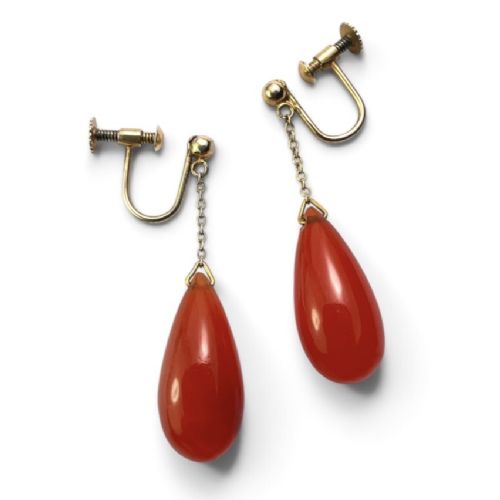


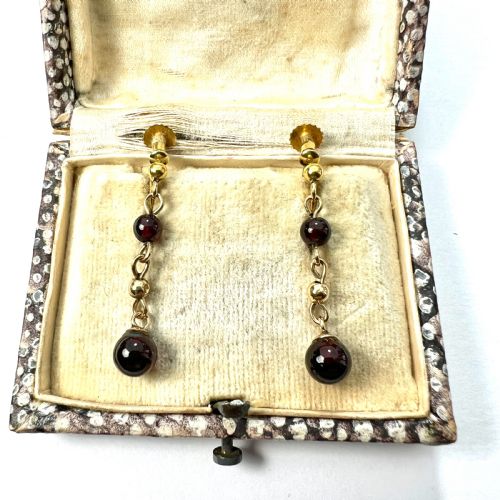

Red Gemstone Earrings
These red gemstone earrings bring rich colour and fine period character to the ear, spanning decades of goldwork from Victorian clusters to mid-century studs.
Red Gemstone Earrings
When you search for red gemstone earrings, you encounter a focused selection of pieces spanning the Victorian, Edwardian, and mid-twentieth-century periods. The forms range from delicate chain drops and intricate cluster designs to versatile daily studs.
Garnet dominates the selections, appearing in deep bohemian clusters, oval cuts, and bead configurations alongside ruby and red agate. Gold settings accompany these stones, utilising yellow, rose, and white gold across various purities.
Materials and construction
Goldsmiths constructed these pieces using 9ct, 14ct, 15ct, and 22ct gold, shaping metal into filigree wirework, clusters, and hinged screw-back or clip mechanisms. Gemstones including garnet, ruby, diamond, and seed pearl were secured in claw settings or dense cluster arrangements.
Makers paired rich red stones with supporting gems like white spinel and white zircon to create contrast. Metalwork techniques range from cast yellow gold to detailed Edwardian chain drops.
Red Gemstone Earrings Retail Price Guide 2026
Typical asking prices for red gemstone earrings among the pieces listed under this phrase on Sellingantiques today, from the lower quarter to the upper quarter. They describe what is for sale here now, not the wider market.
Listings span from Victorian and Edwardian items to pieces from 1940, 1950, and 1960, utilising garnet, ruby, diamond, and seed pearl.
Distinctions in quality
Quality rests in the depth of stone selection and the complexity of the gold mount. Fine examples feature matched natural cabochon garnets or rubies with crisp facet symmetry and secure, integrated fastenings.
Heavier gold weights and detailed period ornamentation, such as ivy leaf motifs or fine filigree work, elevate a pair above standard mass-produced variants from the mid-century decades.
The Red Gemstone Earrings Glossary
- Cabochon
- A gemstone shaped and polished with a smooth convex surface rather than faceted. This style highlights the natural deep red colour of garnets.
- Cluster
- An arrangement of smaller gemstones tightly grouped around a central stone. This technique maximises visual impact and light reflection.
- Screw back
- A mechanical earring fastening utilising a threaded post and a small nut screwed down against the earlobe. This design predates standard modern butterfly backs.
- Filigree
- Delicate ornamental work consisting of fine gold wire twisted into intricate patterns. It appears frequently in Edwardian and mid-century pieces.
- Seed pearl
- A very small, naturally occurring pearl often used as a delicate border. These pearls provide a soft white contrast to deep red garnets.
Red Gemstone Earrings: Frequently Asked Questions
What periods do these earrings cover?
The pieces span from the late nineteenth century through the Edwardian era and into the 1940s, 1950s, and 1960s. Victorian examples often showcase high-carat gold and bohemian garnet clusters.
Later pieces from the mid-century transition towards accessible 9ct gold studs and simple drop configurations.
Are these earrings made of real gold?
The selections feature genuine gold mounts varying from 9ct yellow, rose, and white gold up to 14ct, 15ct, and 22ct configurations. Hallmarks and metal tests determine the exact purity.
Different decades favoured different gold alloys, with Victorian pieces frequently utilising richer gold content.
How do screw back earrings work?
Screw back earrings use a threaded post that passes through the pierced earlobe, secured by a threaded nut that winds down safely. They offer adjustable pressure for non-pierced or pierced ears alike.
This mechanism was standard during the Victorian and Edwardian periods before modern butterfly clutches became common.
What gemstones are used besides garnets?
Alongside deep red garnets, you find rubies paired with accent diamonds, white spinels, or white zircons. Red agate also appears in Edwardian drop configurations.
Seed pearls frequently serve as framing elements around central red stones in cluster designs.
How should I care for vintage earrings?
Clean these pieces gently with a soft dry cloth, avoiding harsh chemical dips that can damage organic gems like pearls or weaken foil-backed stones. Store them individually to prevent scratching the soft gold surfaces.
Inspect the settings periodically to ensure the garnets or rubies remain secure in their claws.