




Recipe Cocktail Shaker
These recipe cocktail shakers combine functional barware with built-in drink formulae, offering a direct link to the cocktail culture of the early twentieth century.
Recipe Cocktail Shaker
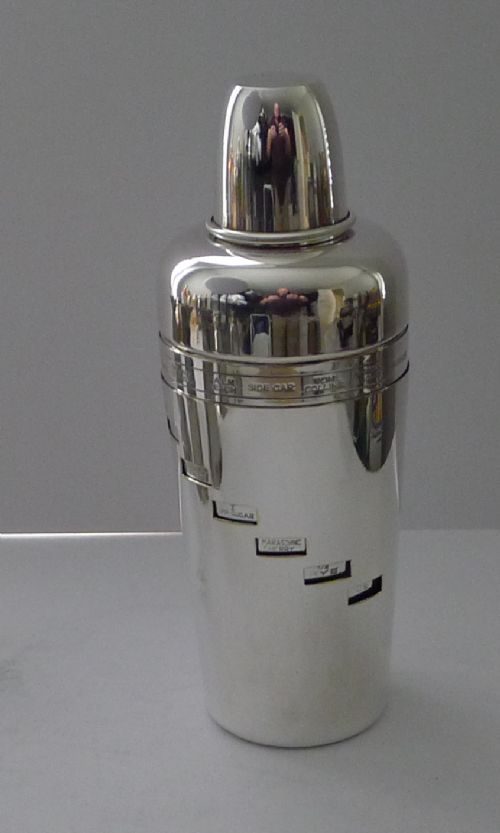
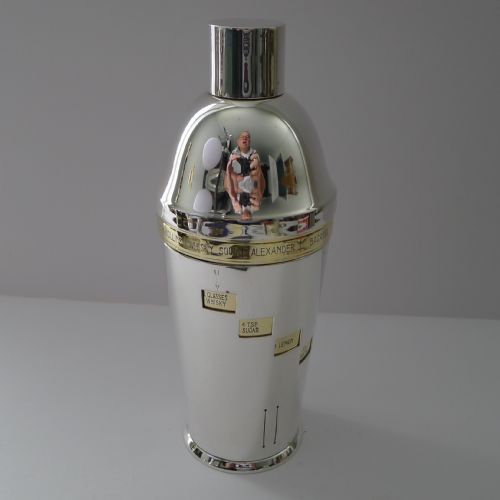
A recipe cocktail shaker is a barware vessel inscribed or fitted with mechanisms to display drink formulations. When you search for this phrase, you encounter pieces designed to dispense liquid measures while revealing proportions for various beverages through rotating bands or engraved text.
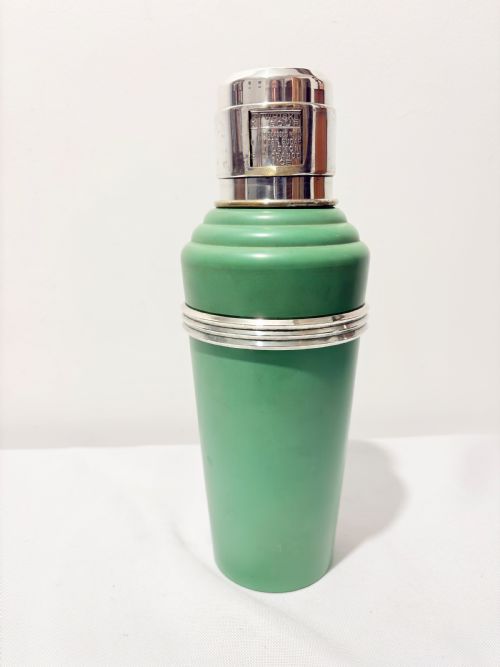
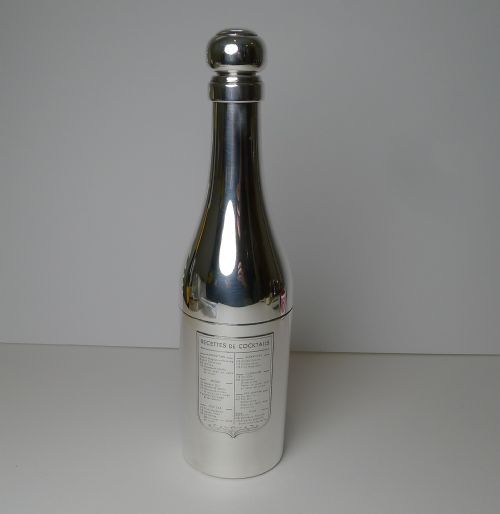
The examples available here sit firmly in the Art Deco period, spanning the 1920s, 1930s, and 1940s. Forms vary from straight-sided cylinders and champagne bottles to bullet shapes and novelty bowling pins.
Origin points cluster around English, Italian, French, and American makers. The Italian iterations often feature rotating dials or multiple tiered sections for menus, while English and American pieces lean toward engraved text or patent rolling mixers.
Distinctions in Execution
Quality rests on the crispness of the engraving and the smoothness of any mechanical movement. Superior examples maintain legible, deep-stamped or engraved text that does not blur with wear, and their rotating dials operate without binding.
The choice of materials also separates standard production from finer output. Pieces utilising combinations of silver and gold plating, heavy gauge metal, or moulded Bakelite handles demonstrate greater ambition in design and execution than plain plated brass equivalents.
Materials documented across the inventory include silver plate, solid silver, brass, gilt metal, chrome, Bakelite, and glass.
Mappin & Webb·Napier·MACABO·C S Green·BARRA Maître Orfèvre à PARIS
The Recipe Cocktail Shaker Glossary
- Art Deco
- A design style dominant in the 1920s and 1930s characterised by stylised motifs, geometric symmetry, and streamlined forms. It heavily influences the architecture of these barware pieces.
- Silver Plate
- A thin layer of silver bonded to a base metal substrate, such as brass or copper. Most examples in this category employ this technique for a polished exterior finish.
- Bakelite
- An early form of synthetic phenol formaldehyde resin used for heat resistance and durability. It appears on handles, finials, and decorative bands within this selection.
- Dial-a-Drink
- A patented mechanism featuring rotating outer rings that align with internal openings to reveal specific drink recipes. This patent is frequently found on English and Italian pieces.
- Gilt Metal
- Metal treated with a thin coating of gold applied via chemical or electrochemical methods. It provides dual-tone contrast against silver-plated bodies on select luxury models.
Recipe Cocktail Shaker: Frequently Asked Questions
How do the rotating dials work?
The exterior sleeve turns around an inner cylinder to reveal specific drink ingredients through small windows or cut-out slots.
This mechanical setup allowed the bartender to select a beverage and read the corresponding proportions directly from the barrel.
Are the recipes still usable today?
Many formulas rely on historical measures and classic spirits that remain staples of modern mixology. Adjusting the proportions to suit contemporary tastes is straightforward, though original quantities often reflect stronger pours.
Using them practically requires checking that interior seals and threads remain watertight after decades of stationary display.
Did these originate in America or Europe?
Production occurred simultaneously across America and Europe during the interwar period. American firms like Napier produced numerous engraved and rotating designs, while Italian workshops in Milan and Rome specialised in complex multi-tiered and dial mechanisms.
English silversmiths also contributed significant patented novelty forms through firms such as Mappin & Webb.