


Queen Anne Mahogany Seating
Queen Anne mahogany seating offers elegant timber frames and supportive high backs that anchor a dining room or parlour with traditional grace.
Queen Anne Mahogany Seating
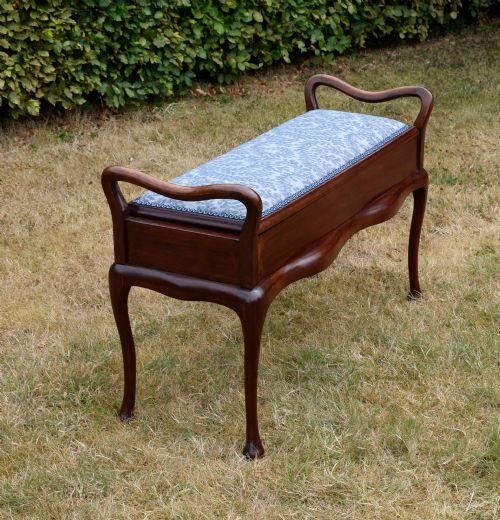
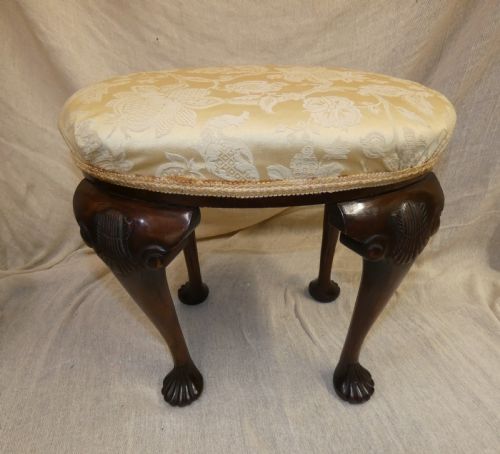
When seeking queen anne mahogany seating, buyers encounter a diverse range of forms including dining chairs, armchairs, piano stools, and window seats. The majority of available pieces date from the early twentieth century, spanning revival styles from 1890 through the 1920s alongside genuine eighteenth-century examples.
Sets of dining chairs frequently appear, ranging from smaller four-piece groupings up to extensive sets of fourteen. Individual armchairs, children's chairs, and various dressing or duet stools supplement these larger dining suites across the inventory.
Materials and Construction
Construction relies heavily on solid mahogany timbers shaped into vase splats and curved supports, often incorporating ball and claw details on the feet. Frames are joined using traditional methods to support the upright forms characteristic of the style.
Upholstery forms an integral part of these pieces, utilising materials such as leather, hide, velvet, tapestry, fabric, and damask. Brass details occasionally appear as subsidiary hardware on stools and adjustable piano seats.
Several miniature armchairs and child's seats are available, proving that miniature furniture for young gentlefolk was taken very seriously indeed.
Assessing Quality and Execution
The refinement of the carved splats and the crispness of the ball and claw foot details distinguish superior examples from simpler production. Wood selection plays a significant role, with rich grain patterns and robust timber framing elevating the stature of a chair or stool.
The choice and execution of upholstery also define quality, where traditional textile coverings or well-fitted leather hides demonstrate careful craftsmanship. Consistency across large dining sets adds considerable merit compared to assembled or mismatched suites.
Whytock & Reid·Morris & Co.
The Queen Anne Mahogany Seating Glossary
- Splat
- The vertical wooden strip down the centre of a chair back. In these pieces, the vase shape is most typical.
- Carver
- An armchair, usually designed to match a set of smaller dining chairs. These often sit at the head of a table.
- Duet Stool
- An upholstered seat designed for two people to sit side by side, commonly found at a piano.
- Hide
- Untanned or tanned animal skin used for upholstery. Green hide appears on several of the heavier armchairs.
Queen Anne Mahogany Seating: Frequently Asked Questions
How do I date these chairs?
Dating relies on timber characteristics, construction joints, and stylistic revival markers. Pieces from the Edwardian era and the 1920s often interpret earlier forms with distinct manufacturing methods.
Examining the underside and the wear on the mahogany helps distinguish genuine eighteenth-century antiques from later nineteenth- and twentieth-century revivals.
Are large dining sets matched?
Many larger sets of twelve or fourteen chairs are assembled during revival periods to meet dining room demands. It is common to find slight variations among larger groupings.
Checking the uniformity of the timber and the carved splats reveals whether the chairs originated as a single unified set.
How should I care for leather upholstery?
Leather and hide upholstery benefit from regular dusting and occasional conditioning to prevent drying. Keeping these pieces away from direct heat sources preserves the material.
Avoiding harsh chemical cleaners ensures the natural finish of the leather remains intact over years of daily use.
Where do piano stools fit in?
Duet and piano stools provide adjustable or fixed seating specifically scaled for music rooms and dressing tables. They share the same mahogany frames and cabriole legs as the dining chairs.
These smaller pieces offer a practical way to introduce period woodwork into compact spaces throughout the home.