
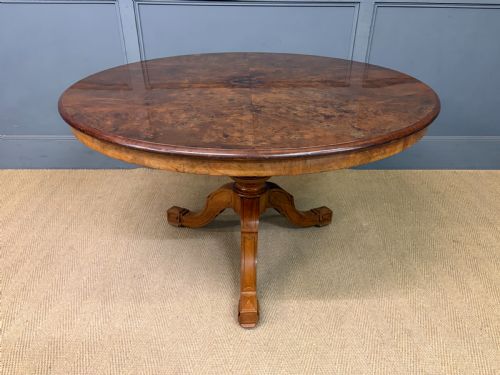
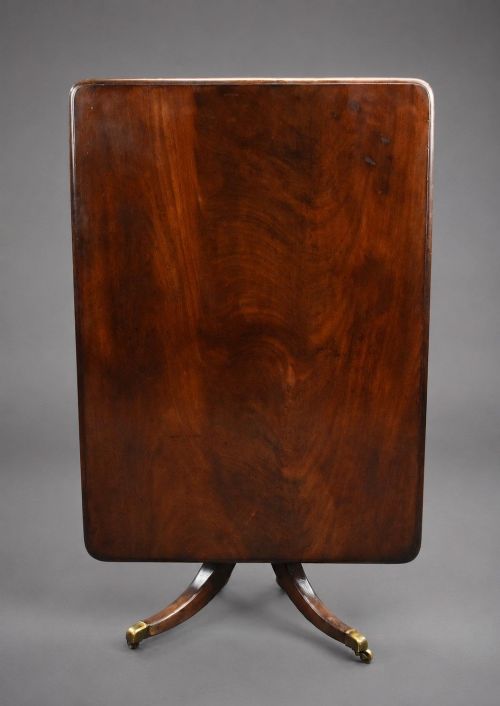


Quadruped Pedestal Dining Table
These quadruped pedestal dining table pieces combine robust timber frames with single central pillars supported by four legs, offering sturdy seating.
Quadruped Pedestal Dining Table
A quadruped pedestal dining table rests upon a central column supported by four distinct feet, providing stability without corner legs getting in the way of chairs. These forms span the Georgian, Regency, and Victorian eras, taking shape as breakfast tables, centre tables, and loo tables.
You will most frequently meet mahogany variants shaped with round, oval, or rectangular tops, often designed to tilt when not in use. The period styles range from George III and Regency through to William IV and Victorian iterations.
Makers utilised rich timbers like Cuban mahogany, rosewood, and burr walnut veneer, occasionally banding the edges with contrasting woods. These surfaces served versatile domestic roles, functioning as morning dining boards or central display pieces.
How they were made
Cabinet makers constructed the tops using solid timber or figured veneers laid over secondary wood foundations, often selecting highly grained mahogany or rosewood. Crossbanding and stringing lines in contrasting timbers were applied to borders for decorative emphasis.
The central pillars connect heavy platform bases or swept quadruped legs, frequently fitted with brass castors to ease movement across heavy carpets. Tilt-top mechanisms employed wooden catches or brass latches, allowing the top to pivot vertically against the pedestal.
Many a Victorian card player lost their patience when a loose snap top dropped mid-game.
What varies in quality
The selection of timber grain dictates much of the visual merit, with deeply figured mahogany or book-matched burr walnut standing above plain, uniform boards. Superior examples display precise crossbanding and meticulous attention to the carving on the pedestal knees and feet.
Structural integrity rests on the stability of the central column and the firm seating of the four leg joints where they meet the pillar. Fine joinery ensures the tilt mechanism operates smoothly without lateral play when locked flat for dining.
James Mein
The Quadruped Pedestal Dining Table Glossary
- Quadruped
- Having four feet or legs supporting a central pillar. This arrangement allows chairs to tuck neatly underneath the rim.
- Tilt top
- A tabletop mounted on a hinge mechanism that pivots vertically. This clever design lets the table stand flat against a wall when not in service.
- Crossbanding
- A border of veneer laid with the grain running perpendicular to the main surface. It frames the central panel with a contrasting linear border.
- Loo table
- A round or oval Victorian table originally intended for the card game loo. These tables typically feature a tilt top and a sturdy pillar base.
- Snap top
- A synonym for a tilt top table fitted with a spring or latch mechanism. The catch secures the top firmly in the horizontal position.
Quadruped Pedestal Dining Table: Frequently Asked Questions
Why do some tables tilt?
Tilt mechanisms were built into many breakfast and loo tables so the heavy top could be folded upright. This saved valuable floor space in smaller rooms when the dining hour finished.
A wooden catch or brass latch keeps the surface steady when lowered into position for daily use.
How do I date a pedestal table?
Dating relies on observing the timber choice, leg profile, and overall style characteristics. Georgian and Regency examples often show clean mahogany lines, while Victorian pieces lean toward rosewood or walnut veneers.
硬件 such as brass castors and the carving style on the pedestal base also offer strong clues to the decade of manufacture.
How do I care for a mahogany top?
Keep these timber surfaces away from direct sunlight and extreme heat sources to prevent the wood or veneer from drying out. Routine dusting with a soft, dry cloth maintains the polished finish.
Applying a quality beeswax periodically nourishes the grain without building up heavy chemical layers.