


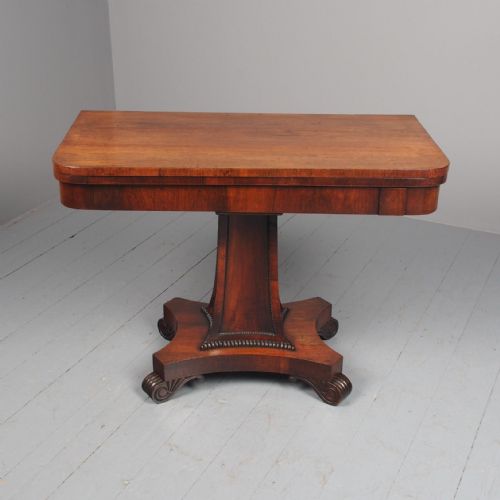


Quadform Base Console
These quadform base console examples are substantial tables designed for cards and tea, combining rich timber and classical pedestals to anchor a room.
Quadform Base Console
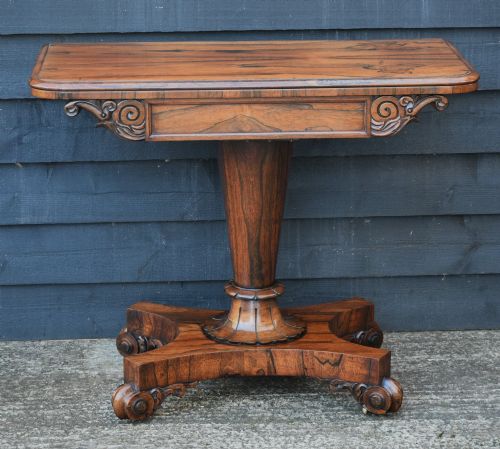
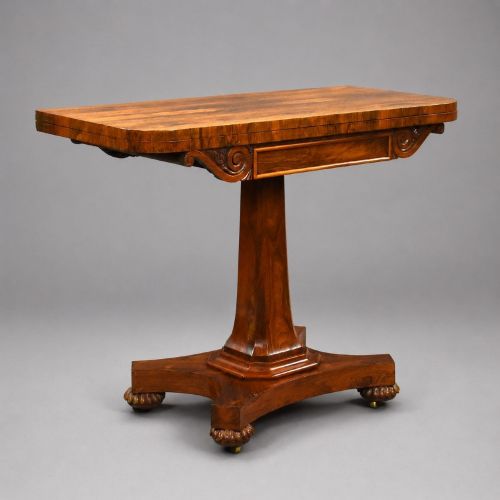
A quadform base console typically appears as a fold-over card or tea table dating from the Georgian, Regency, and Victorian eras. These pieces bridge the gap between functional game furniture and architectural side pieces, often featuring hinged tops that rotate or open to reveal baize-lined playing surfaces.
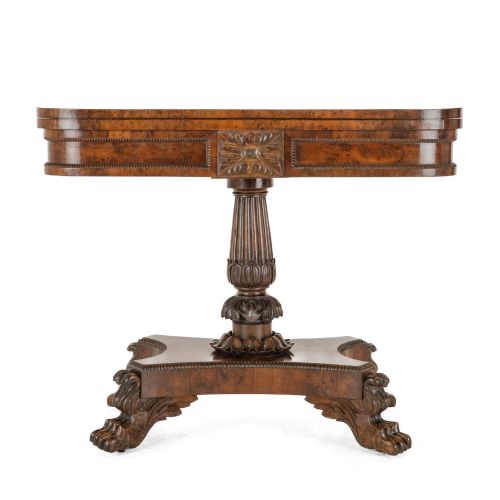
The versions most commonly met on this page span the early nineteenth century, including William IV and George IV periods. Makers constructed these tables in rosewood, mahogany, and burr yew, resting upon robust four-sided or platform pedestals with scrolled feet.
How they were made
Cabinet makers utilised dense native and imported timbers such as mahogany and rosewood, often applying figured veneers over solid secondary woods. Timber selection dictated the visual weight, with burr yew reserved for striking grain patterns on table tops.
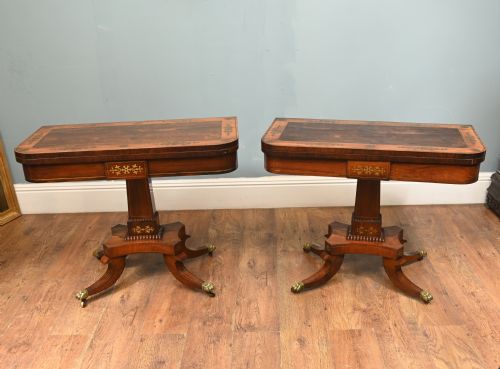
Construction relied on heavy central pillars rising from quadform plinths, frequently accented with brass inlay or intricate carving. Tops were engineered with clever pivoting or folding mechanisms to support the weight of the timber when opened.
Current listings span the Georgian, Regency, and Victorian periods, showcasing predominantly rosewood and mahogany constructions.
What varies in quality
Quality rests heavily on the choice of veneer and the crispness of the timber carving around the base and collar. Superior examples display continuous, well-matched grain patterns across the fold-over top and maintain tight joinery in the pivoting mechanism.
The architectural integrity of the quadform base dictates the overall grade, where heavy brass castors and substantial blocking beneath the plinth separate robust workshop production from lighter commercial output.
William Trotter
The Quadform Base Console Glossary
- Quadform base
- A four-sided pedestal or plinth foundation supporting the central pillar of the table. This configuration provides stability for heavy fold-over tops.
- Fold-over top
- A hinged table surface that doubles in area when opened for games or dining. It often conceals a polished well or storage space underneath.
- Rosewood
- A dense, heavily figured dark timber favoured for high-status nineteenth-century cabinet work. It takes a high polish and displays striking grain variation.
- William IV
- A British design style spanning the 1830s characterised by robust classical proportions and heavy scrolling. Pieces from this period often employ bold rosewood veneers.
- Burr yew
- A highly decorative wood harvested from yew tree growths, showing intricate swirling patterns. It is typically used as a veneer on select table surfaces.
Quadform Base Console: Frequently Asked Questions
How do I use a quadform base console daily?
These tables function well as sideboards or hall consoles when closed against a wall. The hinged top remains stable for displaying lamps or decorative objects during daily use.
When guests arrive, the top swings or folds open to create a generous surface for card games or tea. The internal well often stores small accessories when not in use.
How do I tell Regency from Victorian examples?
Regency and George IV pieces generally display restrained classical lines, delicate brass inlay, and crisp mouldings derived from ancient architectural forms. Proportions tend to feel lighter and more linear.
Victorian and late William IV examples lean towards heavier carving, bolder scrolling on the quadform base, and darker rosewood finishes with less reliance on brass ornamentation.
What woods should I expect to find?
Rosewood and mahogany dominate the selection, offering deep reddish-brown tones and prominent grain structures. These durable timbers were chosen for their strength in supporting pivoting mechanisms.
Some examples feature burr yew veneers on the top surface for decorative contrast. Secondary woods like pine or oak are typically hidden within the internal frame.
Where should I place this table at home?
A hallway or living room wall provides the ideal setting for a closed console, allowing the decorative top and base to catch the eye. Ensure there is adequate clearance space if you plan to unfold the top.
Keep the timber away from direct heat sources and strong sunlight to protect the polished finish and prevent the veneer from drying out over time.