




English Mahogany Card Table
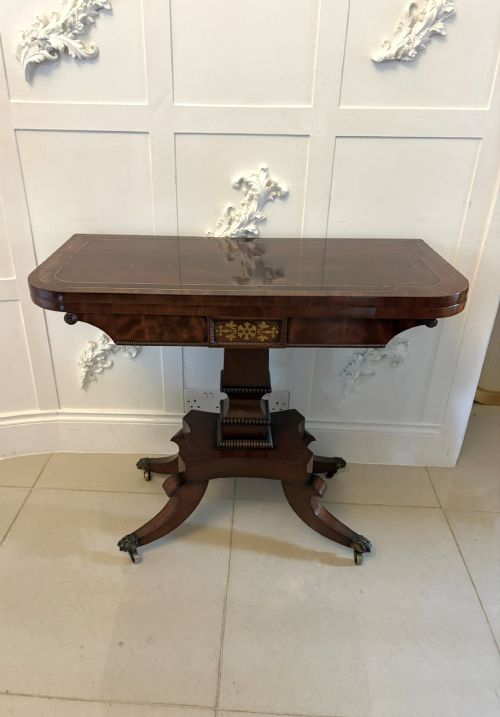
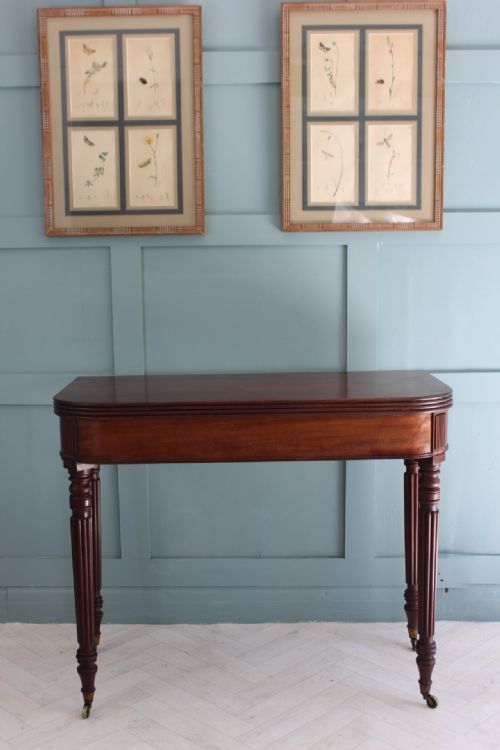
An english mahogany card table brings folding utility and polished grain into a room, serving as a games surface or a slim side console.
English Mahogany Card Table
An english mahogany card table primarily spans the Georgian, Regency, and Victorian eras, taking the form of fold-over tops, D-shapes, and demi-lune consoles. These pieces function as tea tables, games tables, or side tables when closed against a wall.
The George III and Regency periods provide the most numerous examples on this page, often featuring folding leaves supported by swing legs or rotating actions. Later Victorian and Edwardian revivals continue the form with similar timber construction.
Makers adapted these tables for multiple uses, including supper tables and metamorphic dining consoles. The internal wells typically store gaming counters or cards beneath the folded top.
Judging the work
Quality rests on the selection of timber figures, such as flame or plum pudding mahogany, matched across the folding leaves. Crispness in boxwood and satinwood inlay distinguishes superior cabinet work from plain surfaces.
The structural integrity of the pivoting mechanism and the precision of the fold-over top dictate the standard of execution. Well-balanced swing legs and tight joints indicate competent workshop practice.
Some tables double as secretive hiding spots, concealing old playing cards and wooden counters forgotten by players centuries ago.
Edwards and Roberts
The English Mahogany Card Table Glossary
- Baize
- A coarse woolen fabric used to line the playing surface of games tables. It provides a soft texture for handling cards.
- Demi-lune
- Half-moon shape, typically describing tables with a curved front and flat back designed to stand against a wall.
- Turnover top
- A hinged table top that folds open to double the surface area, often revealing a hidden well beneath.
- Flame mahogany
- A veneer cut from the fork of the mahogany tree that produces a flamed, flickering grain pattern.
- Stringing
- Thin inlay of a contrasting wood used to outline panels, drawers, or table edges for decorative contrast.
English Mahogany Card Table: Frequently Asked Questions
How do I use an english mahogany card table today?
These tables fit neatly against a hallway or living room wall as a console when closed. Opening the leaf provides a convenient surface for games, writing, or display.
The slim profile occupies minimal floor space while offering the flexibility of an expanded top when entertaining.
What is inside a fold over table?
Opening the hinged top reveals a baize-lined playing surface designed for cards and board games. Many tables also include a shallow well beneath the top for storing counters or playing cards.
The supporting frame often swings out to bear the weight of the open leaf safely.
How do I date an english mahogany card table?
Georgian examples often display straight or carved tapered legs with Chippendale or Hepplewhite stylistic influences. Regency pieces introduce brass inlay, D-shapes, and bolder grain patterns.
Victorian and Edwardian versions revive these earlier styles, frequently identified by machine-cut elements or later secondary timbers.
Are these tables sturdy enough for daily use?
The robust mahogany construction and pivoting support legs make them suitable for normal household placement. Care should be taken when swinging the top open to avoid straining the original hinges.
Using coasters and avoiding direct sunlight protects both the polished timber finish and the internal baize.