

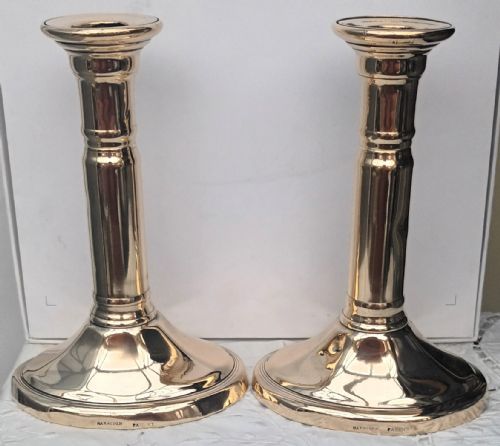


Push Up Candle Holders
Push up candle holders are ingenious mechanical lights crafted to raise the stub as it burns down.
Push Up Candle Holders
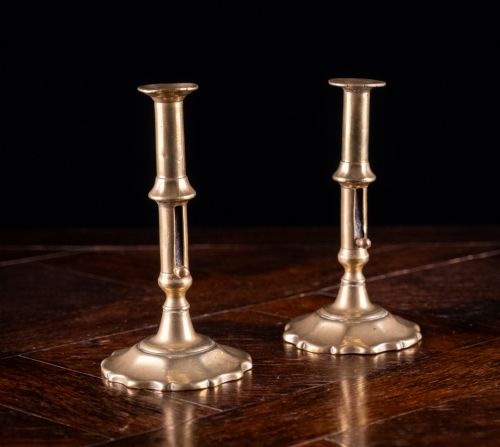
Push up candle holders are functional lighting antiques designed to elevate tallow or wax candles from within the socket as they shorten. When looking at push up candle holders on this page, the visitor encounters pieces primarily fashioned from brass and iron, spanning the eighteenth and nineteenth centuries.
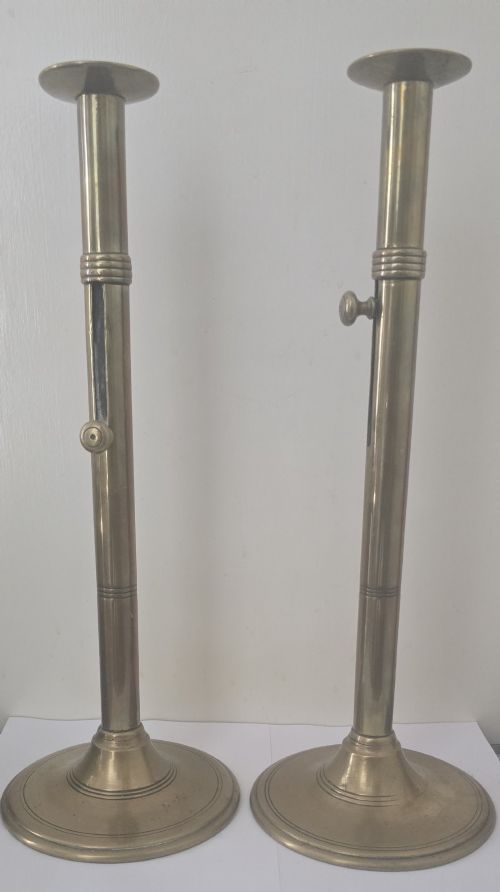
Origins stretch across English workshops utilising seamed brass, cast brass, wrought iron, and hardwood components. Forms vary from petal-based and scalloped bases to tall ecclesiastical sticks and patent telescopic models.
How they were made
Makers constructed these pieces using heavy cast and seamed brass, shaping the components to house internal sliding mechanisms. Wrought iron was equally utilised for spiral and utilitarian designs, sometimes combined with hardwood elements.
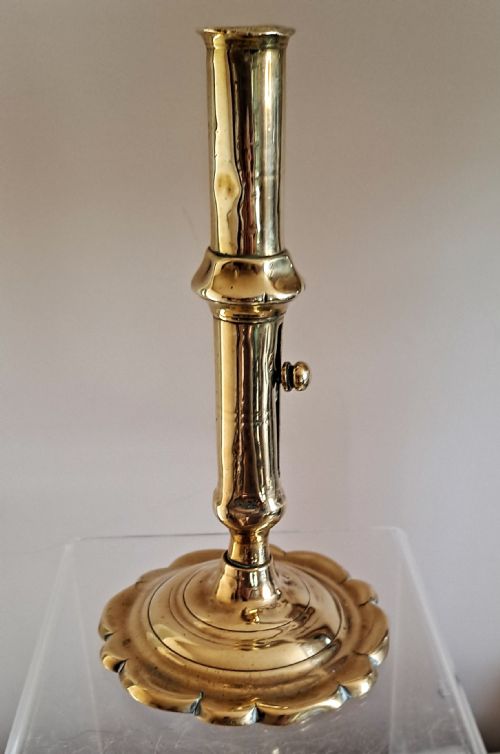
The mechanical ejector relies on a snug internal slide operated by an exterior thumbpiece or side lever. Components were joined with precision so the stem could raise the candle candle-butt smoothly without jamming.
Listings feature eighteenth and nineteenth-century pieces, spanning George II, Georgian, Victorian, and Arts and Crafts styles in brass and iron.
What varies in quality
Quality rests in the integrity of the internal sliding mechanism and the weight of the cast metal. Superior examples retain crisp detail in petal bases and scalloped edges, whereas lower grades show heavy wear to the sliding stem.
The thickness of the brass and the original fit of the side ejector dictate the durability of the piece. Fine George II and Georgian specimens demonstrate heavier casting and more deliberate finishing than later mass-produced Victorian equivalents.
Harrison Patent
The Push Up Candle Holders Glossary
- Ejector
- A mechanical device inside the candlestick socket that pushes the remaining candle remnant upward. This internal sliding plate connects to an external thumbpiece or side lever.
- Petal Base
- A foot shaped like overlapping flower petals, commonly found on mid-eighteenth-century brass candlesticks. This scalloped or lobed outline adds stability and decorative weight.
- Seamed Brass
- Sheet brass formed into a tube and joined down the side before being soldered or brazed to the base. This technique preceded advanced extrusion methods.
- Telescopic
- A stem design that extends or collapses in sections to adjust the overall height of the light. Harrison patent models utilise this mechanism.
- Spiral Candlestick
- An iron form featuring a twist of metal that holds the candle and often includes a sliding clip to adjust the height manually. These pieces date across the nineteenth century.
Push Up Candle Holders: Frequently Asked Questions
How do push up candlesticks work?
Push up candlesticks feature an internal disc connected to a side lever or thumbpiece running up the stem. Pushing this slider from beneath elevates the candle remnant for easy removal.
This clever mechanical system prevented wax from becoming trapped deep inside the socket.
What periods do these pieces date from?
The examples on this page span from the mid-eighteenth century through to the late nineteenth century. Georgian and George II items sit alongside Victorian and Arts and Crafts productions.
Material choices like heavy cast brass and wrought iron help define these different eras.
Are push up holders made of brass?
Brass is the predominant metal used for these lighting pieces, particularly in seamed and cast Georgian forms. Some utilitarian nineteenth-century variants utilise wrought iron and hardwood.
Makers selected these durable materials to withstand the repeated friction of the internal sliding mechanism.
What is a Harrison patent candlestick?
Harrison patent pieces use a telescopic stem mechanism allowing the height of the candlestick to alter. This nineteenth-century innovation provides adjustable illumination.
The patent design combines mechanical ingenuity with the traditional ejector function.
How should I clean antique brass?
Antique brass benefits from gentle dusting and minimal interference to preserve its historic surface and natural patination. Harsh chemical polishes strip away the aged tones gathered over centuries.
A soft dry cloth maintains the finish safely.