


Purple Amethyst Brooch
A purple amethyst brooch brings deep violet colour to a lapel, spanning Victorian grandeur and Edwardian delicacy.
Purple Amethyst Brooch
A purple amethyst brooch combines rich violet stones with precious metals, forming a distinct category of antique and vintage jewellery. The pieces span Victorian, Edwardian, and mid-century periods, capturing diverse stylistic eras from British workshops to Mexican silver studios.
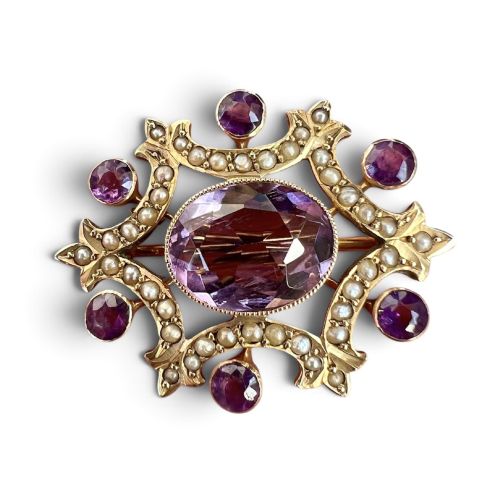
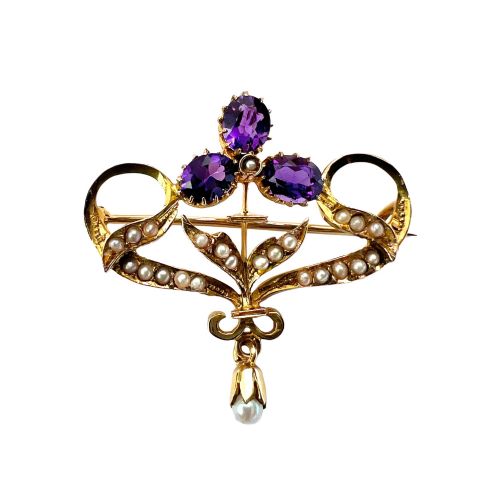
Buyers searching for a purple amethyst brooch most commonly encounter Edwardian nine-carat gold designs enhanced with seed pearls, alongside substantial Victorian cluster settings. Yellow gold and silver serve as the primary foundational metals for these works.
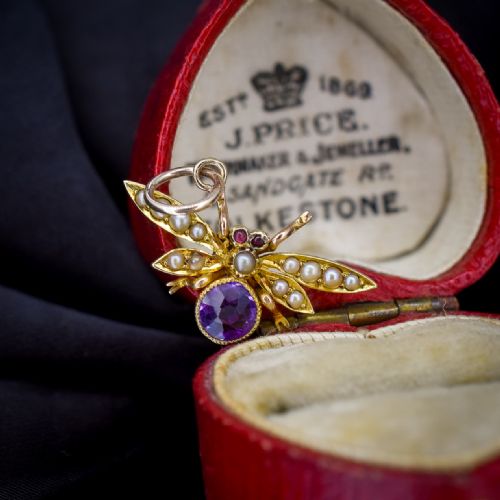
Forms extend beyond standard dress pins to include convertible brooch pendants and insect motifs. Each piece reflects the decorative preferences of its specific decade, utilising central purple gems framed by smaller accents.
How they were made
Maker's hands combined natural amethysts with nine-carat and fifteen-carat yellow gold, silver, and eighteen-carat gold settings. Metalworkers shaped bezels and prongs to secure the violet stones safely within the mount.
Seed pearls and natural pearls frequently accompany the primary purple gems, pinned or strung in floral and target arrangements. Enamel and diamonds occasionally supplement the gold and silver structures on mid-century and Edwardian examples.
What varies in quality
The depth of purple saturation in the amethyst and the clarity of the crystal separate standard examples from finer specimens. Step-cut stones and large cluster arrangements demand superior mineral selection.
The precision of the gold or silver work, particularly in delicate seed pearl framing and insect detailing, dictates the refinement of the piece. Heavier gold carats, such as fifteen-carat and eighteen-carat mounts, indicate higher initial manufacture standards.
Beto
The Purple Amethyst Brooch Glossary
- Amethyst
- A purple variety of quartz prized for its violet hue. It serves as the central gemstone across Victorian and Edwardian brooches.
- Seed Pearl
- A very small, naturally occurring pearl often used in tight clusters. Edwardian jewellers favoured them for framing purple stones.
- Cluster Brooch
- A jewellery setting featuring a prominent central stone surrounded by smaller gems. This layout maximises visual impact on lapels.
- Target Brooch
- A circular concentric design popular in the early twentieth century. These pieces draw the eye inward toward a central amethyst.
- Convertible Pendant
- An item equipped with both a pin fitting and a loop. This allows the purple gemstone jewel to shift between a brooch and a necklace.
Purple Amethyst Brooch: Frequently Asked Questions
How do I wear a brooch?
Pin the piece securely through heavy fabrics like wool coats, thick cardigans, or structured jacket lapels to support the weight of the gold and gemstones.
Ensure the safety catch remains locked during wear to prevent loss, especially when utilising convertible pendant loops for chains.
Are these pieces solid gold?
Many examples utilise nine-carat or fifteen-carat yellow gold for the primary structure, while others employ sterling silver or eighteen-carat gold.
Stamps and hallmarks on the reverse typically confirm the specific metal purity used by the original workshop.
How do I clean my amethyst jewellery?
Wipe the gold, silver, and stones gently with a soft, damp cloth to remove everyday oils and dust accumulation.
Avoid harsh chemical dips or prolonged water immersion, particularly for pieces containing delicate seed pearls or closed-back settings.
How do I date an antique brooch?
Examine the metal purity marks, overall design style, and fastener mechanics to determine the period of manufacture.
Edwardian items often feature light nine-carat gold with seed pearls, whereas Victorian pieces frequently showcase heavier cluster settings in yellow gold or silver.