


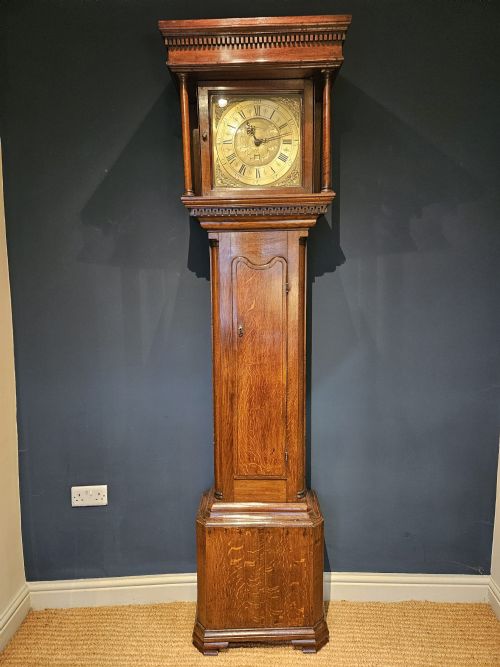
Provincial Oak Pendulum Clock
These provincial oak pendulum clock examples combine honest regional cabinet-making with reliable weight-driven timekeeping for any traditional interior.
Provincial Oak Pendulum Clock
When you search for a provincial oak pendulum clock, you encounter tall floor-standing timepieces alongside smaller wall-mounted formats created outside the capital. These items span the Georgian period, the eighteenth century, and the nineteenth century, reflecting diverse regional tastes across Britain and France.
The most common form on this page is the longcase clock, often referred to as a grandfather clock, housed in timber cases that range from simple country designs to more substantial regional interpretations. Wall clocks also appear, offering alternative proportions for domestic spaces.
How they were made
Cabinet-makers constructed the primary structures using solid oak, occasionally combining mahogany accents or incorporating carved decorative details depending on the regional style. Brass and iron formed the internal mechanical movements, while glass protected the dial faces.
Dials were finished in painted iron or enamel, often featuring regional maker signatures and specialised complications such as rolling moon mechanisms. Hooded designs allowed easy access to the pendulum and weight-driven mechanisms housed within.
Provincial Oak Pendulum Clock Retail Price Guide 2026
Typical asking prices for provincial oak pendulum clock among the pieces listed under this phrase on Sellingantiques today, from the lower quarter to the upper quarter. They describe what is for sale here now, not the wider market.
Listings feature oak, mahogany, brass, iron, and glass across Georgian and nineteenth-century periods in longcase and wall clock formats.
What varies in quality
The standard of a provincial oak pendulum clock rests upon the crispness of the timber carving and the original integrity of the case construction. Regional variations in proportion and the complexity of the dial work distinguish more ambitious workshop output from utilitarian pieces.
Signed movements by recorded makers provide stronger provenance and indicate higher craftsmanship in the gear-train cutting and overall mechanical execution. The survival of original painted or brass dial surfaces further influences the character and standing of each timepiece.
Haythornwaite Kirkby Lonsdale·John Salmon Nantwich·Stanyer Nantwich·Samuel Buxton Diss·James Draycot Wells·Richard Midgley Halifax·J Hummel Worcester
The Provincial Oak Pendulum Clock Glossary
- Longcase clock
- A tall, weight-driven pendulum clock housed in a protective wooden case standing directly on the floor. These items are commonly known as grandfather clocks.
- Thirty-hour clock
- A timekeeping movement designed to run for just over a single day before requiring manual weight winding. This simpler mechanism suited domestic village life.
- Eight-day clock
- A mechanical movement requiring winding roughly once a week, utilising two weights and a more intricate train of gears. This format represented a higher cost and greater convenience.
- Rolling moon
- A mechanical display on the dial tracking the phases of the lunar cycle through a rotating painted disc. This feature appeared on higher-grade regional dials.
Provincial Oak Pendulum Clock: Frequently Asked Questions
How do I wind an oak longcase clock?
Most traditional weight-driven movements require you to pull the cords or use a crank key to raise the heavy iron or lead weights back to the top of the case. Care must be taken not to pull past the maximum height.
Different movements require different intervals, typically running for thirty hours or eight days depending on the internal gear train specified by the maker.
Where should I place a tall clock?
Select an interior wall away from direct sunlight, heating vents, and damp exterior walls to protect the timber case and the internal brass and iron mechanism. Floor stability is vital for the pendulum to beat evenly.
Tall clocks require a solid foundation, preferably secured gently to the wall via the upper case to prevent accidental tipping in busy hallways or living rooms.
How do I tell an eighteenth-century clock from a later one?
Examine the construction methods of the oak case, the style of the brass dial corners, and the hand-carved lettering used for the maker signature. Earlier pieces often display simpler, heavier timber proportions.
Nineteenth-century examples frequently incorporate painted iron dials with more ornate floral spandrels and standardised mechanical components produced in larger regional workshops.
What does a rolling moon dial do?
A rolling moon mechanism uses a painted double-hemisphere disc behind an arched aperture on the dial face to track the lunar month. It advanced automatically with the clock movement.
This complication served a practical purpose in agricultural and coastal communities where tidal schedules and night illumination mattered for daily work.