
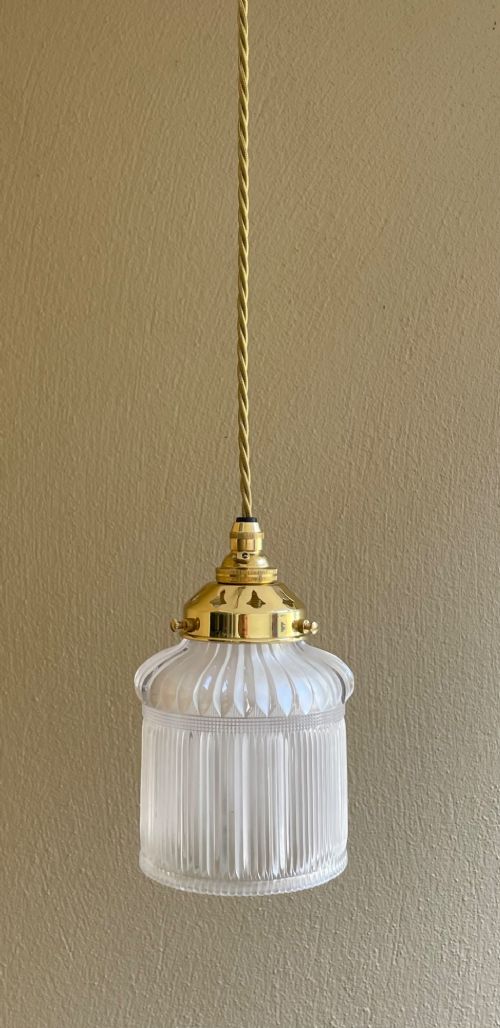


Prismatic Ceiling Light
A prismatic ceiling light brings focused illumination and industrial character into a room through its characteristic ribbed glass shade.
Prismatic Ceiling Light
A prismatic ceiling light is typically encountered as a pendant light hanging from a ceiling suspension. These pieces span periods from the 19th Century and Edwardian era through to the 1920s and 1940s.
The core of what you find here centres on Holophane shades, which appear in various forms including bell pendants and nine-inch designs. Industrial styles dominate the selection alongside Edwardian industrial and industrial art deco pieces.
Materials and construction
The primary material is prismatic glass, utilised for its light-diffusing optical properties across single and double prismatic shade configurations. These shades are paired with metal components such as brass galleries, chrome galleries, and cast iron elements.
Makers mounted these ribbed glass shades onto sturdy metal holders to suspend them safely from ceilings. The combination of pressed glass and durable metal hardware defined the standard manufacturing approach for industrial lighting of these periods.
Listings feature prismatic ceiling lights spanning from the 19th Century through Edwardian, 1910, 1920, and 1940 periods.
Assessing quality and differences
Quality differences lie in the crispness of the glass moulding and the optical depth within the prismatic ribs. Finer examples display precise geometric forming that directs light efficiently without distortion.
The accompanying metalwork also dictates the calibre of a piece. Solid brass or well-cast iron galleries demonstrate superior original manufacture compared to simpler or later substitute fittings.
Holophane
The Prismatic Ceiling Light Glossary
- Prismatic glass
- Glass moulded with precise ribs or prisms on the surface to refract and distribute light evenly. This optical design reduces glare while maximising illumination.
- Gallery
- The metal collar or fitter that grips the top of the glass shade and connects it to the suspension rod or chain. Galleries are commonly cast in brass, chrome, or iron.
- Bell pendant
- A lighting fixture featuring a shade shaped like a traditional hand bell. This form directs the primary beam downwards while casting a soft glow laterally.
- Double prismatic
- A shade construction utilising two layers or integrated optical patterns to further enhance light diffusion. This technique provides stronger glare reduction in large spaces.
Prismatic Ceiling Light: Frequently Asked Questions
Where should I hang a prismatic ceiling light?
These fixtures suit spaces requiring direct yet diffused illumination, such as over kitchen islands, dining tables, or in hallways. Their industrial origins also make them practical for utility rooms and workshops.
Ensure the hanging height allows sufficient headroom while positioning the shade to project light where it is most needed.
How do I clean the ribbed glass shades?
Dust the exterior and interior ribs regularly with a soft brush or microfibre cloth to maintain light clarity. For deeper cleaning, remove the glass from the metal gallery and wash it in warm soapy water.
Dry the glass thoroughly before reassembling the fixture to prevent water spots from forming on the prismatic surface.
What is the difference between Edwardian and 1940s pendants?
Edwardian and early 20th century pendants often feature softer decorative touches on the metal galleries alongside traditional bell profiles. Pieces from the 1940s tend towards utilitarian designs reflecting industrial wartime standards.
Both periods utilise the same core prismatic glass technology, meaning the visual distinctions primarily reside in the metal hardware.
Can I use modern bulbs in these vintage lights?
Most antique pendants accept standard modern LED or incandescent bulbs provided the wattage aligns with the original wiring limits. The prismatic glass is designed to work effectively with various light sources.
Consult a qualified electrician to check the internal wiring and ensure compatibility with contemporary electrical standards before installation.