


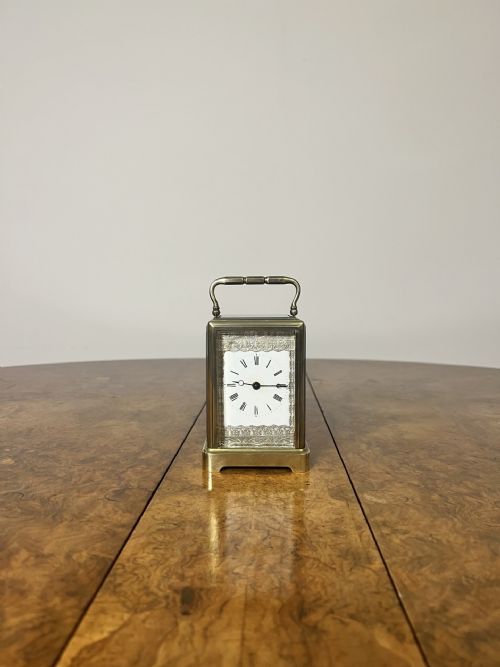


Portable Travelling Clock
A portable travelling clock is a mechanical timekeeper designed to move between rooms or across countries, offering dependable movement in a robust metal housing.
Portable Travelling Clock
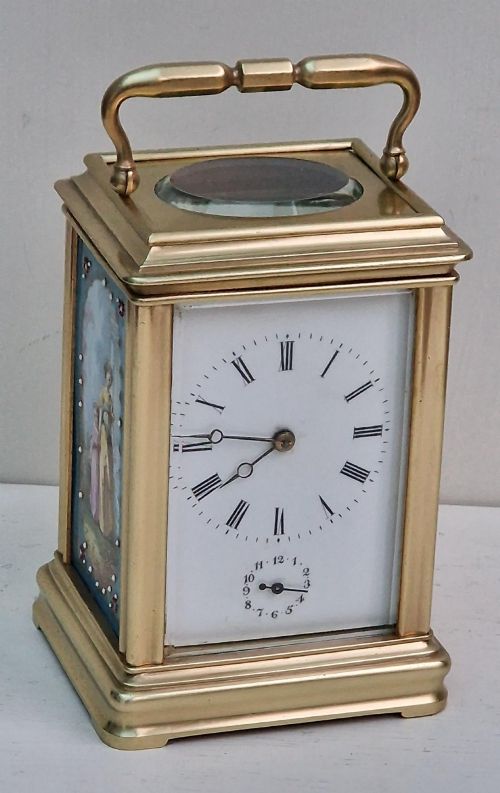
A portable travelling clock bridges the gap between domestic mantel timepieces and personal pocket watches, housing a spring-driven movement in a protective metal frame. These objects appear in various forms, from plain brass designs to ornate models featuring porcelain panels and delicate enamel dials. Most examples encountered here originate from the nineteenth and early twentieth centuries, spanning Victorian and Edwardian periods.
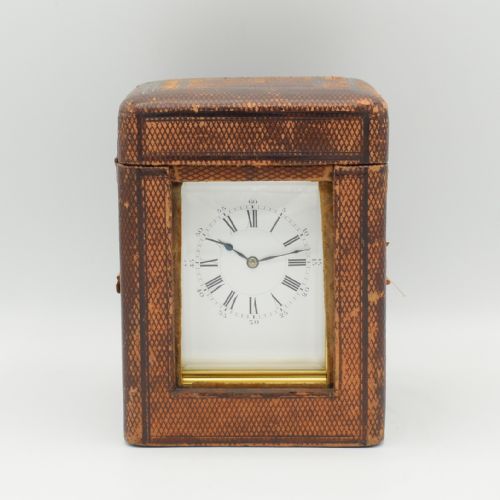
Makers housed these mechanisms in glazed brass or gilt cases, often accompanied by fitted leather travel cases to withstand the rigours of transit. Dimensions range from small miniature pieces to larger striking clocks capable of chiming the hours. French workshops produced a significant proportion of these items, alongside contributions from British retailers and makers.
Materials and construction
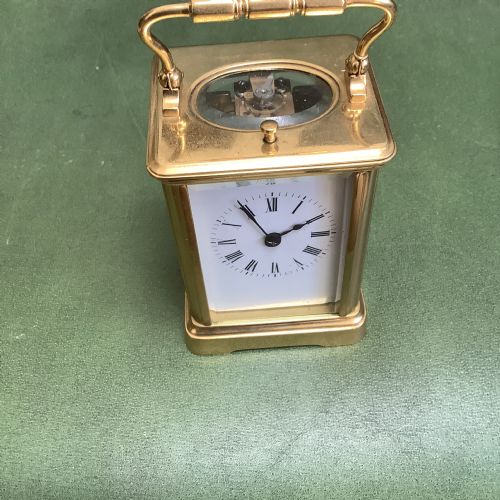
Makers constructed these clocks primarily from brass and gilt brass, forming heavy frames to protect the delicate internal gear trains and escapements. Glass panels inserted into the top and sides allow light to reach the movement while keeping dust away from the gears. Enamel serves for the chapter rings and dials, providing a clear white surface for painted numerals.
Certain miniature models were manufactured specifically for export to distant overseas markets, travelling halfway across the world in velvet-lined boxes.
Judging quality
Quality rests in the precision of the mechanical movement and the weight and finish of the outer metal case. Heavier gilt brass frames with finely cast details indicate higher craftsmanship than lighter, plain housings. The presence of original fitted leather travel cases adds substantially to the completeness of an individual piece.
The complexity of the mechanism also separates standard timepieces from finer examples, particularly those with eight-day movements or striking capabilities. Painted porcelain panels and signed dial plates by known makers point to superior workshop standards.
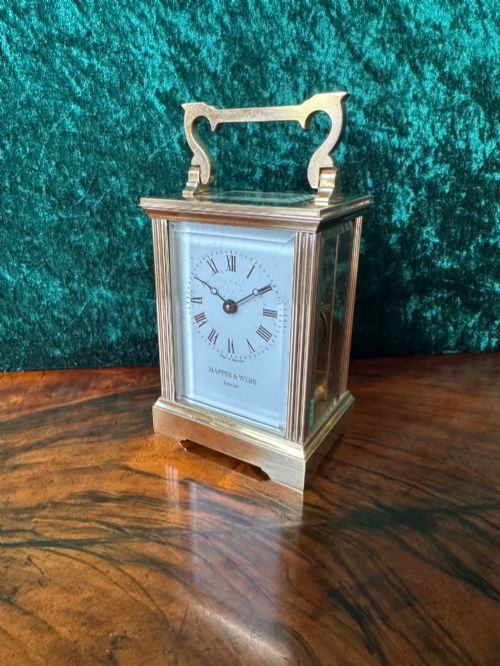
Henri Jacot·Mappin and Web·Pickford of London·Paul Garnier·Latshea and Sons Edinburgh
The Portable Travelling Clock Glossary
- Carriage clock
- A small, spring-driven timekeeper with a carrying handle, originally built for travellers in the nineteenth century. These clocks rely on a platform escapement rather than a pendulum.
- Platform escapement
- The tiny horizontal assembly containing the balance wheel and hairspring, allowing a clock to keep time while moving. This mechanism renders the timepiece independent of a stationary surface.
- Gilt brass
- Brass coated with a thin layer of gold or gold-coloured alloy to enhance appearance and prevent tarnish. This finish appears frequently on nineteenth-century French models.
- Striking clock
- A timepiece equipped with an internal mechanism that chimes the hours or quarters automatically. These models require additional gear trains and twin barrel springs.
- Enamel dial
- A metal face fused with powdered glass melted at high heat to create a smooth, glossy surface. Black painted numerals are typically baked onto this white background.
Portable Travelling Clock: Frequently Asked Questions
How do I wind a travelling clock?
Most of these clocks utilise a small key placed onto arbors at the back of the movement to tension the internal springs. Turn the key gently until resistance is felt, taking care not to over-wind the mechanism.
Ensure you identify the correct winding square for the timekeeping train versus any striking train before applying pressure. Regular, moderate winding preserves the tension of the springs over time.
Can I take a travelling clock on journeys today?
While these objects were originally built for transit in leather cases, modern travel subjects delicate nineteenth-century gear trains to high vibrations. Transporting them requires secure padding and careful handling to prevent damage to the balance staff.
For daily use, setting the clock in a stable domestic location reduces wear on the platform escapement. Keep the piece away from direct sunlight and damp environments to protect the metal and glass.
How do I date a brass carriage clock?
Dating relies on stylistic shifts in the brass case, the shape of the handle, and the design of the white enamel dial. Victorian and Edwardian examples often display distinct proportions and case feet characteristic of their decade of manufacture.
Engraved signatures on the backplate or movement can also point to a specific maker and operational period. Comparing the escapement style helps distinguish mid-nineteenth-century models from later twentieth-century iterations.
Why do some clocks have leather cases?
Outer leather cases protected the polished brass surfaces and glass panels from knocks and scratches during Victorian and Edwardian journeys. Many cases feature small viewing windows so the traveller could check the time without opening the lid.
Finding a clock with its original fitted leather case is uncommon, as these outer housings suffered heavy wear during transit. The presence of a matching case enhances the historical completeness of the object.