


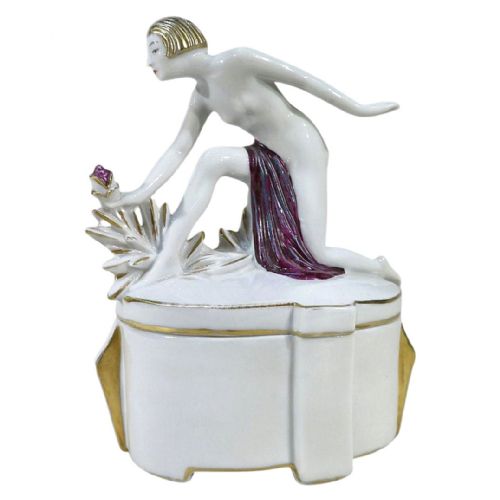


Porcelain Vanity Powder Dish
A porcelain vanity powder dish sits on a dressing table to hold cosmetics, offering a charming slice of early twentieth-century vanity culture.
Porcelain Vanity Powder Dish
A porcelain vanity powder dish is a decorative vessel designed for dressing tables, frequently encountered in forms such as powder boxes, bowls, and trinket boxes. These pieces often serve as functional containers for loose powder, puffs, or small personal items.
The selections available lean heavily towards the Art Deco period of nineteen thirty, alongside earlier French Rococo revival pieces and Chinoiserie designs from nineteen hundred to nineteen ten. Common configurations include figural lids featuring half dolls, flapper girls, bathing belles, and jesters.
Origins span across France and Germany, encompassing notable regional workshops like Limoges and Meissen. Buyers frequently discover round lidded boxes and bowls fashioned for boudoir use.
Materials and construction
These items are constructed primarily from ceramic, earthenware, and porcelain, shaped into bowls, jars, and boxes. Glaze provides a smooth, protective finish over the ceramic body.
Decoration is applied through hand painting, enamel work, and gold leaf or gilt detailing. Fabric occasionally appears in auxiliary elements like powder puffs accompanying the ceramic vessels.
Listings for porcelain vanity powder dishes are dominated by nineteen thirty Art Deco designs, alongside examples from nineteen hundred and nineteen ten.
Distinctions in craftsmanship
Superior examples exhibit finely detailed hand painting and precise facial expressions on figural lids such as flapper girls and half dolls. The crispness of the gilt detailing and gold leaf application distinguishes finer artistic execution from simpler production.
The complexity of the form itself elevates certain pieces, particularly novelty figural groups involving jesters or pierrots compared to standard round bowls. Origin also plays a role, with established factories like Meissen and Limoges commanding particular interest for their refined ceramic bodies.
Meissen·Limoges
The Porcelain Vanity Powder Dish Glossary
- Half doll
- A ceramic upper torso without legs, commonly mounted to fabric skirts or directly onto powder box lids. These figures serve as decorative handle grips for vanity containers.
- Flapper girl
- A stylistic representation of young women from the nineteen thirties characterised by bobbed hair and modern fashion. They frequently top ceramic powder boxes as figural handles.
- Gilt
- A thin layer of gold applied to the surface of porcelain or ceramic for decorative embellishment. It provides metallic contrast against painted enamel designs.
- Chinoiserie
- A decorative style reflecting European interpretations of Chinese and East Asian artistic traditions. It appears on early twentieth-century boxes through characteristic motifs.
Porcelain Vanity Powder Dish: Frequently Asked Questions
What is a porcelain vanity powder dish used for?
These lidded vessels held loose cosmetic powder on dressing tables during the early twentieth century. They kept powder contained while adding a decorative element to the boudoir.
Today, they serve primarily as display items or small trinket containers for jewellery and keepsakes.
How do I identify an Art Deco powder dish?
Art Deco pieces from the nineteen thirties often feature stylised figures like flapper girls, bathing belles, and pierrots on the lid. The ceramic forms favour geometric lines or stylised figural sculpture.
Decoration tends to use bold painted colours and simplified motifs characteristic of the interwar period.
Are these powder dishes fragile?
As ceramic and porcelain objects with delicate painted surfaces, they require careful handling. Lids featuring half dolls or figural extensions need particular care when lifted.
Displaying them away from high-traffic edges prevents accidental knocks and preserves the hand-painted enamel and gilt.
Where were these powder boxes made?
The pieces originate predominantly from European ceramic centres in France and Germany. Prominent workshops and factories like Limoges and Meissen produced many of the surviving examples.
French pieces frequently lean towards Rococo revival styles, while German production often embraces Art Deco novelty figures.