


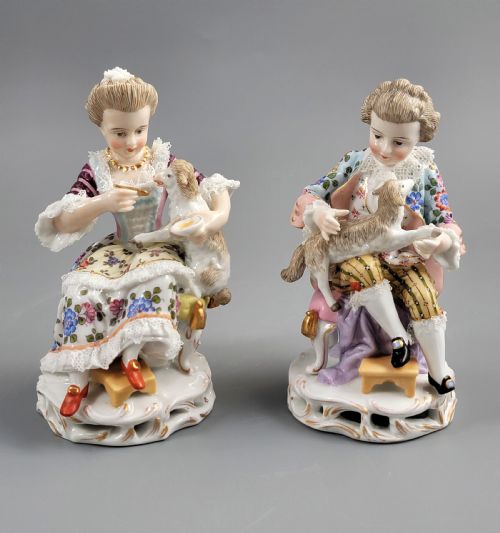


Porcelain Pastoral Figurines
Porcelain pastoral figurines bring an idealized rural life into the parlour through figures of shepherds, gardeners and musicians.
Porcelain Pastoral Figurines
Porcelain pastoral figurines depict rustic subjects such as shepherds, shepherdesses, gardeners and musicians in romanticized rural settings. These decorative pieces take the form of single figures, pairs and sculptural groups designed for display on mantelpieces and side tables.
The versions most commonly met on this page span the eighteenth and nineteenth centuries, originating from English factories like Derby and Staffordshire alongside major continental potteries from Germany and France. They frequently adopt Rococo Revival or Victorian styling to emulate earlier European ceramic traditions.
Materials and manufacture
Makers shaped these pieces from hard-paste porcelain and bisque porcelain, occasionally employing pearlware for earthen figures. The unfired clay was pressed into moulds and hand-modelled before undergoing high-temperature firing.
Surface decoration relies on polychrome enamel painting, applied glaze and selective gilding with gold leaf. Some continental workshops utilised unglazed bisque porcelain to highlight sculptural modelling without the distraction of glossy finishes.
Listings feature porcelain pastoral figurines spanning from the eighteenth century through the 1930s, using materials including enamel, gold leaf, glaze and bisque porcelain.
Assessing quality and execution
Quality rests upon the crispness of the modelling and the sensitivity of the hand-painted enamels. Finer examples display delicate facial expressions, sharply rendered drapery folds and intricate details such as applied leaves and small animals.
The prestige of the manufactory and the fidelity of the style influence the character of each piece. Early factory output or careful nineteenth-century revival work by houses like Samson or Sitzendorf demonstrates superior depth and proportion compared to later mass production.
Meissen·Derby·Samson·Sitzendorf·Royal Dux·Carl Thieme Dresden
The Porcelain Pastoral Figurines Glossary
- Bisque porcelain
- Unglazed porcelain fired once to produce a matte, marble-like surface texture. It allows sculptural details to remain crisp and prominent.
- Hard-paste porcelain
- A durable ceramic composition fired at very high temperatures using kaolin and petuntse. It forms the body of most fine continental European figures.
- Pearlware
- A fine earthenware developed in Staffordshire featuring a transparent lead glaze over a bluish tinge. It mimics the appearance of porcelain at a lower cost.
- Polychrome enamel
- Coloured glass-based pigments applied to fired porcelain and fused in a muffle kiln. This technique provides the bright hues seen on garments and flora.
- Rococo Revival
- A nineteenth-century design movement resurrecting the asymmetry, scrollwork and playful naturalism of the eighteenth century. It heavily influences Victorian pastoral figures.
Porcelain Pastoral Figurines: Frequently Asked Questions
How were pastoral figurines displayed?
These figures were placed on mantelpieces, console tables and inside cabinets to decorate domestic interiors. Pairs were often arranged symmetrically flanking a clock or candelabrum.
Larger sculptural groups served as centrepieces for formal dining tables during dessert courses before moving to permanent display surfaces.
What subjects do these figures show?
The common subjects include shepherds, shepherdesses, gardeners, grape harvesters and musicians accompanied by livestock like sheep, cows and lambs. These pastoral themes reflect an aristocratic fascination with rustic simplicity.
Figures often appear in pairs representing complementary rural pursuits, such as a boy with a flute and a girl with a basket of flowers.
How do I distinguish eighteenth-century pieces from nineteenth-century copies?
Eighteenth-century originals generally exhibit finer hand-modelling, lighter porcelain bodies and softer enamel palettes characteristic of early factory production. Markings, when present, reflect period practices rather than later revival standards.
Nineteenth-century revival pieces by makers like Samson or Sitzendorf often use heavier paste and brighter, more uniform glazes while imitating earlier Chelsea or Derby styles.