
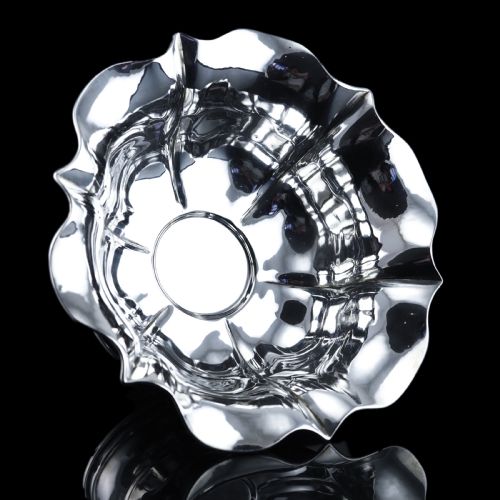


Polished Silver Centrepiece
A polished silver centrepiece commands the middle of a dining table, combining substantial weight with intricate metalwork.
Polished Silver Centrepiece
A polished silver centrepiece takes various decorative and functional forms across different eras, including bowls, pedestal dishes, vases, bread baskets, loving cups, candelabras, and candlesticks. The examples found here range across the 18th century, Victorian period, Edwardian era, 1930, 1950, and later than 1960.
Buyers frequently encounter pedestal bowls and candlesticks in this category, alongside bread baskets and multi-branch candelabras. These objects originate from British, French, Italian, Austro-Hungarian, and Polish makers, reflecting diverse regional aesthetics.
Styles span Georgian, Classical and Neoclassical Revivals, Neo-Rococo, Art Nouveau, Edwardian, and Art Deco designs. Such variety allows collectors to select pieces matching specific historical interiors or decorative preferences.
Materials and construction
Makers utilised sterling silver, solid silver, silver plate, and vermeil, alongside polished metal and chrome for later pieces. Gilding frequently appears on internal surfaces, as seen in Georgian pedestal dishes.
Techniques involve piercing and repoussé work, producing decorative bowls with detailed floral or openwork patterns. Candlesticks and candelabras demonstrate substantial metal casting, achieving heights up to thirty-one centimetres.
Among the stately bowls and candelabras, a delightful miniature model of a sailing boat unexpectedly anchors the collection.
Assessing quality
Quality differentiates through the crispness of repoussé detailing and the depth of pierced work on bowls and baskets. Heavier gauge metal and secure construction in multi-branch candelabras indicate superior manufacturing standards.
Provenance and maker attribution elevate certain items, particularly those bearing hallmarks from notable workshops or retailers. The integration of specialised finishes, such as gilt interiors within silver vessels, marks higher grade production.
Garrard and Co Ltd·Brille Paris·Joseph Rodgers and Sons
The Polished Silver Centrepiece Glossary
- Sterling silver
- An alloy consisting of 92.5 percent silver by mass, with the remainder typically copper. This standard composition provides the necessary durability for large table objects.
- Repoussé
- A metalworking technique where the metal is hammered from the reverse side to form a raised design in relief. It creates textured, ornamental surfaces on bowls and baskets.
- Vermeil
- Sterling silver plated with a thin layer of gold. This finish protects the underlying silver while providing a rich, golden interior to vessels.
- Pedestal dish
- An elevated vessel supported by a central foot or stem. These pieces lift fruit or floral arrangements above the surface of the dining table.
- Candelabra
- A branched candlestick holding multiple lights. Examples in this category include four-branch Italian designs and substantial paired arrangements.
Polished Silver Centrepiece: Frequently Asked Questions
How were silver candelabras used?
Silver candelabras provided primary illumination for dining tables before the widespread adoption of electric lighting. They held multiple wax candles to cast light across formal meals and evening gatherings.
As dining customs evolved, these multi-branch fixtures transitioned into purely decorative table ornaments. Their height and branched structure allowed them to dominate table arrangements without obstructing conversation across the table.
How do I identify an Edwardian centrepiece?
Edwardian silver centrepieces generally date from the reign of King Edward VII between 1901 and 1910, though the style extends slightly either side. These pieces often exhibit lighter, more graceful proportions than their heavy Victorian predecessors.
Common design motifs from this period include Neoclassical Revival elements and floral patterns executed in sterling silver. Hallmarks stamped on the metal provide definitive proof of the assay office and exact year of manufacture.
What is the difference between solid silver and silver plate?
Solid silver objects are constructed throughout from a precious silver alloy, such as sterling silver. These pieces carry intrinsic metal value and full assay hallmarks indicating their composition.
Silver plate involves a thin layer of silver bonded to a base metal substrate, such as copper or white metal. Plated items were produced to offer the appearance of solid silver at a lower cost.