



Plique a Jour Gold
These plique a jour gold pieces bring translucent vitreous enamel panels together with gold work, creating small masterpieces of light.
Plique a Jour Gold
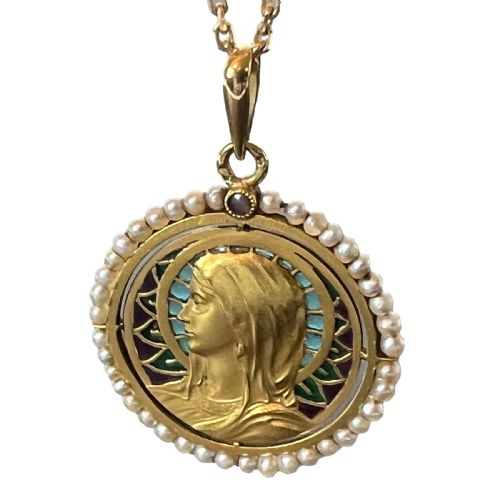
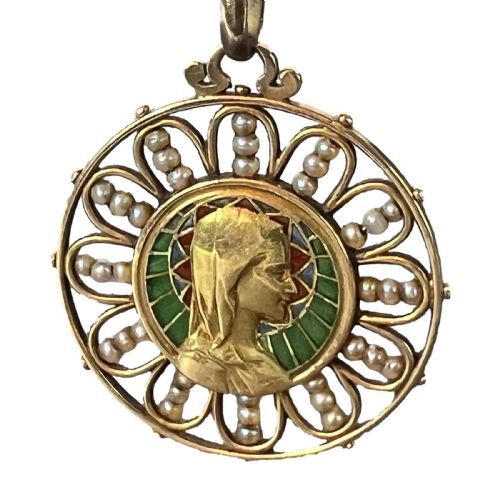
When you search for plique a jour gold, you enter a sphere of jewellery where enamel resembles stained glass without a solid backing. The selection on this page consists chiefly of pendants, brooches, charms and necklaces that capture light through delicate translucent cells.
Most examples hail from the early decades of the twentieth century, aligning with the Art Nouveau movement and French craftsmanship. Pendants bearing religious motifs such as the Virgin Mary or Madonna and Child appear frequently, often bordered by seed pearls.
Beyond devotional medals, the forms stretch to heart-shaped brooches, city coats of arms and necklaces set with peridot, amethyst or diamonds. These items combine gold frames with vibrant colour, preserving the distinct aesthetics of the nineteen hundreds to the nineteen thirties.
How they were made
Goldsmiths constructed wire frameworks from yellow gold or silver gilt to form the outlines of petals, wings or geometric windows. Artisans then applied vitreous enamel into these open cells without a backing plate, firing the pieces repeatedly so the glass fused strictly to the metal wire.
Gems such as diamonds, pearls, peridot and amethyst augment the gold and enamel compositions. Seed pearls often trace the outer borders of pendants, while small diamonds or coloured stones accent the central motifs of brooches and rings.
Plique a Jour Gold Retail Price Guide 2026
Typical asking prices for plique a jour gold among the pieces listed under this phrase on Sellingantiques today, from the lower quarter to the upper quarter. They describe what is for sale here now, not the wider market.
French city windows and tiny devotional medals hide transparent glass in their gold frames, ready to catch the morning sun through your jumper.
What varies in quality
The clarity and light transmission of the enamel panels define the visual success of each piece. Superior examples display even thickness across the cells, allowing light to pass uniformly without opaque patches or clouded areas.
The fineness of the gold wire framework and the precision of the soldering dictate the structural integrity of the design. Clean execution in the metalwork supports the translucent enamel, ensuring the delicate openwork remains secure.
Monier
The Plique a Jour Gold Glossary
- Plique-a-jour
- An enamelling technique where enamel is applied in open cells, creating a stained glass effect that lets light shine straight through. This method requires considerable skill to prevent the glass from cracking during firing.
- Vitreous enamel
- Glass fused to metal under high heat to produce a durable and glossy coloured surface. It resists fading over decades and maintains its original hue.
- Seed pearl
- A very small natural or cultured pearl, often used in rows to border pendants and medals in early twentieth-century jewellery. These pearls add a soft white contrast to bright enamel.
- Art Nouveau
- An international style of art and architecture prominent from the late nineteenth century until the First World War, characterised by flowing, organic lines. This movement heavily influenced the design of plique a jour jewellery.
Plique a Jour Gold: Frequently Asked Questions
What is plique a jour?
Plique a jour translates from French as letting in daylight. It is an enamelling technique that creates transparent or translucent cells without a backing, resembling miniature stained glass windows.
Jewellery makers utilise this method to capture and refract light through coloured enamel, mounting the delicate panels in gold or silver gilt settings.
How do I care for plique a jour jewellery?
These pieces require gentle handling because the enamel cells lack a solid metal backing. Store them separately in padded boxes to prevent pressure on the openwork panels.
Clean them with a soft dry cloth and avoid ultrasonic cleaners or harsh chemical dips that could weaken the enamel or dislodge seed pearls.
Which periods do these pieces date from?
The listings span the early twentieth century, with items originating from the nineteen hundreds through to the nineteen thirties. This timeframe encompasses the height of the Art Nouveau movement in France.
Many pieces reflect the French stylistic preferences of the era, incorporating religious subjects alongside natural motifs and heraldic designs.
What materials accompany the enamel?
Gold forms the primary metal structure, appearing mostly as eighteen carat yellow gold alongside occasional fifteen carat or silver gilt elements. Gemstones frequently accent the main enamel panels.
Seed pearls, diamonds, peridots and amethysts complement the translucent colours, adding textural contrast and framing the central subjects of pendants and brooches.