


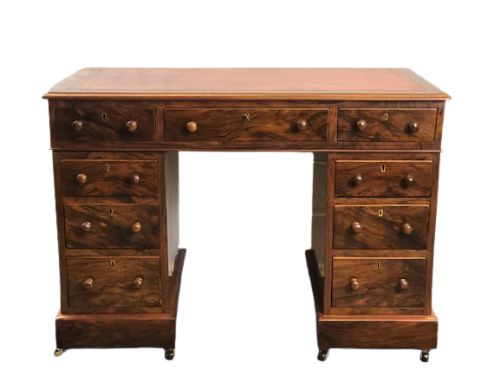
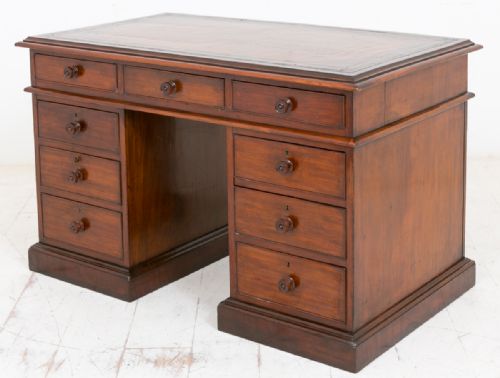
Plinth Base Pedestal Desk
These plinth base pedestal desk examples offer substantial workspace and storage, built for serious study or correspondence.
Plinth Base Pedestal Desk
Most examples date from the Victorian era, spanning decades from the mid-nineteenth century onwards, often featuring leather writing inserts and brass hardware. These pieces balance architectural weight with practical compartments for daily correspondence and administration.
Materials and construction
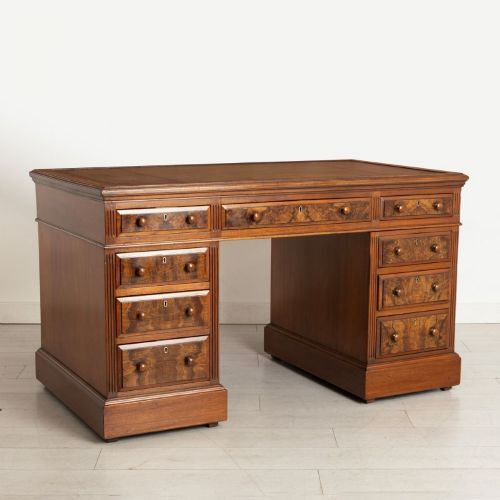
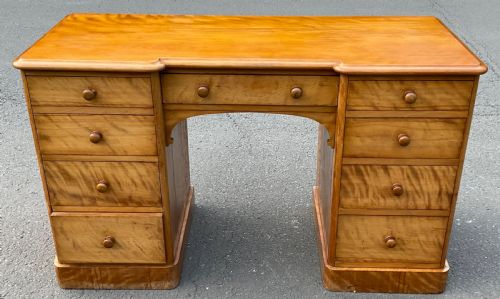
Cabinetmakers utilised dense hardwoods like mahogany and walnut, sometimes selecting burr walnut veneers or satin birch for striking grain patterns. Carcasses were constructed in sections to facilitate movement, resting upon solid plinth bases that anchor the heavy timber.
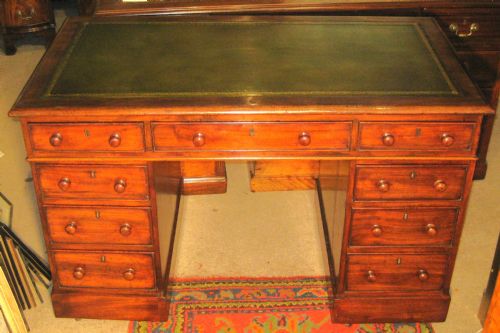
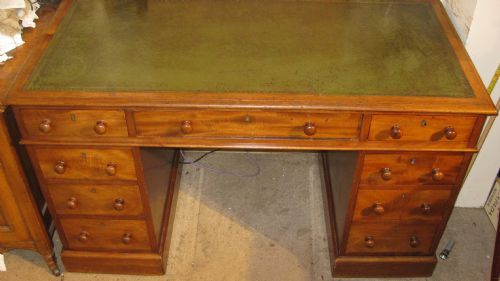
Writing surfaces were typically inset with tooled leather, whilst drawers incorporated brass handles and functional locks. Edges frequently received decorative treatments such as reeding or crossbanding to finish the architectural form.
Distinguishing quality
Superior quality emerges in the selection of timbers, where book-matched burr veneers or dense, richly figured mahogany command greater admiration. The crispness of edge details, such as reeding and panelled sides, distinguishes standard utility pieces from finer commissions.
Internal construction reveals craftsmanship through secondary timber choices, drawer linings, and the retention of original brass hardware. The integration of the plinth base with the pedestals demonstrates the structural integrity demanded by nineteenth-century makers.
Deighton Dunthorne Holborn
The Plinth Base Pedestal Desk Glossary
- Plinth base
- A continuous solid block or low platform supporting the pedestals, replacing traditional feet or castors.
- Pedestal desk
- A form comprising two freestanding drawer units supporting a central writing top.
- Burr walnut
- A figured timber veneer sliced from the knot growths of walnut trees, displaying intricate swirls.
- Tooled leather
- Leather hide impressed with decorative gilt or blind-stamped borders around the writing surface.
- Kneehole
- The central recessed space between the pedestals designed to accommodate the user's legs.
Plinth Base Pedestal Desk: Frequently Asked Questions
How do I care for leather inserts?
Apply specialised leather balms periodically to maintain suppleness and prevent the material from drying out over time.
Avoid placing hot cups or liquids directly onto the leather surface to prevent permanent staining or discolouration of the hide.
Are these desks easy to move?
Many nineteenth-century examples are constructed in multiple modular sections, typically separating into two pedestals and a top for transportation.
Because of the dense hardwoods and plinth bases, these pieces remain heavy and benefit from professional handling during relocation.
How do I distinguish walnut from mahogany?
Mahogany displays a reddish-brown hue with straight or ribbon-like grain patterns that deepen in tone as the timber ages.
Walnut presents a cooler brown colour with darker figuring, and when burr timber is utilised, it shows intense swirling patterns.
What is a plinth base?
A plinth base is a flat, solid foundation block running along the floor beneath the pedestals, giving the furniture a grounded appearance.
This construction style contrasts with desks raised on legs or castors, offering a heavier architectural presence.