


Planters Chair
These planters chair examples bring colonial ease to a room, offering deep seats and long arms built for long afternoons.
Planters Chair
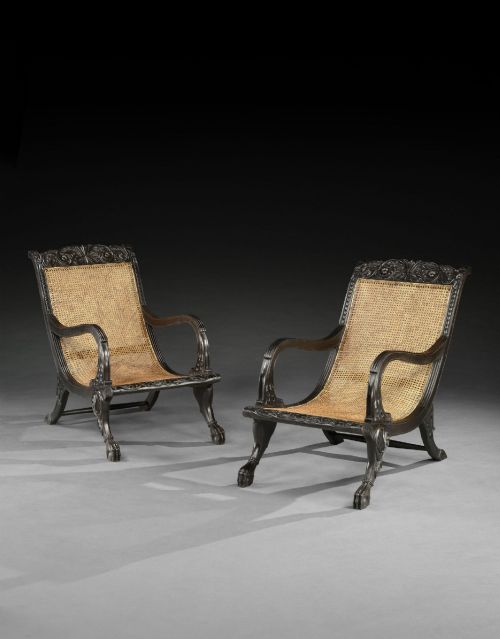
A planters chair is a deep-seated armchair designed for tropical climates, featuring extended arms that double as footrests. The pieces on this page span the nineteenth and early twentieth centuries, drawing on Victorian and Anglo-Indian colonial styles.
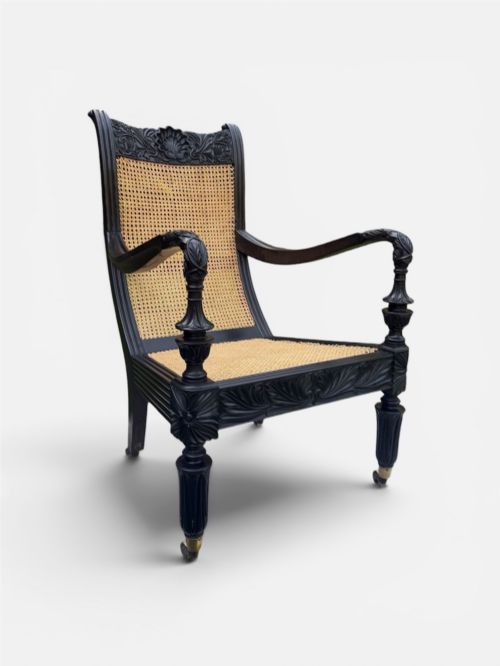
Most examples you encounter here are constructed from hardwoods like teak, ebony, and rosewood. Forms range from standard armchairs and reclining plantation chairs to chaise longues and folding variants.
How they were made
Maker workshops utilised dense tropical timbers such as teak and ebony, often joined with cane panels and leather upholstery. Metal studs frequently secure the leather elements to the wooden frames.
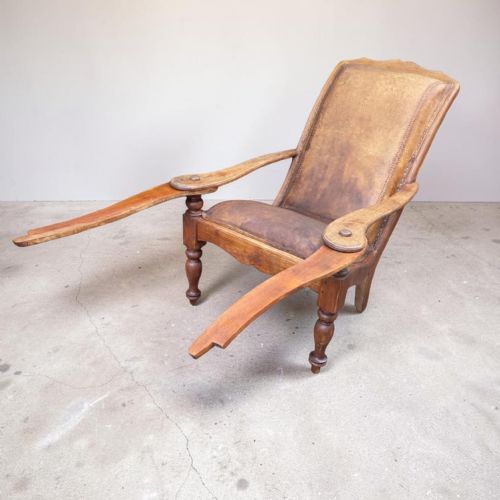
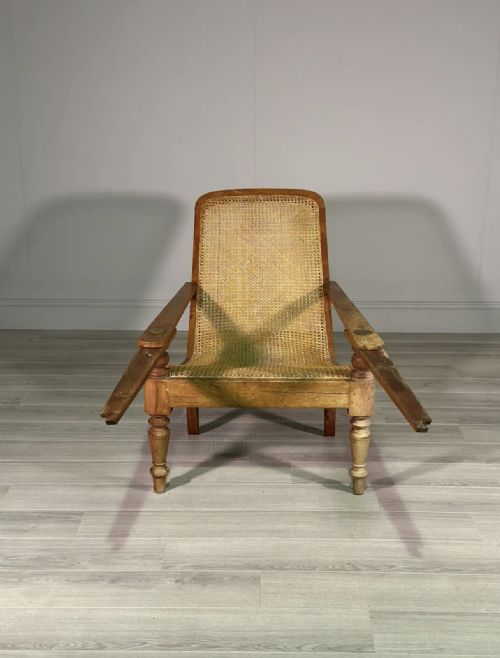
Extending arm mechanisms allow the front of the arms to swing out, creating a support for the legs. Folding frames appear in certain regional variants for ease of transport.
Listings feature teak, ebony, rosewood, and hardwood, alongside leather and cane elements across nineteenth and twentieth-century periods.
What varies in quality
The choice of timber sets the baseline for quality, with dense ebonised woods and finely grained rosewood occupying the upper tier. Plain teak and secondary hardwoods appear on simpler or later pieces.
Construction detail in the extending arm mechanism and the integrity of the cane work distinguish standard utilitarian seating from finer colonial commissions.
The Planters Chair Glossary
- Anglo-Indian
- Describing furniture made in India by local craftsmen for British residents, blending European forms with local carving traditions. This style defines many pieces on the page.
- Cane
- Woven rattan material used for seat panels and backrests to allow airflow in hot climates. It provides a resilient and breathable surface.
- Extending arm
- A pivoting wooden arm that pulls forward to support the legs of the seated person. This characteristic feature turns the armchair into a chaise-style lounger.
- Hardwood
- Dense timber from broad-leaved trees, including teak, mahogany, and ebony. These woods resisted tropical humidity and insect damage.
Planters Chair: Frequently Asked Questions
What is a planters chair?
A planters chair is a traditional colonial armchair featuring exceptionally long, flat arms designed to support the legs of the person sitting. They originated in tropical regions to provide maximum comfort and ventilation.
Most examples are made from heavy timbers like teak and ebony, often incorporating woven cane or leather. The extending arms are their most defining physical characteristic.
How do you use the extending arms?
The front portion of each arm pivots or pulls outward on a hinge or slide mechanism to form a continuous footrest. You swing both arms out to recline fully with your legs raised.
When not in use, the arms push back into alignment with the rest of the chair frame for standard sitting.
How old are these chairs?
The pieces seen here generally date from the nineteenth and early twentieth centuries, spanning the Victorian era through to the 1920s. Styles include Anglo-Indian and Victorian colonial designs.
Earlier examples often feature solid ebony or rosewood, while later twentieth-century versions frequently employ teak and cane.
Where were they made?
They were manufactured primarily in British colonial regions, notably India, Ceylon, and surrounding territories, for use by European expatriates and officials. Local workshops combined British furniture forms with indigenous materials and carving techniques.
This production history accounts for the recurring use of colonial timber species and regional construction methods.