

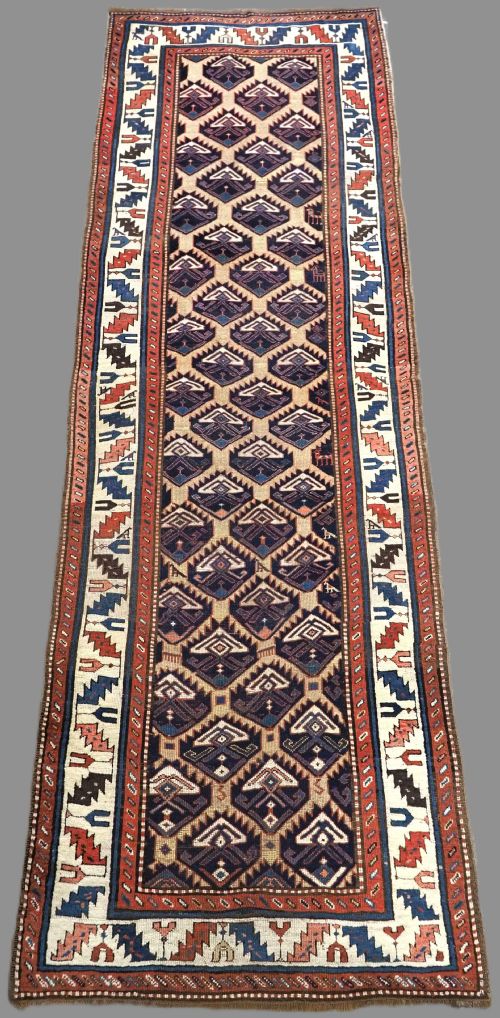

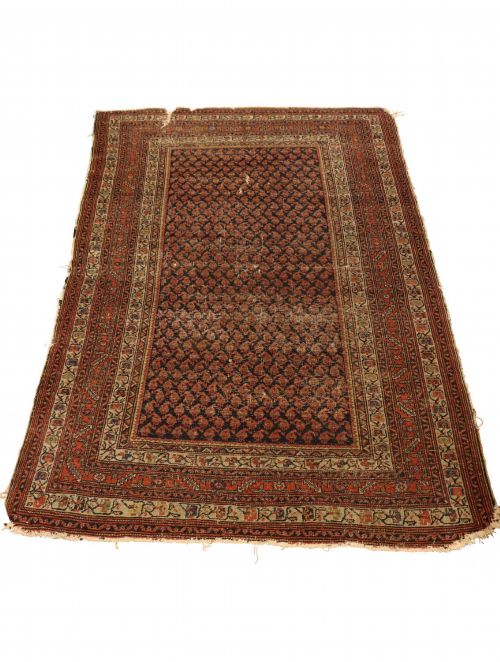


Persian Design Runner
A persian design runner brings distinct tribal motifs and enduring room presence to a hallway through disciplined hand-knotting.
Persian Design Runner
A persian design runner encompasses elongated hallway carpets and narrow rugs woven by various tribal and regional groups, featuring repetitive motifs like boteh, lattice, and shrub patterns.
The pieces on this page span from the late nineteenth century into the early twentieth century, originating from workshops and nomadic communities across Persia, the Caucasus, and surrounding regions.
Buyers encounter formats specifically proportioned for corridors, alongside related tribal rugs and long formats displaying traditional field arrangements.
Materials and Construction
Weavers utilised hand-spun wool for the pile, frequently combining cotton foundations and natural dyes to achieve rich, enduring colour palettes.
Certain regional pieces incorporated camel hair or goat hair within the structure, adding tactile variation and distinct tonal depth to the finished floor covering.
Persian Design Runner Retail Price Guide 2026
Typical asking prices for persian design runner among the pieces listed under this phrase on Sellingantiques today, from the lower quarter to the upper quarter. They describe what is for sale here now, not the wider market.
Camel hair occasionally forms the un-dyed ground of a Baluch runner, providing a wonderfully soft, warm underfoot texture.
Assessing Execution
Knot density and structural tightness dictate the crispness of the geometric and floral motifs, separating finely wrought examples from simpler village output.
The stability of the natural dye palette and the condition of the wool pile determine how well a runner withstands heavy foot traffic in a hallway setting.
Waring and Gillow
The Persian Design Runner Glossary
- Boteh
- A stylised almond or pear-shaped motif representing a shrub or flame, frequently repeated across the field of tribal rugs.
- Herati
- A classic floral pattern composed of a central rosette surrounded by four leaves, enclosed within a rectangular frame.
- Kilim
- A flat-woven carpet or rug produced without a pile, utilising warp and weft interlocking techniques.
- Pushti
- A small mat or face covering, often woven by nomadic groups for personal use or saddle placement.
- Latch hook
- A geometric hooked motif projecting from the edges of medallions or borders, common in tribal weaving.
Persian Design Runner: Frequently Asked Questions
Where do these runners work best?
Narrow formats suit corridors, entrances, and gallery spaces where linear patterns guide the eye along the floor.
Their robust construction handles everyday movement while introducing historical character to domestic interiors.
How do I care for wool pile?
Gentle vacuuming without a rotating brush roll removes grit without straining the hand-knotted foundation.
Professional specialist cleaning maintains the natural lanolin in the wool and preserves the stability of natural dyes.
What defines tribal design?
Nomadic weavers relied on memory and local symbolism, resulting in geometric abstractions of plants, animals, and protective amulets.
These designs contrast with the formal court patterns found in urban Persian manufactories.
How are different periods identified?
Structural analysis reveals shifts in material preparation, synthetic dye introduction, and regional weaving techniques over time.
Earlier nineteenth-century examples typically display softer colour transitions and denser hand-spinning compared to later production.