


Peridot Seed Pearl Pendant
A peridot seed pearl pendant brings together the vibrant green of August's birthstone and the delicate lustre of tiny pearls in a lasting piece of antique jewellery.
Peridot Seed Pearl Pendant
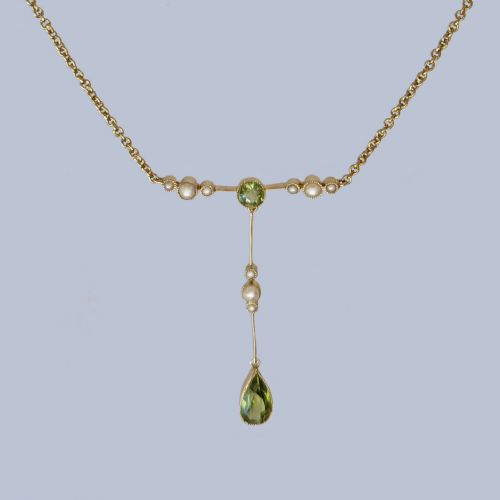
A peridot seed pearl pendant belongs chiefly to the Victorian, Edwardian and Art Nouveau periods, spanning the late nineteenth and early twentieth centuries. These ornaments take the form of drops, lavalieres, garlands and star motifs, often doubling as brooches.
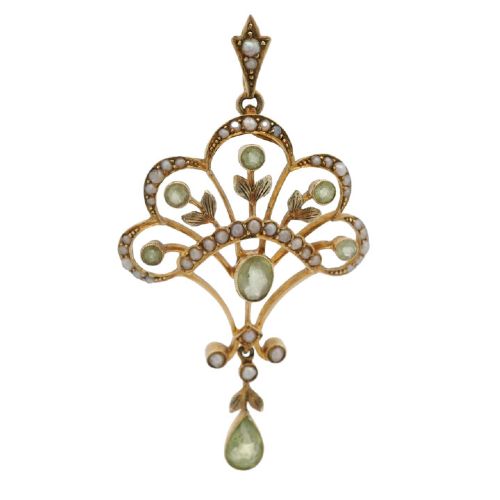
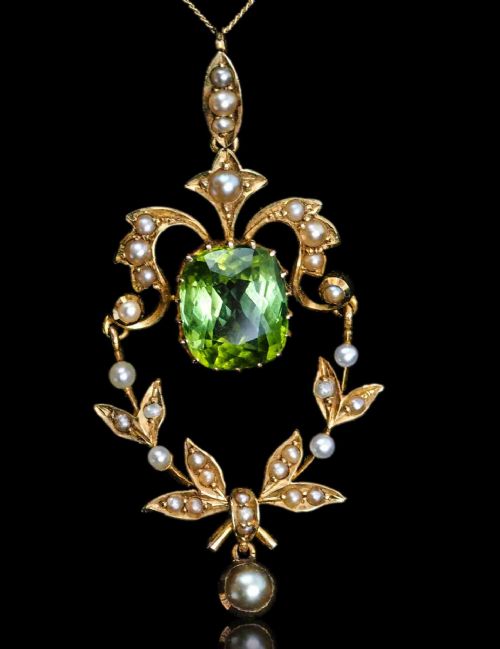
The version most commonly met on this page is the Edwardian 15ct or 9ct gold pendant, where bright green peridots are framed by shimmering seed pearls in openwork or scroll designs. Pieces from this era often incorporate platinum highlights or delicate drop elements.
Makers of the period arranged these gemstones into symmetrical floral clusters or flowing, organic lines that reflect prevailing design movements. Buyers will find both standalone pendants and complete necklaces equipped with their original fine gold chains.
Materials and Techniques
Goldsmiths of the late Victorian and Edwardian eras typically worked with 9ct and 15ct yellow gold, occasionally employing platinum or 14k gold for enhanced durability in intricate settings. Stones were handset into open-backed mounts to allow light to pass through the transparent peridots.
Seed pearls were meticulously drilled and secured onto fine wire or pinned directly into gold frameworks to create luminous borders around the central green stones. Advanced techniques such as plique-à-jour enamel also appear, creating translucent stained-glass effects within the gold frames.
Ancient Romans called peridot the evening emerald because its vibrant green colour refused to fade in candlelight.
Assessing Quality
The distinction between standard examples and the finest work lies in the depth of the gold karat, the precision of the openwork metal framing, and the saturation of the peridot. Higher-tier items utilise 15ct gold rather than 9ct, alongside cleaner gemstones with vivid green colour rather than olive or brownish tones.
Proportion and originality dictate value in this category, with integrated drops, well-matched seed pearls with strong lustre, and scarce inclusions like plique-à-jour enamel or platinum settings separating exceptional pieces from ordinary production.
Murrle Bennett
The Peridot Seed Pearl Pendant Glossary
- Peridot
- A transparent gemstone ranging from yellow-green to bottle-green, forming the bright centrepiece of these Edwardian and Victorian jewels. It was a favourite stone during the early twentieth century.
- Seed Pearl
- A tiny, naturally occurring or early cultured pearl, typically under two millimetres in diameter, utilised to form delicate glowing borders and floral motifs in antique jewellery.
- Lavalier
- A pendant featuring a main gemstone from which one or more smaller drops hang freely, popularised during the Edwardian and Art Nouveau eras for its fluid movement.
- Plique-à-jour
- An enamelling technique resembling miniature stained glass, where enamel is fired in open cells without a backing metal, allowing light to shine straight through.
- Garland Style
- A decorative design popular in Edwardian jewellery that mimics looped ribbons, floral wreaths, and swags of foliage using diamonds, pearls and coloured gemstones.
Peridot Seed Pearl Pendant: Frequently Asked Questions
How do I care for a peridot pendant?
Peridot is a softer gemstone compared to diamond or sapphire, rating around 6.5 to 7 on the Mohs hardness scale. Clean it gently using warm soapy water and a soft cloth, avoiding ultrasonic cleaners or harsh chemicals that might damage the seed pearls.
Store the pendant separately in a lined box to prevent the gold or harder stones from scratching the delicate seed pearls and softer peridot facets.
Were these pendants originally worn as brooches?
Many examples from the Victorian and Edwardian periods were manufactured with dual-purpose fittings, incorporating both a pendant loop and a detachable pin mechanism on the reverse. This versatility allowed owners to pin the ornament to a lace collar or suspend it from a fine gold chain.
When buying, examine the reverse to see if the hinged pin and C-clasp remain intact alongside the suspension bale.
How can I tell an Edwardian piece apart from a Victorian one?
Victorian pieces often feature heavier gold work, closed or half-hoop settings, and darker gemstone tones associated with the late nineteenth century. The metal is frequently marked in lower gold karats alongside traditional hallmarks.
Edwardian jewellery leans towards lighter, airier designs in 15ct gold or platinum, utilising garland motifs, star bursts, and bright peridots paired with luminous seed pearls.
What is a suffragette pendant?
Suffragette jewellery incorporates the symbolic colour triad of green for hope, white for purity, and violet for dignity. In this category, those colours are represented by peridot, seed pearls, and pink tourmalines or sapphires.
These pieces were worn by supporters of the women's suffrage movement during the early twentieth century as a subtle yet public display of political allegiance.