
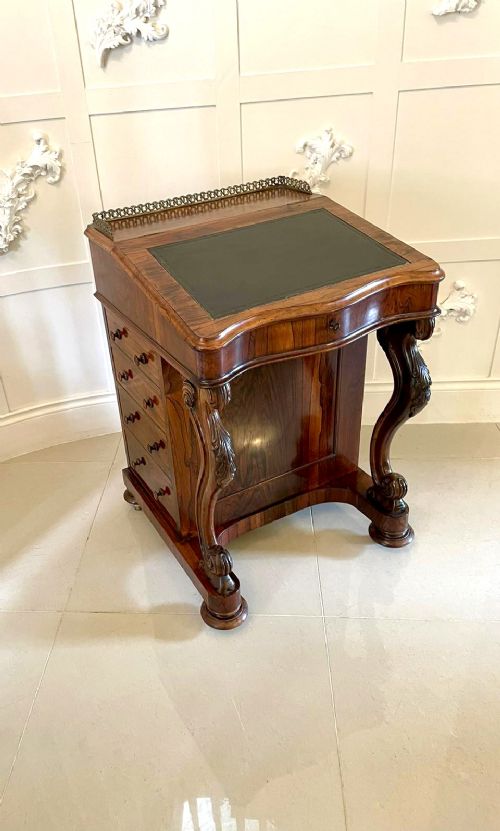
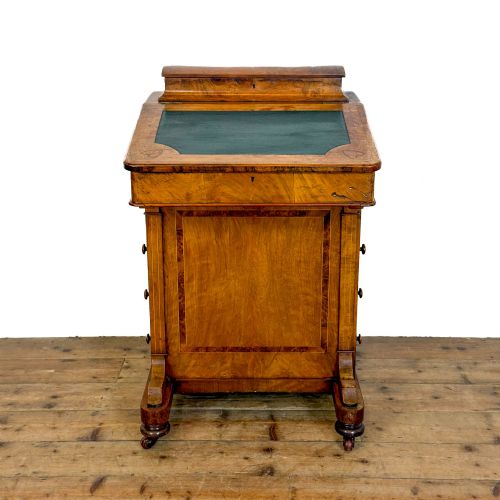
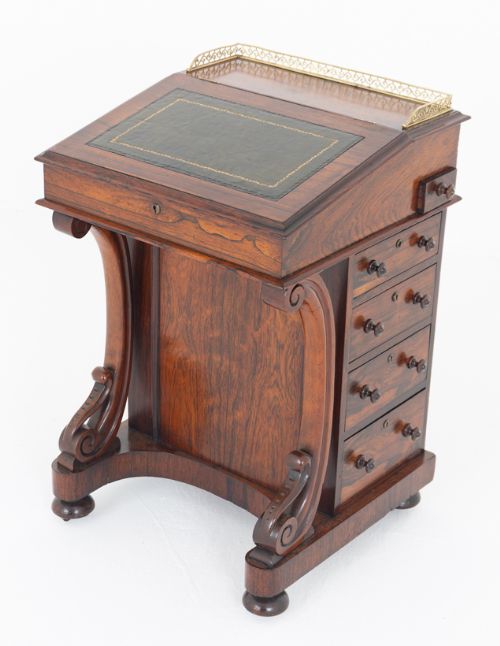


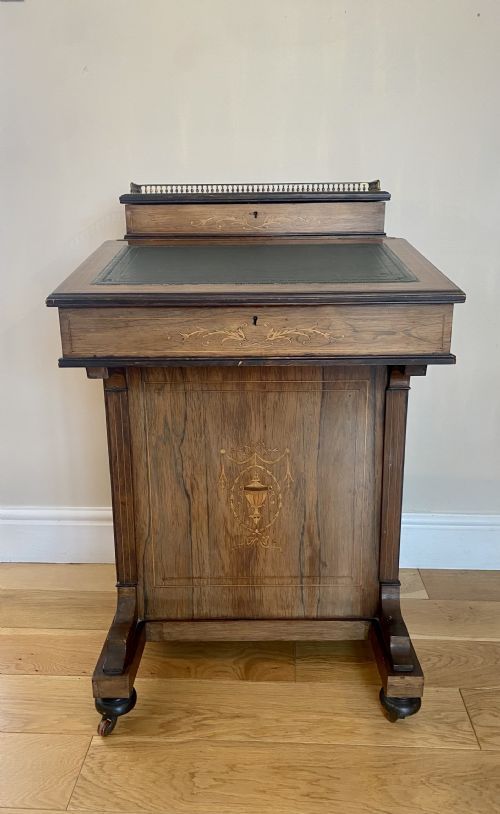

Pedestal Davenport Desk
A pedestal davenport desk packs a sloping writing surface and a set of drawers into a compact footprint.
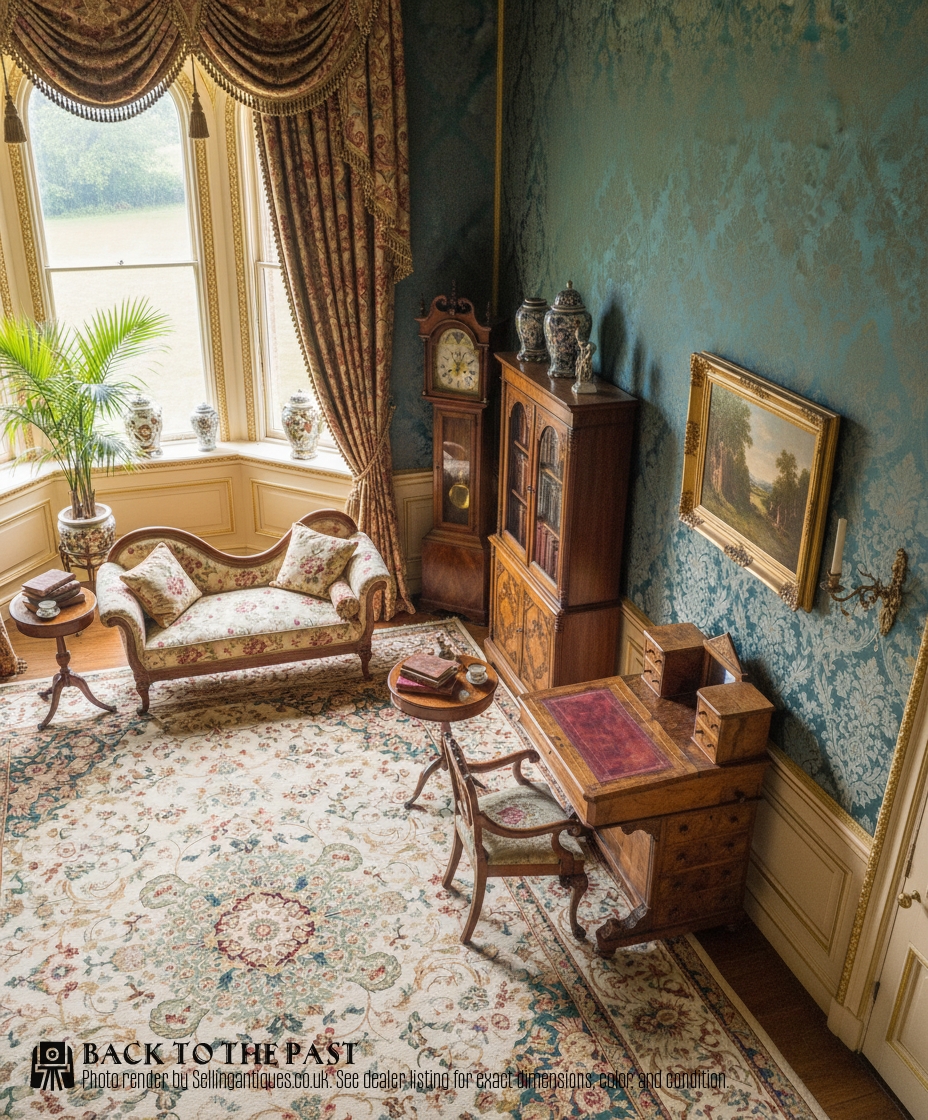
Pedestal Davenport Desk
A pedestal davenport desk is a compact writing cabinet featuring a sloping lid above a bank of side drawers, designed for writing and storing papers in a limited space. The form emerges frequently in Victorian and nineteenth-century pieces, spanning earlier Regency examples down to Edwardian variants.
You will most commonly meet Victorian examples in burr walnut or mahogany, often fitted with internal stationery compartments and resting on small castors. The arrangement places the drawer stack beneath the writing slope, whilst the opposite side often conceals dummy drawers to maintain symmetry.
How they were made
Cabinet makers built these desks using dense timbers such as mahogany, rosewood, and burr walnut, frequently applied as veneers over a secondary wood to show rich grain patterns. Boxwood inlay, brass fittings, and tooled leather writing inserts complete the exterior and writing surfaces.
Construction relies on sturdy carcase framing to support the heavy sloping desk box above a single pedestal of drawers. Drawers use traditional dovetail joints, and specialised variants incorporate mechanical pop-up or sliding tops operated by internal linkages.
Certain Victorian models hide secret compartments and spring-loaded stationery wells that pop up automatically the moment you lift the main writing slope.
What varies in quality
The standard of a pedestal davenport desk rests on the choice of timber veneers, such as richly figured burr walnut or flame mahogany, and the crispness of any applied boxwood inlay or carved details. Finer pieces display careful book-matching across the writing slope and drawer fronts.
Mechanical complexity also distinguishes superior examples, notably those with sliding tops, pop-up stationery compartments, or fully fitted internal drawers. Freestanding versions finished on all sides require greater cabinet-making skill than those intended to stand permanently against a wall.
Gillows of Lancaster·James Winter and Son·Thomas Turner·James Shoolbred
The Pedestal Davenport Desk Glossary
- Crossbanded
- A border technique where strips of veneer are laid perpendicular to the grain of the central panel, creating a framed effect around drawer fronts or writing surfaces.
- Pedestal
- A single supporting pillar or cabinet base containing drawers, which underpins one side of the desk while the other side rests on matching feet or legs.
- Pop-up
- A mechanical interior arrangement where opening the main desk lid causes an upper tier of stationery pigeonholes to rise automatically.
- Sloping lid
- The inclined writing surface, often hinged and lined with leather, that covers the main compartment and can be lifted to access storage underneath.
- Burr walnut
- A highly figured timber harvested from walnut tree growths, prized by cabinet makers for its swirling patterns and rich texture.
Pedestal Davenport Desk: Frequently Asked Questions
How were pedestal davenport desks originally used?
These desks served as compact writing stations for correspondence and record keeping in parlours, bedrooms, or private studies where full-sized partners desks took up too much room.
The sloping lid provided a comfortable angle for writing letters, while the side drawers held stationery, inkwells, and personal documents close at hand.
How do I tell Regency from Victorian examples?
Regency and early nineteenth-century pieces often lean towards rosewood or mahogany with cleaner, classical lines and simpler proportions.
Victorian iterations frequently utilise burr walnut, elaborate crossbanding, richer carvings, and more complex internal mechanisms like sliding or pop-up tops.
Can these desks stand away from a wall?
Some pedestal davenport desks are built as freestanding pieces with finished panel detail on all four sides, allowing placement anywhere in a room.
Others are designed with a plain or unfinished back intended to sit flush against a wall or within the corner of a study.