

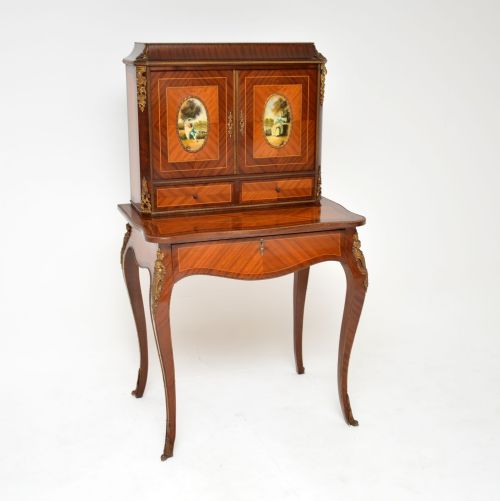
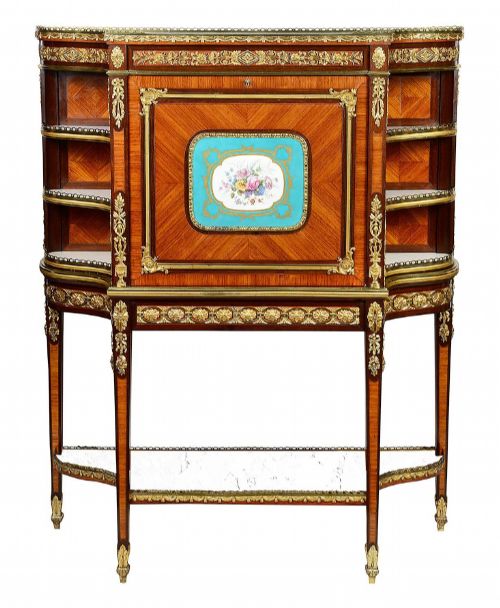
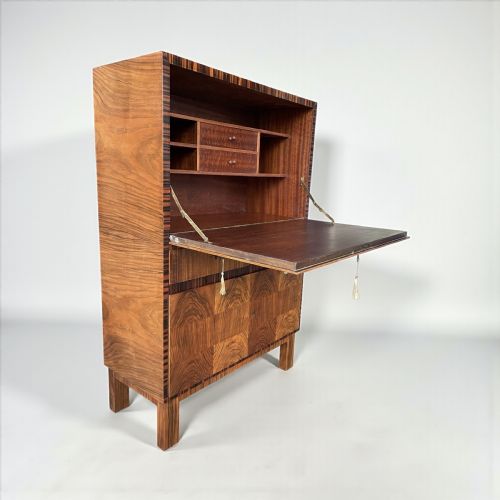


Parquetry Writing Cabinet
These parquetry writing cabinet pieces combine geometric wood veneers with fitted writing surfaces, offering both display space and a practical desk.
Parquetry Writing Cabinet
A parquetry writing cabinet brings together storage, a dedicated writing surface, and patterned wood veneers arranged in geometric arrays. When searching for a parquetry writing cabinet, buyers encounter forms ranging from drop-front secretaires to compact bonheur du jour desks.
The selections span the eighteenth, nineteenth, and early twentieth centuries, with a strong presence of nineteenth-century French revival pieces. Workshops utilised decorative timbers like kingwood, rosewood, and walnut to build these functional writing vessels.
How they were made
Cabinetmakers constructed carcases from native and exotic hardwoods, then applied precise geometric veneer patterns known as parquetry across the exterior surfaces. Carpenters integrated drop-front panels and pull-out drawers to conceal internal writing compartments.
Makers mounted ormolu, gilt bronze, and brass elements to frame corners and protect edges, whilst select examples incorporate porcelain plaques or painted panels into the woodwork.
Listings feature eighteenth and nineteenth-century pieces incorporating kingwood, rosewood, walnut, ormolu, and Sevres porcelain plaques.
What varies in quality
Quality rests upon the precision of the veneer work and the crispness of the cast metal mounts. Pieces displaying signed maker stamps or integrated porcelain plaques generally reflect higher workshop ambition.
The choice of dense timbers such as kingwood and tulipwood paired with well-proportioned marble tops distinguishes the more accomplished examples from standard production.
Blake London·Jean Werner·Millet
The Parquetry Writing Cabinet Glossary
- Parquetry
- Geometric wood mosaic work formed by small veneer pieces laid down in repeating patterns. This technique decorates the exterior of writing cabinets and desks.
- Secrétaire à abattant
- A tall cabinet featuring a hinged drop-front flap that opens to reveal a writing surface and small drawers. It hides correspondence behind a vertical facade.
- Bonheur du jour
- A light ladies writing desk featuring a small cabinet or shelving superstructure on top. These compact pieces appeared frequently in nineteenth-century French salons.
- Ormolu
- Gilded bronze mounts applied to furniture edges and corners for ornamentation. Makers cast and chased these metal fixtures to accent the timber frames.
- Kingwood
- A dense, richly figured timber featuring dark violet and brown tones. Cabinetmakers utilised this wood extensively for patterned veneer work.
Parquetry Writing Cabinet: Frequently Asked Questions
What is a secretaire abattant?
A secretaire abattant is a tall upright cabinet with a hinged front panel that folds down to create a writing surface. Inside, the user finds an arrangement of small pigeonholes and drawers for stationery.
This vertical form saves floor space while offering the storage capacity of a larger bureau.
How do I use a bonheur du jour?
A bonheur du jour functions as a light, portable writing desk intended for correspondence and reading. The small cabinet superstructure holds letters and inkwells.
Place the desk in a reception room where its decorative veneer and metal mounts can be seen from all sides.
How do I identify Louis XVI style?
Louis XVI style pieces feature straight tapered legs, geometric parquetry, and restrained classical mounts in gilt bronze. The silhouettes favour rectangular lines over curves.
This restraint separates the aesthetic from earlier Rococo revival forms.
Where should I place a writing cabinet?
Position the cabinet against a sturdy wall away from direct sunlight to protect the kingwood or rosewood veneers. Leave adequate floor clearance for the drop-front flap or pull-out drawer to open fully.
Good ambient light helps illuminate the fitted interior compartments.