


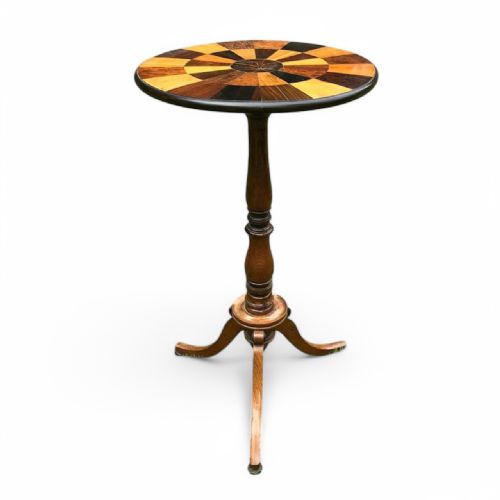


Parquetry Oak Side Table
A parquetry oak side table brings geometric patterned woodwork into a room on a sturdy timber frame.
Parquetry Oak Side Table
When you search for a parquetry oak side table, you encounter tables built from oak and ornamented with geometric veneer patterns across the top. These pieces appear in forms ranging from compact occasional tables and wine tables to larger hall tables and writing desks.
The selections available here span from the late seventeenth century through the eighteenth and nineteenth centuries, with occasional examples from the early and mid twentieth century. French and English regional designs dominate the selection, showing distinct regional variations in proportion and framing timber.
The most common formats you meet on this page are square or round occasional tables where the main structure relies on solid oak while the top surface displays decorative parquetry arrangements. Alongside these, specific pieces incorporate walnut, fruitwood veneers, and marquetry inlay to enrich the surface design.
Materials and construction methods
Makers built the foundational frames of these tables using solid oak, selecting timber for its strength and straight grain to support daily use as side or hall furniture. Joinery relied on traditional framing techniques designed to accommodate seasonal wood movement without splitting the primary structure.
The distinctive surface decoration uses thin slices of timber arranged in geometric parquetry patterns, sometimes combined with mixed wood veneers or fruitwood highlights. Craftsmen applied these veneer tiles onto a stable secondary base to create crisp lines and contrasting tones across the table top.
Listings span from the late 17th century through the Victorian era to the mid 20th century, uniting oak frames with parquetry and veneer.
Distinctions in craftsmanship and design
The standard of a parquetry oak side table rests upon the precision of the geometric veneer work and the integration of the top with its base structure. Superior pieces display tight joints within the parquetry grid and a harmonious balance between the patterned surface and the supporting timber frame.
Simpler examples rely on straightforward geometric layouts and standard framing, whereas finer pieces incorporate secondary timbers such as walnut or fruitwood veneers alongside sophisticated inlay work. The overall proportion and the crispness of the surface geometry ultimately determine the grade of the piece.
Howard & Sons
The Parquetry Oak Side Table Glossary
- Parquetry
- A geometric mosaic of wood pieces used for decorative surfaces, commonly seen on table tops in this selection. It relies on contrasting wood tones to form patterns.
- Veneer
- A thin layer of fine wood applied to a stable base timber to provide decorative surface grain. Mixed wood veneers and fruitwood veneers appear frequently in these designs.
- Occasional table
- A small, movable table designed for intermittent use around a room, encompassing wine tables and side tables in the current selection.
- Marquetry inlay
- The art of applying decorative pieces of wood veneer to form pictorial or ornamental designs. This technique sometimes complements the geometric parquetry work.
- Wine table
- A small occasional table traditionally used for holding drinks, often featuring a circular top supported by a central pillar or four legs.
Parquetry Oak Side Table: Frequently Asked Questions
What is a parquetry oak side table used for?
These tables function as surface furniture in halls, living rooms, and studies, traditionally holding small decorative objects, lamps, or writing materials.
Their compact scale allows them to fit easily beside seating or against hallway walls while adding geometric pattern to the room.
How do I identify the period of an oak table?
Dating relies on examining the construction methods, framing proportions, and the specific style of the parquetry or inlay work.
Seventeenth and eighteenth-century pieces often show different framing characteristics compared to Victorian or early twentieth-century interpretations.
Are all parquetry tables made entirely of oak?
While the main structure and base typically use solid oak, the decorative top surfaces frequently incorporate mixed wood veneers and fruitwoods.
Craftsmen combined these different timbers to create tonal contrast within the geometric parquetry patterns.
How should I care for a veneered table top?
Keep wooden furniture away from direct heat sources and strong sunlight to prevent the timber veneers from drying out or lifting.
Regular dusting with a dry cloth helps maintain the polished surface without the need for heavy chemical polishes.